
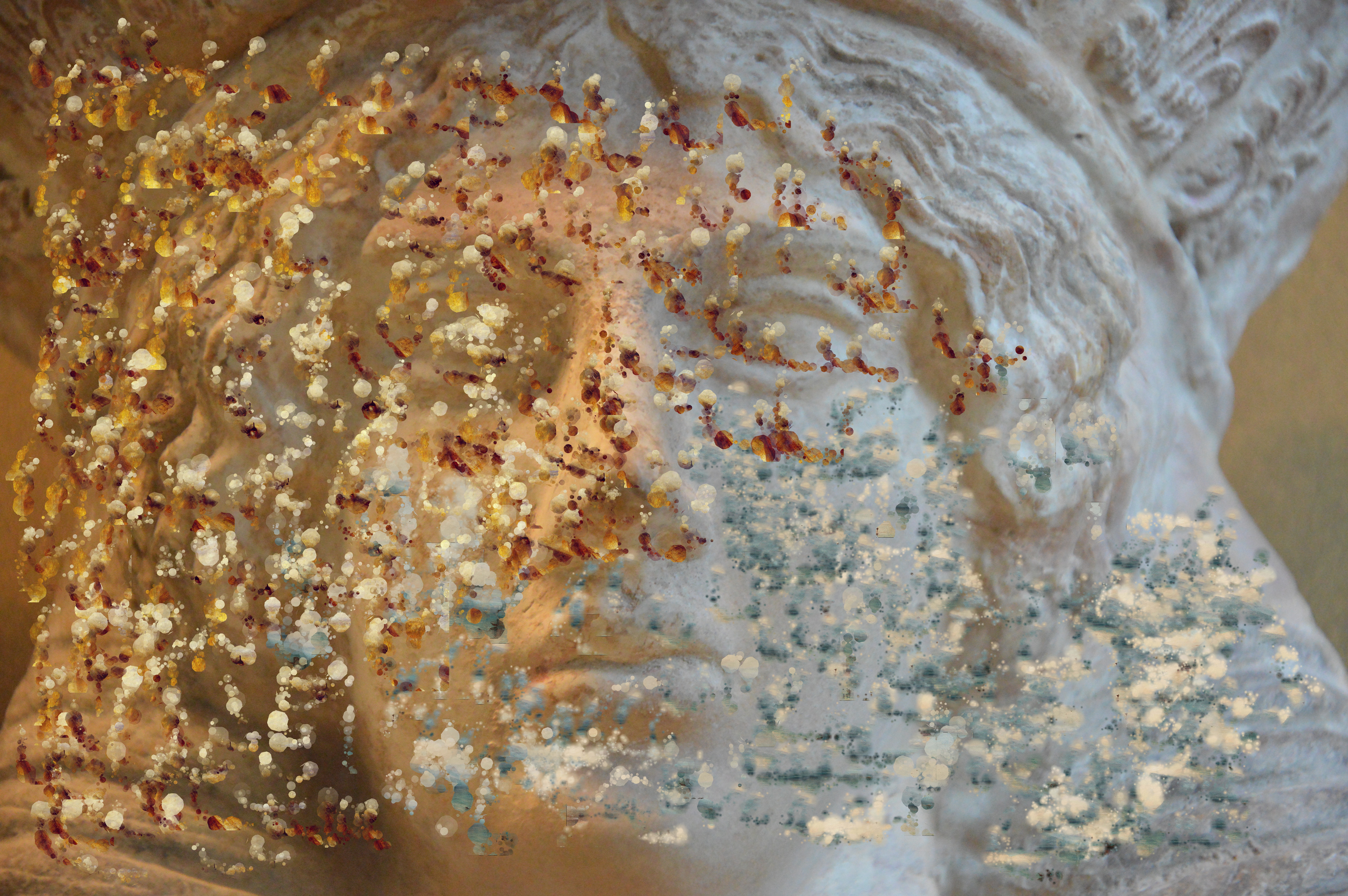
The word “plagiarism originally meant « the act of selling or buying a free person as a slave ». The word comes from the Latin plagiarius or plagiator, « thief of man ». This meaning is unused today. The word is now only used in a literary, artistic or scientific context. Plagiarism is the act of appropriating someone else’s ideas or words by passing them off as one’s own.
The Latin plagiator and plagiarists have one thing in common, and that is that they attack the very being of man. To steal a man’s ideas is to steal him as a being, to steal his substance.
« Plagiarising » means enslaving a man’s thought, putting it under the control of another man, making it a « slave ».
A Palestinian bishop, Eusebius of Caesarea (265-339), recognised as the « Father of the Church », brought a severe charge against the many plagiarisms and borrowings made by the Greeks at the expense of the many peoples who had preceded them in the history (of ideas).
Eusebius’ intention was apologetic. It was intended to diminish the prestige of Greek philosophy at a time when the development of the Christian religion needed to be reinforced.
« The Greeks took from the Barbarians the belief in multiple gods, mysteries, initiations, and furthermore the historical relations and mythical accounts of the gods, the allegorising physiologies of the myths and all idolatrous error ».i
Pillage is permanent, universal. The Greeks steal from everyone and steal from each other.
« The Greeks monopolised Hebrew opinions and plundered the rest of the sciences from the Egyptians and Chaldeans as well as from the other barbarian nations, and now they are caught stealing each other’s reputation as writers. Each of them, for example, stole from his neighbor passions, ideas, entire developments and adorned himself with them as his own personal labor.”ii
Eusebius quotes the testimony of Clement of Alexandria: « We have proved that the manifestation of Greek thought has been illuminated by the truth given to us by the Scriptures (…) and that the flight of truth has passed to them; well! Let us set the Greeks against each other as witnesses to this theft.»iii
The most prestigious names in Greek thought are put on the pillory of dishonor.
Clement of Alexandria quotes « the expressions of Orpheus, Heraclitus, Plato, Pythagoras, Herodotus, Theopompus, Thucydides, Demosthenes, Eschina, Lysias, Isocrates and a hundred others that it would be superfluous to enumerate.”iv
Porphyrus, too, accuses Plato of being a plagiarist in his Protagoras.
The accusation is clear, precise and devastating. « All the famous philosophical culture of the Greeks, their first sciences, their proud logic were borrowed by them from the Barbarians.”v
The famous Pythagoras himself went to Babylon, Egypt and Persia. He learned everything from the Magi and the priests. He even went to learn from the Brahmins of India, it is said. From some he was able to learn astrology, from others geometry and from others arithmetic and music.vi
Even the Greek alphabet was invented in Phoenicia, and was introduced to Greece by Cadmos, a Phoenician by birth.
As for Orpheus, he borrowed from the Egyptians his rites, his « initiations into the mysteries », and his « affabulations » about Hades. The cult of Dionysus is entirely modelled on that of Osiris, and the cult of Demeter on that of Isis. The figure of Hermes Psychopompe, the conductor of the dead, is obviously inspired by Egyptian myths.
It must be concluded, says Eusebius, that Hebrew theology must be preferred to the philosophy of the Greeks, which must be given second place, since it is nothing but a bunch of plagiarism.
The Greek gods form a cohort of second-hand gods, of eclectic borrowings, from Egypt to Mesopotamia and from India to Persia. Moses predates the capture of Troy and thus precedes the appearance of the majority of the gods of the Greeks and their sages.
Eusebius aims to magnify the Hebrew heritage by completely discrediting « Greek wisdom » and the pantheon of its imported gods.
So, Greek thought, — a plagiary thought?
First of all, the ideas of the Persian magi, the Egyptian priests and the Brahmins of India were not copied as such. Pythagoras or Plato digested them, transformed, even transmuted them into something entirely original.
Greek thought also added a level of freedom of thought by copying, augmenting, criticizing.
Then the so- called « Greek loans » represent a very long chain, which goes back to the dawn of time. And everyone was doing that. It is not at all certain, for example, that Moses himself was entirely free of plagiarism. Raised at the court of Pharaoh Amosis, – according to Tatian and Clement of Alexandria, it is very likely that Moses benefited from many Egyptian ideas about the hidden God (Ammon) and the one God (Aten).
Ammon, the ‘hidden’ God, had been worshipped in Egypt for more than two millennia before Moses. As for the « one » God Aten, he was celebrated by Amenophis IV, who took the name of Akhenaten in his honour several centuries before the Exodus. Several religious rites established by Moses seem to have been copied from the Egyptian rites, by means of a deliberate « inversion », taking the direct opposite side, which is, it is true, an original form of plagiarism. Thus the biblical sacrifice of sheep or cattle was instituted by Moses, as it were, as a reaction against the Egyptian cult which banned precisely blood sacrifices. It is not by chance that Moses had adopted as a « sacred » rite what seemed most « sacrilegious » to the Egyptians — since they accorded the bull Apis the status of a sacred, and even « divine » figure, and for whom it was therefore out of the question to slaughter cows, oxen or bulls on altars.
It is interesting to recall that this prohibition of bloody sacrifices had also been respected for several millennia by the Vedic cult in the Indus basin.
What can we conclude from this? That the essential ideas circulate, either in their positive expressions, or by provoking negative reactions, direct opposition.
As far as ideas are concerned, let us say provocatively, nothing is more profitable than plagiarism, in the long term. And as far as religion is concerned, the more we plagiarize, the closer we come, in fact, to a common awareness, and to a larval consensus, but one can hope for a slowly growing one, on the most difficult subjects.
World religion began more than 800,000 or a million years ago, as evidenced by the traces of religious activity found at Chou Kou Tien, near Beijing, which show that Homo sapiens already had an idea of the afterlife, of life after death, and therefore of the divine.
Moses and Plato are milestones in the long history of world religion. The shamans who officiated 40,000 years ago in the cave of Pont d’Arc, those who later took over in Altamira or Lascaux, were already human in the full sense of the word.
From the depths of the centuries, they have been announcing the coming of the prophets of the future, who will emerge, it is obvious, in the heart of an overpopulated planet, threatened by madness, death and despair.
iEusebius of Caesarea. Praeparatio Evangelica, X, 1,3
iiIbid. X, 1,7-8
iiiIbid. X,2,1
ivIbid. X,2,6
vIbid. X,2,6
viIbid. X,4,15


Vous devez être connecté pour poster un commentaire.