Surpassing the Sibyl


« The Cumaean Sibyl »

There were no ‘prophets’ in archaic and classical Greece, at least if we take this term in the sense of the nebîîm of Israel. On the other hand, there was a profusion of soothsayers, magicians, bacchae, pythias, sibyls and, more generally, a multitude of enthusiasts and initiates into the Mysteriesi … Auguste Bouché-Leclercq, author of a Histoire de la divination dans l’antiquité, emphasises the underlying unity of the sensibilities expressed through these various names: « The mystical effervescence which, with elements borrowed from the cult of the Nymphs, the religion of Dionysus and that of Apollo, had created prophetic enthusiasm, spread in all directions: it gave rise, wherever the cults generating divinatory intuition met, to the desire to inscribe in local traditions, as far back in time as possible and sheltered from any control, memories similar to those adorned by the oracle of Pytho. We can therefore consider these three instruments of the revealed word – pythias, chresmologists and sibyls – as having been created at the same time and as stemming from the same religious movement ».ii

However, it is important to appreciate the significant differences between these « three instruments of the revealed word ». For example, unlike the Pythia of Delphi, the sibyls were not linked to a particular sanctuary or a specific population. They were wanderers, individualists, free women. The character that best defined the sibyl, in comparison with the regular, appointed priestesses, was her « sombre, melancholy temperament, for she was dispossessed of her human and feminine nature, while possessed by the God ».iii The state of divine possession seemed to be a constant part of her nature, whereas the Pythia was visited only occasionally by inspiration.

Heraclitus was the first classical author to mention the Sibyl and the Bacchanalia. He left behind a few fragments that were clearly hostile to Dionysian orgies. He condemns the exaltation and exultation of excess because, as a philosopher of the balance of opposites, he knows that they multiply the deleterious effects and ultimately lead to destruction and death. However, two of his fragments exude a curious ambiguity, a kind of hidden, latent sympathy for the figure of the Sibyl. « The Sibyl, neither smiling, nor adorned, nor perfumed, with her delirious mouth, making herself heard, crossed a thousand years with her voice, thanks to the God ».iv The Sibyl does not smile because she is constantly in the grip of the God. This « possession » is an unbearable burden for her. Her innermost consciousness is crushed by the divine presence. A totally passive instrument of the God who controls and dominates her, she has neither the desire nor even the strength to wear make-up or perfume. In contrast, the priestesses of the temples and official sanctuaries, fully aware of their role and social rank, were obliged to make an effort to represent themselves and put on a show.

The Sibyl belongs entirely to God, even if she denies it. She is surrendered to him, in a trance, body and soul. She has broken all ties with the world, except that of publicly delivering the divine word. It is because she has surrendered herself entirely to the divine spirit that it can command her voice, her language, and make her utter the unheard of, say the unforeseeable, explore the depths of the distant future. In the time of an oracle, the Sibyl can cross a thousand years in spirit, by the grace of God. All the divine power, present or future, is revealed in her. We know, or we sense, that her words will prove far wiser in their ‘madness’ than all human wisdom, though perhaps only in the distant future.

The Pythia of Delphi was devoted to Apollo. But the Sibyl, in her fierce independence, had no exclusive divine allegiance. She might be in contact with other gods, Dionysus, Hades or Zeus himself. According to Pausaniasv , the Sibyl, Herophilia, prophesied to the Delphians to reveal to them the « mind of Zeus », without worrying about Apollo, the tutelary god of Delphi, towards whom she harboured an old grudge.

In fact, we already knew that these different names for the God covered the same mystery. Dionysus, Hades or Zeus are « the same », because everything divine is « the same ». « If it wasn’t for Dionysus that they were doing the procession and sing the hymn to the shameful parts, they would do the most shameless things. But he is the same as Hades and Dionysus, the one for whom they rave and lead the bacchanal. »vi

Heraclitus knows and affirms that Hades and Dionysus are « the same » God, because in their profound convergence, and despite their apparent opposition (Hades, god of death / Dionysus, god of life), their intrinsic unity and common essence emerge, and their true transcendence reveals itself. Those who live only in Dionysian enthusiasm, in bloody bacchanals, are inevitably doomed to death. On the other hand, those who know how to dominate and ride ecstasy can go far beyond the loss of self-consciousness. They can surpass even the initiated consciousness of the mystics, reach a transcendent level of revelation, and finally surpass the Mystery as such.

The Dionysian bacchanals, enthusiastic and ecstatic, ended wit the death of the victims, who were torn apart, butchered and devoured. Heraclitus recognises In ‘Dionysus/Hades’, a dual essence, two ‘opposites’ that are also ‘the same’, enabling us to transcend death through a genuine ecstasy that is not corporeal or sensual, but intuitive and spiritual. Heraclitus rejects the excesses of Dionysian ecstasy and the death that puts an end to them. He is fascinated by the Sibyl, for she alone, and singularly alone, stands alive and ecstatic at the crossroads of life and death. While she is awake, the Sibyl sees death still at work: « Death is all we see, awake… ».vii Made a Sibyl by the God, and possessed by him against her will, she is, in a way, dead to herself and her femininity. She allows herself to be passively « taken » by God, she abandons herself, to allow the life of God to live in her. Living in God by dying to herself, she also dies of this divine life, by giving life to his words. Heraclitus seems to have drawn inspiration from the Sibyl in this fragment: « Immortals, mortals, mortals, immortals; living from those death, dying from those life ».viii Given its unique position as an intermediary between the living and the dead, between the divine and the human, it has been said that the Sibylline type was « one of the most original and noble creations of religious sentiment in Greece ».ix In ancient Greece, the Sibyl certainly represented a new state of consciousness, which it is important to highlight.

Isidore of Seville reports that, according to the best-informed authors, there were historically ten sibyls. The first appeared in Persia, or Chaldeax , the second in Libya, the third in Delphi, the fourth was Cimmerian from Italy. The fifth, « the noblest and most honoured of them all », was Eritrean and called Herophilia, and is thought to be of Babylonian origin. The sixth lived on the island of Samos, the seventh in the city of Cumae in Campania. The eighth came from the plains of Troy and radiated out over the Hellespont, the ninth was Phrygian and the tenth Tiburtine [i.e. operating in Tivoli, the ancient name of Tibur, in the province of Rome].xi Isidore also points out that, in the Aeolian dialect, God was said to be Σιός (Sios) and the word βουλή meant ‘spirit’. From this he deduced that sibyl, in Greek Σιϐυλλα, would be the Greek name for a function, not a proper name, and would be equivalent to Διὸς βουλή or θεοϐουλή (‘the spirit of God’). This etymology was also adopted by several Ancients (Varron, Lactantius,…). But this was not the opinion of everyone. Pausanias, noting that the prophetess Herophilia, cited by Plutarchxii and, as we have just seen, by Isidore, was called ‘Sibyl’ by the Libyansxiii , suggests that Σιϐυλλα, Sibyl, would be the metathesis or anagram of Λίϐυσσα, Libyssa, ‘the Libyan’, which would be an indication of the Libyan origin of the word sibyl. This name was later altered to Elyssa, which became the proper name of the Libyan sibylxiv . There have been many other etymologies in the past, more or less far-fetched or contrived, which preferred to turn to Semitic, Hebrew or Arabic roots, without winning conviction. In short, the problem of the etymology of sibyl is « for the moment a hopeless problem »xv . The history of the sibyl’s name, and the variety of places where it has been used around the Mediterranean and in the Middle East, bear witness to its influence on people’s minds, and to the strength of its personality.

But who was she really?

The Sibyl was first and foremost a woman’s voice in a trance, a voice that seemed to emanate from an abstract, invisible being of divine origin. Witnesses on the lookout wrote down everything that came out of this ‘delirious mouth’. Collections of Sibylline oracles were produced, free from any priestly intervention or established political or religious interests, at least at the origin of the Sibylline phenomenon. Much later, because of its centuries-long success, it was used to serve specific or apologetic interests.xvi In essence, the Sibyl manifested a pure prophetic spirit, contrasting with the conventional, regulated techniques of divination emanating from priestly guilds duly supervised by the powers of the day. It highlighted the structural antagonism between free inspiration, expressing the words of God himself without mediation or pretense, and the deductive divinatory practices of clerical oracles, taking advantage of the privileges of the priests attached to the Temples. Sibylline manticism could also be interpreted as a reaction against the monopoly of the Apollonian clergy, the lucrative privileges of professional diviners and competition from other ‘chresmologists’, whether Dionysian or Orphic.

The latent hostility between the Sibyl and Apollo can be explained by the constant efforts of the Sibyl to take away from the Apollonian priests the monopoly of intuitive and ceremonial divination and replace it with the testimony of direct revelation.

But there is another, more fundamental, and more psychological reading. The Sibyl is a nymph enslaved, submissive to the God. Her intelligence is literally « possessed » by Apollo, she is « furious » about it, but her heart is not takenxvii . In her trance, the Sibyl is dominated by what I would call her « unhappy consciousness ». We know that Hegel defines unhappy consciousness as consciousness that is at once « unique, undivided » and « double »xviii .

The Sibyl is ‘unhappy’ because she is aware that a consciousness other than her own is present within her, in this case that of God. What’s worse, it’s a God she doesn’t love, and who has taken complete possession of her consciousness. And her consciousness is as aware as she is of these two consciousnesses at once.

If you feel that referring to Hegel is too anachronistic, you can turn to authors from the 3rd century BC: Arctinos of Miletus, Lesches of Lesbos, Stasinos, or Hegesinos of Cyprusxix who portrayed Cassandra as the type of unhappy, sad, abandoned sibyl who was thought to be mad. Cassandra became the archetypal model of the sibyl, both messenger and victim of Apollo. According to the myth, Cassandra (or ‘Alexandra’, a name which means « she who drives men away or repels them »xx ) was given the gift of divination and foreknowledge by the grace of Apollo, who fell in love with her and wished to possess her. However, having accepted this gift, Cassandra was unwilling to give him her virginity in return, and « repulsed » him. Dejected by this refusal, he spat in her mouth, condemning her to an inability to express herself intelligibly and never to be believed. Lycophron, in his poem Alexandra, describes Cassandra as « the Sibyl’s interpreter », speaking in « confused, muddled, unintelligible words »xxi . The expression « the Sibyl’s interpreter » found in several translations is itself an interpretation… In Lycophron’s original text, we read: ἢ Μελαγκραίρας κόπις, literally « the sacrificial knife (κόπις) of Melankraira (Μελαγκραίρα) ». The sacrificial knife, as an instrument of divination, can be interpreted metonymically as ‘interpretation’ of the divine message, or as ‘the interpreter’ herself. Melankraira is one of the Sibyl’s nicknames. It literally means « black head ». This nickname is no doubt explained by the obscurity of her oracles or the unintelligibility of her words. A. Bouché-Leclercq hypothesises that Lycophron, in using this nickname, had been reminded of Aristotle’s doctrine associating the prophetic faculty with « melancholy », i.e. the « black bile », the melancholikè krasis xxii, whose role in visionaries, prophets and other « enthusiasts » has already been mentioned.

We could perhaps also see here, more than two millennia ahead of time, a sort of anticipation of the idea of the unconscious, as the « black head » could be associated by metonymy with the idea of « black » thought, i.e. « obscure » thought, and thus with the psychology of the depths.

In any case, Cassandra’s confusion of expression and her inability to make herself understood were a consequence of Apollo’s vengeance, as was her condemnation to being able to predict the future only in terms of misfortune, death and ruin.xxiii

Cassandra, the « knife » of the Melankraira, sung by Lycophron (320 BC – 280 BC) had then become the poetic reincarnation of a much older archetype. When the religious current of Orphism, which emerged in the 6th century BC, began to gain momentum in the 5th century BC, authors opposed to the Orphics were already saying that the Sibyl was « older than Orpheus » to refute the latter’s claims. It was even possible to trace the Sibyl back to before the birth of Zeus himself, and therefore before all the Olympian gods… The Sibyl was identified with Amalthea, a nymph who, according to Cretan and Pelasgian traditions, had been Zeus’ nurse. The choice of Amalthea was very fortunate, because it gave the Sibyl an age that exceeded that of the Olympian gods themselves. Secondly, it did not prevent us from recognising the Ionian origin of the Sibyl, Amalthea being linked indirectly, through the Cretan Ida, to the Trojan « Ida », where Rhea, the mother of Zeus, also dwelled. In other words, Amalthea was linked to the Phrygian Kybele or the Hellenised Great Mother.xxiv I think it is essential to emphasise that this ascent to the origins of the gods reveals that gods as lofty as Apollo and even Zeus also had a ‘mother’ and a ‘nurse’. Their mothers or nurses were, therefore, before them, because they gave them lifexxv .

The awareness of a pre-existing anteriority to the divine (in its mythical aspect) can also be interpreted as a radical advance in consciousness : i.e. as the symptom of a surpassing of mythological thought by itself, – as a surpassing by human consciousness of any prior representation on what constitutes the essence of the Gods.

This surpassing highlights an essential characteristic of consciousness, that of being an obscure power, or a power emanating from the Obscure, as the Sibyl’s name Melankraira explicitly indicates. Sibyl’s consciousness discovers that she must confront at once both the pervasive, dominant presence of the God, and her own, obscure, abyssmal depth. She discovers that she can free herself from the former, and that she can also surpass herself, and all her own profound darkness.

____________

iHeraclitus, Fragment 14: « Wanderers in the night: magi, bacchants, bacchantes, initiates. In things considered by men as Mysteries, they are initiated into impiety. »

iiA. Bouché-Leclercq, Histoire de la divination dans l’antiquité, Tome II, Ed. Ernest Leroux, Paris, 1880, p.142

iiiMarcel Conche, in Heraclitus, Fragments, PUF, 1987, p. 154, note 1

ivHeraclitus. Fragment 92

vPausanias, X,12,6

viHeraclitus. Fragment 15

viiHeraclitus. Fragment 21

viiiHeraclitus. Fragment 62

ixA. Bouché-Leclercq, Histoire de la divination dans l’antiquité, Tome II, Ed. Ernest Leroux, Paris, 1880, p.133

xIt should be noted that three centuries after Isidore of Seville (~565-636), the Encyclopaedia Souda (10th century), while repeating the rest of the information provided by Isidore, nevertheless states that the first Sibyl was among the Hebrews and that she bore the name Sambethe, according to certain sources: « She is called Hebrew by some, also Persian, and she is called by the proper name Sambethe from the race of the most blessed Noah; she prophesied about those things said with regard to Alexander [sc. the Great] of Macedon; Nikanor, who wrote a Life of Alexander, mentions her;[1] she also prophesied countless things about the lord Christ and his advent. But the other [Sibyls] agree with her, except that there are 24 books of hers, covering every race and region. As for the fact that her verses are unfinished and unmetrical, the fault is not that of the prophetess but of the shorthand-writers, unable to keep up with the rush of her speech or else uneducated and illiterate; for her remembrance of what she had said faded along with the inspiration. And on account of this the verses appear incomplete and the train of thought clumsy — even if this happened by divine management, so that her oracles would not be understood by the unworthy masses.
[Note] that there were Sibyls in different places and times and they numbered ten.[2] First then was the Chaldaean Sibyl, also [known as] Persian, who was called Sambethe by name. Second was the Libyan. Third was the Delphian, the one born in Delphi. Fourth was the Italian, born in Italian Kimmeria. Fifth was the Erythraian, who prophesied about the Trojan war. Sixth was the Samian, whose proper name was Phyto; Eratosthenes wrote about her.[3] Seventh was the Cumaean, also [called] Amalthia and also Hierophile. Eighth was the Hellespontian, born in the village of Marmissos near the town of Gergition — which were once in the territory of the Troad — in the time of Solon and Cyrus. Ninth was the Phrygian. Tenth was the Tiburtine, Abounaia by name. They say that the Cumaean brought nine books of her own oracles to Tarquinus Priscus, then the king of the Romans; and when he did not approve, she burned two books. [Note] that Sibylla is a Roman word, interpreted as « prophetess », or rather « seer »; hence female seers were called by this one name. Sibyls, therefore, as many have written, were born in different times and places and numbered ten. »

xiIsidore of Seville. The Etymologies. VIII,viii. Cambridge University Press, 2006, p. 181

xiiPlutarch. « Why the Pythia no longer renders her oracles in verse ». Moral works. Translation from the Greek by Ricard. Tome II , Paris, 1844, p.268

xiiiPausanias, X, 12, 1

xivIt is also another name of Queen Dido.

xvA. Bouché-Leclercq, Histoire de la divination dans l’antiquité, Tome II, Publisher Ernest Leroux, Paris, 1880, p.139, Note 1.

xviThe article « sibyl » in the Thesaurus of the Encyclopaedia Universalis (Paris, 1985) states, for example, on page 2048: « The Jewish sibyl corresponds to the literature of the Sibylline Oracles. The Hellenistic Jews, like the Christians, reworked the existing Sibylline Books, and then composed their own. As early as the 2nd century, the Jews of Alexandria used the sibylline genre as a means of propaganda. Twelve books of these collections of oracles are in our possession (…) The third book of the Sibylline Oracles is the most important of the collection, from which it is the source and model; it is also the most typically Jewish. A pure Homeric pastiche, it reflects Greek traditions, beliefs and ideas (Hesiod’s myth of the races) and Eastern ones (the ancient Babylonian doctrine of the cosmic year). Despite this cultural gap, it remains a Jewish work of apocalypse. It is similar to the Ethiopian Book of Enoch and the Book of Jubilees. Israel’s monotheistic credo runs throughout.

xviiPausanias, X,12,2-3 : « [ the sibyl] Herophilus flourished before the siege of Troy, for she announced in her oracles that Helen would be born and brought up in Sparta to the misfortune of Asia and Europe, and that Troy would be taken by the Greeks because of her. The Delians recall a hymn by this woman about Apollo; in her verses she calls herself not only Herophilus but also Diana; in one place she claims to be Apollo’s lawful wife, in another her sister and then her daughter; she says all this as if she were furious and possessed by the god. In another part of her oracles, she claims that she was born of an immortal mother, one of the nymphs of Mount Ida, and of a mortal father. Here are her expressions: I was born of a race half mortal, half divine; my mother is immortal, my father lived on coarse food. Through my mother I come from Mount Ida; my homeland is the red Marpesse, consecrated to the mother of the gods and watered by the river Aïdonéus« .

xviiiThe unhappy consciousness remains « as an undivided, unique consciousness, and it is at the same time a doubled consciousness; itself is the act of one self-consciousness looking into another, and itself is both; and the unity of the two is also its own essence; but for itself it is not yet this very essence, it is not yet the unity of the two self-consciousnesses… ». G.W.F. Hegel. The Phenomenology of Spirit. Translated by Jean Hyppolite. Aubier. 1941, p.177

xixQuoted in A. Bouché-Leclercq, Histoire de la divination dans l’antiquité, Tome II, Éditeur Ernest Leroux, Paris, 1880, p.148.

xxThe name Alexandra (Alex-andra) can be interpreted as meaning « she who repels or pushes aside men » from the verb άλεξω, to push aside, to repel, and from ἀνήρ, man (as opposed to woman). Cf. Pa ul Wathelet, Les Troyens de l’Iliade. Mythe et Histoire, Paris, les Belles lettres, 1989.

xxi« From the interior of her prison there still escaped a last Siren song which, from her groaning heart, like a maenad of Claros, like the interpreter of the Sibyl, daughter of Neso, like another Sphinx, she exhaled in confused, muddled, unintelligible words. And I have come, O my king, to repeat to you the words of the young prophetess ». Lycophron. Alexandra. Translation by F.D. Dehèque. Ed. A. Durand and F. Klincksieck. Paris, 1853

xxiiRobert Burton, The Anatomy of Melancholy, Oxford, 1621 (Original title: The Anatomy of Melancholy, What it is: With all the Kinds, Causes, Symptoms, Prognostickes, and Several Cures of it. In Three Maine Partitions with their several Sections, Members, and Subsections. Philosophically, Medicinally, Historically, Opened and Cut Up)

xxiii« In Cassandra, the prototype of the sibyls, mantic inspiration, while deriving from Apollo, bears the mark of a fierce and unequal struggle between the god and his interpreter. What’s more, not only was Cassandra pursued by Apollo’s vengeance, but she could only foretell misfortune. All she could see in the future was the ruin of her homeland, the bloody demise of her people and, at the end of her horizon, the tragic conclusion of her own destiny. Hence the sombre character and harshness of the Sibylline prophecies, which hardly foretold anything but calamities, and which undoubtedly owed to this pessimistic spirit the faith with which Heraclitus honoured them ». A. Bouché-Leclercq, Histoire de la divination dans l’antiquité, Tome II, Éditeur Ernest Leroux, Paris, 1880, p.149

xxivA. Bouché-Leclercq, Histoire de la divination dans l’antiquité, Tome II, Éditeur Ernest Leroux, Paris, 1880, p.160

xxvZeus is begotten by his mother and nourished by the milk of his nurse, which can be represented by this diagram: (Cybèle) = Rhéa → Zeus ← Sibylle = (Almathéa)

God’s Imperfect Consciousness


« F.W.J. Schelling »

Plato claims that the oldest inhabitants of Greece, the Pelasgians, gave their gods the name ‘Runners’ (θεούς, theous), because they saw the stellar and planetary gods ‘running’ across the sky. The name is said to come from the verb θέω, theo, ‘to run’.i The Cratylus abounds in somewhat fanciful etymologies, in the service of Platonic verve and irony. However, one of the meanings of the verb θέω is indeed ‘to run’. But there is a second, no less relevant: ‘to shine’.

The first meaning (‘to run; to rush; to extend, to develop’) allows Plato to consider this link, established by the Pelasgians, between the name of the gods and their celestial ‘course’. According to Chantraine’s Greek dictionary, this meaning of the verb θέω is etymologically related to a Sanskrit verb, dhavate, ‘to flow’. However, the second meaning of θέω, theo, ‘to shine’, would also be compatible with the ancient way of representing the divine essence. It is closer to another Sanskrit root, dyaus, द्यौष्, which is in fact the origin of the French word ‘dieu’, the English word ‘divine’ and the Greek name ‘Zeus’. In the Veda, the word ‘god’ (deva) meant the ‘Brilliant One’.

In other, even older traditions, the orderly march of the stars has been interpreted as an immense ‘army’ setting out to battle. This metaphor combines the two meanings of the verb θέω, evoking both the regular ‘course’ of the starry vault and the brilliant ‘brilliance’ of the ‘gods’ in arms. Schelling proposed giving the name ‘Sabaeism’ to this ‘astral’ religion, which he said should be recognised as the oldest religion of mankind. « This astral religion, which is universally and unquestionably recognised as the first and oldest of mankind, and which I call Sabaeism, from saba, army, and in particular the celestial army, was subsequently identified with the idea of a kingdom of spirits radiating around the throne of the supreme king of the heavens, who did not so much see the stars as gods, as vice versa in the gods, the stars ».ii In other texts, Schelling calls it « sabism » (Zabismus), retrospectively considering that the word sabism (Sabeismus) could lead to misunderstanding by implying that the name could come from the Sabaeans, the people of happy Arabia known for its astrolatry.iii The word saba, which Schelling mentions in passing without giving any further details, certainly refers to the Hebrew word צָבָא, tsaba‘, « army ». This word is actually used in the Hebrew Bible to denote the stars, tsaba ha-chamaïm, as being « the army of heaven » (Jer. 33:22), an expression that is also applied to denote the sun, the moon and the stars (Deut. 4:19). It also refers to the angels as the « host of heaven » (1 Kings 22:19). In the Hebrew Bible, the Lord is often called « YHVH of hosts » (YHVH Tsebaoth), or « Lord of hosts » (Elohim Tsebaoth), and even « YHVH Lord of hosts » (YHVH Elohim Tsebaoth).

The expression « the armies from the height », in Hebrew צְבָא הַמָּרוֹם , tseba ha-marom, is also used by Isaiah, but in an unexpected, paradoxical context. For Isaiah, the « armies from the height » will not be used by YHVH to punish the kings of the earth on the day of judgement, but they themselves, just as much as the latter, will be the object of His wrath: « On that day, YHVH will punish the armies of heaven in heaven and the kings of the earth on the earth. » (Is. 24:21). Be that as it may, a kind of historical and conceptual continuity links the « astral armies » of ancient religions and the « armies (tsebaoth) », celestial or angelic, gathered under the law of YHVH in Hebrew tradition.

In parallel, so to speak, in the Greek world, the mythological tradition portrayed the intense, passionate and exuberant lives of the gods. Hesiod’s Theogony describes in detail their war against the Titans, and their final victory, under the aegis of Zeus. Homeric polytheism presented many aspects of the divine pleroma, while also recognising the primacy of the greatest of them all, Zeus, in terms of power, intelligence and wisdom. In the Mysteries of Eleusis or Samothrace, it has been said that the initiation was in fact about the esoteric revelation of the supreme God, subsuming the exoteric multiplicity of gods and their various figures or attributes.

The unity of the Divine, insofar as it is called the One, was undoubtedly evoked very early on in the Greek tradition by pre-Socratic philosophers such as Heraclitus, Parmenides and Empedocles.

Heraclitus said, for example:

« The One, the only wise One, does not want to be called and wants the name of Zeus. »iv

« Law too, obey the will of the One.v

He wrote these lines, which earned him the epithet Obscure:

« Embracing all and not all

In tune and out of tune

Consonant and dissonant

And of all things the One

And from the One all things ».vi

He was aware of the esoteric nature of divine truths:

« The Logos, that which is, men are always unable to understand, either before hearing it or after hearing it for the first time ».vii

As for Parmenides, he was the first philosopher to assert that the path to Divinity is that of ‘it is’.

« But now there’s only one way left

Of which we can speak; it is that of ‘it is’.

As for the path of non-being, it leads nowhere. »viii

For his part, Empedocles, in the first book of his Physics, dialectically combines the being of the One and the being of the Multiple:

« I have two points to make. Indeed, sometimes the One

Increases to the point of existing alone

From the Multiple; and then again

Divides, and so out of the One comes the Many ».ix

In archaic times, long before the pre-Socratics, human consciousness was undoubtedly still undivided and fundamentally unified. The idea of divine multiplicity was meaningless then, compared with the immediate intuition of cosmic unity, the unity of the human world, nature and spirit. In ancient times, people worshipped rough stones or meteors as sacred images. This original cult symbolised the divine as a formless material, a ‘raw’ material, lithic, unalterable, shapeless stone, which sometimes fell from the sky. It corresponded to an immanent, muted, auroral consciousness. It represented the divine presence, unique, undivided, unbroken.

Originally, man’s first religion was naturally oriented towards the One and the All. Later, the cult and contemplative erection of individual sculptures, detached from the mass of the mountains or carved into the walls of caves, and the staging of idols made by human hands, visible and tangible, corresponded to another stage in religious awareness. The more visible the idols, the more paradoxically people became aware of the mystery hidden in the invisible.

Consciousness became freer, because it became more aware of its capacity to apprehend the existence of mystery behind the appearance of symbols, and all the more so because it had visible symbols in front of it. Visible, and therefore powerless to show the hidden, the concealed, the buried, the invisible essence. In so doing, consciousness began to divide itself; it oscillated between the exotericism of the visible, accessible to all, to ordinary mortals, and the esotericism of the ineffable, the indescribable, which only the rare initiated could conceive and contemplate. For the uninitiated, the multiplication of visible representations diffracted the light of the divine down here. They were specific, singular, vernacular, linked to the countless needs and vicissitudes of human existence.

Much later, other, more abstract ideas appeared, enriching the conception inherent in the single idea of « the One », with which they were associated. They represented the divine powers that accompanied the One, even before the Creation of the world. These powers were called ‘Wisdom’, ‘Intelligence’ or ‘Finesse’, and they are respectively quoted in the Hebrew Bible as חָכְמָה, ḥokhmah, בִינוּ , binah, and עָרְמָה , ‘ormah, The Scriptures also revealed that these divine powers were created before all things: « YHVH created me in the beginning of His ways »x . From this verse, we deduce that there was a time when YHVH began in his ways. So, before the world began its genesis, after having been created by Elohim, there was another « beginning » (rechit), a beginning of the « ways » (darakh) of which YHVH was the author.

To sum up: at the very beginning of the history of human consciousness, there was the intuition of the embracing of the One and the All. Then, after the muted intuition of this divine and immobile unity of the Whole, came the idea of the divine in movement, in action, in this world and in the next. This idea spread to the Vedic, Egyptian and Greek worlds, as well as to the Hebrew world. From this we can infer the genesis of a similar, overarching idea, that of the movement or overcoming of human consciousness, in its relationship to the divine and in its relationship with itself. What does this overcoming of consciousness mean? How can consciousness abandon itself and go beyond itself? For consciousness to be able to surpass itself, it must make itself surpassable, it must prepare to welcome within itself a power greater than its essence. ‘Rebirth’ could be an image of this potential overcoming.

The history of the divine in consciousness has only just begun. The next steps may seem all the more obscure for being so far away. But some Prophets see far ahead. David sung that, one day, « it will be said that in Zion every man is born' »xi . One may add: one day, every man will be born again, in consciousness, and will surpass himself by being « reborn ». All consciousness is both ‘in act’ and ‘in potential’. In essence, it is an « intermediary being », a metaxuxii , meaning that its function is « to make known and transmit to the Gods what comes from men, and to men what comes from the Gods »xiii . This ability to link worlds can be interpreted as belonging simultaneously, and without contradiction, to different orders of reality. An intermediate being is a ‘being’ from one point of view and a ‘non-being’ from another.

When YHVH revealed his name: « I will be who I will be »xiv , did He not imply that He too was both, in a sense, « being » and « non-being »? This name, « I will be » (Ehyeh), is grammatically, in Hebrew, the first person of the verb to be, conjugated in the imperfect (used generally to describe actions that are not completed or actions that occur in the present or future). One could argue that the Hebrew grammar then recognizes that God’s name is in essence ‘imperfect’ or ‘uncompleted’xv . As a being, He is still a non-being in relation to what He will be. But is not God also the Whole? We could conjecture that this Whole does not yet exist in its entirety, and that it is not entirely in action. In essence, a large part of the Whole remains unfinished, imperfect, and is perhaps still inconceivable, given the freedom of the actors who contribute to it and will contribute in the future. All that can be said is that the Whole exists partly « in act » and partly, « in potential ». The Whole is therefore also an « intermediate being », a metaxu.

As for God, what we can say is that there is a principle in Him according to which « He is who He is », and there is another principle, according to which « He will be who He will be », which the grammar of biblical Hebrew expresses by the imperfect conjugation of the verb to be, as we said.

Could it be that the very existence of everything God is not contributes to the emergence of His ‘power’, as yet unfulfilled and always in the process of becoming?

Creation evolves in temporal tandem with the timelessness of divine eternity. Does temporal creation play a role in God’s timeless ‘power’?

In consciousness there is already a substantial principle at work, which literally underlies consciousness (the English word ‘sub-stantial‘ comes form the Latin sub-stare, « to stand under »). It can be considered as a material principle, to which consciousness adds a formal principle. It is also a maternal principle (etymologically, mother = matter = matrix), through which consciousness generates a new principle, succeeding the previous one, and through which consciousness increases and surpasses itself. The feminisation of consciousness is the occasion for a transition from the old to the new, from the virgin to the wife, from the wife to the mother, and from the couple to the new-born child.

The separation of consciousness between a masculine and a feminine aspect (symbolised in mythology by the contrast between the male gods and the virgin goddesses, the wives and mothers goddesses) has been the occasion, in certain cultures, for the emergence of the idea of dualism, which links in absolute unity two apparently opposed principles, – one excluding the new creature and being hostile to it, and the other being benevolent to it.

___________________

i« The men who first lived in Hellas knew no other gods than those who are now the gods of most Barbarians: Sun, Moon, Earth, Stars, Sky. Also, because they saw them all running in an endless race, theonta, they took this property, the property of ‘running’, theïn, as the basis for calling them ‘gods’, theoï. » Plato , Cratylus, 397d

iiF.W.J. Schelling. Philosophy of Revelation. Translation edited by J.F. Marquet and J.F. Courtine. PUF, 1991, Book II, p.244

iii F.W.J. Schelling. Philosophy of Mythology. Translated by Alain Pernet. Ed. Millon, Grenoble, 2018, Lesson 9, p.119

ivHeraclitus, Fragment XXXII. The Presocratics. Gallimard, 1988, p.154

vHeraclitus, Fragment XXXIII. The Presocratics. Gallimard, 1988, p.154

viHeraclitus, Fragment X. The Presocratics. Gallimard, 1988, p.148

viiHeraclitus, Fragment I. The Presocratics. Gallimard, 1988, p.145

viiiParmenides. Fragment II, Les Présocratiques. Gallimard, 1988, p. 257-258

ixEmpedocles. Fragment XVII. The Presocratics. Gallimard, 1988, p.379

x יְהוָה–קָנָנִי, רֵאשִׁית דַּרְכּוֹ: (Prov. 8,22)

xiPs 87,5 : וּלְצִיּוֹן, יֵאָמַר– אִישׁ וְאִישׁ, יֻלַּד-בָּהּ; Vé l-Zion yamar – ich v-ich youlad bah « And they will say of Zion, every man was born there ».

xiiPlato, The Symposium, 201d-212c

xiiiPlato. The Symposium, 202nd

xivEx. 3,14

xvIn his Grammar of Biblical Hebrew, Paul Joüon explains: « The temporal forms of Hebrew express both tenses and certain modalities of action. As in our languages, they mainly express tenses, namely past, future and present; but they often express them less perfectly than in our languages because they also express certain modes of action, or aspects. These aspects are 1) the unicity and plurality of the action, depending on whether the action is represented as unique or as repeated; 2) the instantaneity and duration of the action, depending on whether the action is represented as being accomplished in an instant or over a more or less prolonged period of time. » Paul Joüon, Grammaire de l’hébreu biblique, Rome, 1923, p. 111 c

Deep Logos and Bottomless Soul


« Heraclitus »

For at least a million years, man has been using the spoken word more or less skillfully. Since ancient times, its uses and modes of expression have been infinite, from the most futile to the most elevated. The stammering child, the fluent poet, the sure sage, the inspired prophet, all tried and continue trying their own ways and speaking their voices.

With the same breath of expelled air, they generate gutturals from the glottis, fricatives from the pharynx, hissing on the tongue, whistling labials through the lips.

From these incessant sounds, what sense does exhale?

Heraclitus, master in obscure matters, great lord of meaning, once made this sharp judgment:

ἀνὴρ νήπιος ἤκουσε πρὸς δαίμονος ὅκωσπερ παῖς πρὸς ἀνδρός.

« The man is held as a little boy by the divinity, like the child by the man. »i

This both pessimistic and optimistic fragment proposes a ratio of proportion: what the child is to man, man is to the divinity. The observation of man’s impotence in relation to the divine is not dissociated from the natural and expected perspective of a passage from childhood to adulthood.

In his translation of this fragment, Marcel Conche curiously emphasizes speech, although the word logos is clearly absent from the Heraclitus text:

« A ‘marmot’ (a toddler) who cannot speak! Man is thus called by the divine being (δαίμων), just as a child is called by man. « ii

The periphrase ‘A marmot who cannot speak’ is the choice (bold and talkative) made by Marcel Conche to render the meaning of the simple Greek word νήπιος, affixed by Heraclitus to the word ‘man’ (ἀνὴρ).

Homer also uses the word νήπιος in various senses: ‘who is in infancy’, ‘young child’, but also ‘naive’, ‘foolish’, ‘devoid of reason’.

Conche evokes these various meanings, and justifies his own translation, which is periphrastic and therefore not very faithful, in the following way:

« Translating as ‘child without reason’ sounds right, but not precise enough: if νήπιος applies to the ‘infant’ child, one must think of the very young child, who does not yet speak. Hence the translation [in French] by ‘marmot’, which probably comes from ‘marmotter’, which originates from an onomatopoeia expressing murmuring, the absence of distinct speech. « iii

This is followed by a comment on the supposed meaning of the fragment:

« It is about becoming another being, who judges by reason, and not as habit and tradition would have it. This transformation of the being is translated by the ability to speak a new language: no longer a particular language – the language of desire and tradition – but a discourse that develops reasons referring to other reasons (…) Now, from this logical or philosophical discourse, from this logos, men do not have the intelligence, and, in relation to the demonic being – the philosopher – who speaks it, they are like little brats without speech (…) To speak as they speak is to speak as if they were devoid of reason (of the power to speak the truth). »iv

Although this fragment of Heraclitus does not contain any allusion to logos, the main lesson that Conche learns from it is : « Man is incapable of logos for the demonic being ».

In a second departure from the commonly received meaning for this fragment, Marcel Conche considers that the divinity or demonic being (δαίμων) evoked by Heraclitus is in reality the ‘philosopher’. For Conche, it is the philosopher who is the demonic being par excellence, and it is precisely he who is able to determine for this reason that « man is incapable of logos ».

However Heraclitus certainly did not say: « Man is incapable of logos.»

Man may mumble. But he also talks. And he even has, in him, the logos.

Indeed, if the word logos is absent from fragment D.K. 79, it is found on the other hand in ten other fragments of Heraclitus, with various meanings : ‘word’, ‘speech’, ‘discourse’, ‘measure’, ‘reason’…

Among these ten fragments, there are five that use the word logos in such an original, hardly translatable way that the common solution is just not to translate it at all, and to keep it in its original form : Logos

Here are these five fragments:

« The Logos, which is, always men are incapable of understanding him, both before hearing him and after hearing him for the first time, for although all things are born and die according to this Logos, men are inexperienced when they try their hand at words or deeds. »v

« If it is not I, but the Logos, that you have listened to, it is wise to agree that it is the One-all. »vi

« In Prayer lived Bias, son of Teutames, who was more endowed with Logos than the others. « vii

In these three fragments, the Logos seems to be endowed with an autonomous essence, a power to grow, and an ability to say birth, life, death, Being, the One and the Whole.

In the next two fragments, the Logos is intimately associated with the substance of the soul itself.

« It belongs to the soul a Logos that increases itself. « viii

« You cannot find the limits of the soul by continuing on your way, no matter how long the road, so deep is the Logos it contains. « ix

As a reminder, here is the original text of this last fragment :

ψυχῇ πείρατα ἰὼν ἰὼν ἂν ἐξεύροιο, πᾶσαν ἐπιπορευόμενος ὁδόν- οὕτω βαθὺν λόγον ἔχει.

Strangely enough, Conche, who added the idea of speech in a fragment that did not include the word logos, avoids using the word logos here, in his translation, though the fragment does contain it explicitly: « You wouldn’t find the limits of the soul, even if you walked all the roads, because it has such a deep discourse.»x

Is it relevant to translate here the word logos by discourse?

If not, how to translate it?

None of the following meanings seems satisfactory: cause, reason, essence, basis, meaning, measure, report. The least bad of the possible meanings remains ‘speech, discourse’xi according to Conche, who opts for this last word, as we have seen.

But Heraclitus uses a strange expression here: ‘a deep logos‘, – a logos so ‘deep’ that it doesn’t reach its ‘limit’.

What is a logos that never reaches its own depth, what is a limitless logos?

For her part, Clémence Ramnoux decided not to translate in this fragment the word logos. She even suggested to put it in brackets, considering it as an interpolation, a late addition:

« You wouldn’t find a limit to the soul, even when you travel on all roads, (it has such a deep logos). « xii

She comments on her reluctance in this way:

« The phrase in parentheses may have been added over. If it was added, it was added by someone who knew the expression logos of the psyche. But it would not provide a testimony for its formation in the age of Heraclitus. « xiii

In a note, she presents the state of scholarly discussion on this topic:

 » ‘So deep is her logos’. Is this added by the hand of Diogenes Laërtius (IX,7)?

Argument for: text of Hippolytus probably referring to this one (V,7): the soul is hard to find and difficult to understand. Difficult to find because it has no boundaries. In the mind of Hippolytus it is not spatial. Difficult to understand because its logos is too deep.

Argument against: a text of Tertullian seems to translate this one: « terminos anime nequaquam invenies omnem vitam ingrediens » (De Anima 2). It does not include the sentence with the logos.

Among the moderns, Bywater deleted it – Kranz retained it – Fränkel retained it and interpreted it with fragment 3. »xiv

For his part, Marcel Conche, who, as we have seen, has opted for the translation of logos by ‘discourse’, justifies himself in this way: « We think, with Diano, that logos must be translated, here as elsewhere, by ‘discourse’. The soul is limited because it is mortal. The peirata are the ‘limits to which the soul goes,’ Zeller rightly says. But he adds: ‘the limits of her being’. « xv

The soul would thus be limited in her being? Rather than limited in her journey, or in her discourse? Or in her Logos?

Conche develops: « If there are no such limits, it is because the soul is ‘that infinite part of the human being’. »

And he adds: « Snell understands βαθὺς [bathus] as the Grenzenlosigkeit, the infinity of the soul. It will be objected that what is ‘deep’ is not the soul but the logos (βαθὺν λόγον). (…) In what sense is the soul ‘infinite’? Her power is limitless. It is the power of knowledge. The power of knowledge of the ψυχὴ [psyche] is limitless in so far as she is capable of logos, of true speech. Why this? The logos can only tell reality in a partial way, as if there was somewhere a reality that is outside the truth. Its object is necessarily reality as a whole, the Whole of reality. But the Whole is without limits, being all the real, and the real cannot be limited by the unreal. By knowledge, the soul is equal to the Whole, that is to say to the world. « xvi

According to this interpretation, reality is entirely offered to the power of reason, to the power of the soul. Reality has no ‘background’ that remains potentially obscure to the soul.

« The ‘depth’ of the logos is the vastness, the capacity, by which it equals the world and establishes in law the depth (immensity) of reality. Βαθὺς : the discourse extends so deeply upwards or downwards that it can accommodate everything within it, like an abyss in which all reality can find its place. No matter which way the soul goes on the path of knowledge, inward or outward, upward or downward, she encounters no limit to her capacity to make light. All is clear in law. Heraclitus’ rationalism is absolute rationalism. « xvii

Above all what is absolute, here, is the inability to understand the logos in its infinite depth, in its deepest infinity.

We’re starting to understand that for Heraclitus, the Logos cannot be just reason, measure or speech.

The soul (psyche) has no ‘limits’, because she has a ‘deep logos‘ (βαθὺν λόγον).

The soul is unlimited, she is infinite, because she is so vast, so deep, so wide and so high that the Logos himself can dwell in her always, without ever finding his own end in her, – no matter how many journeys or speeches he may make…

No wonder the (word) Logos is ‘untranslatable’. In theory, and in good logic, to ‘translate’ it, one would need an infinitely deep periphrase comprising an infinite number of words, made of infinite letters…

____________

iFragment D.K. 79. Trad. Jean-Paul Dumont. Les Présocratiques. Bibliothèque de la Pléiade. Gallimard 1988, p. 164

iiD.K. 79. Translation by Marcel Conche, in Héraclite PUF, 1986, p.77.

iiiMarcel Conche, Héraclite PUF, 1986, p.77

ivMarcel Conche, Héraclite PUF, 1986, p.80

vFragment D.K. 1, Trad. Jean-Paul Dumont. The Presocratics. Bibliothèque de la Pléiade. Gallimard 1988, p. 145

viFragment D.K. 50. Trad. Jean-Paul Dumont. The Presocratics. Bibliothèque de la Pléiade. Gallimard 1988, p. 157

viiFragment D.K. 39. Trad. Jean-Paul Dumont. The Presocratics. Bibliothèque de la Pléiade. Gallimard 1988, p. 155

viiiFragment D.K. 115. Trad. Jean-Paul Dumont. The Presocratics. Bibliothèque de la Pléiade. Gallimard 1988, p. 172

ixFragment D.K. 45. Trad. Jean-Paul Dumont. The Presocratics. Bibliothèque de la Pléiade. Gallimard 1988, p. 156

xM. Conche, Heraclite PUF, 1986, p.357

xiIbid.

xiiRamnoux, Heraclitus, or the man between things and words. Ed. Les Belles Lettres, Paris, 1968, p. 119.

xiiiIbid.

xivRamnoux, Heraclitus, or the man between things and words. Ed. Les Belles Lettres, Paris, 1968, p. 119, note 1.

xvM. Conche, Héraclite PUF, Paris, 1986, p.357.

xviM. Conche, Héraclite PUF, Paris, 1986, p.357-359

xviiM. Conche, Héraclite PUF, Paris, 1986, p.359-360

Separate Wisdom


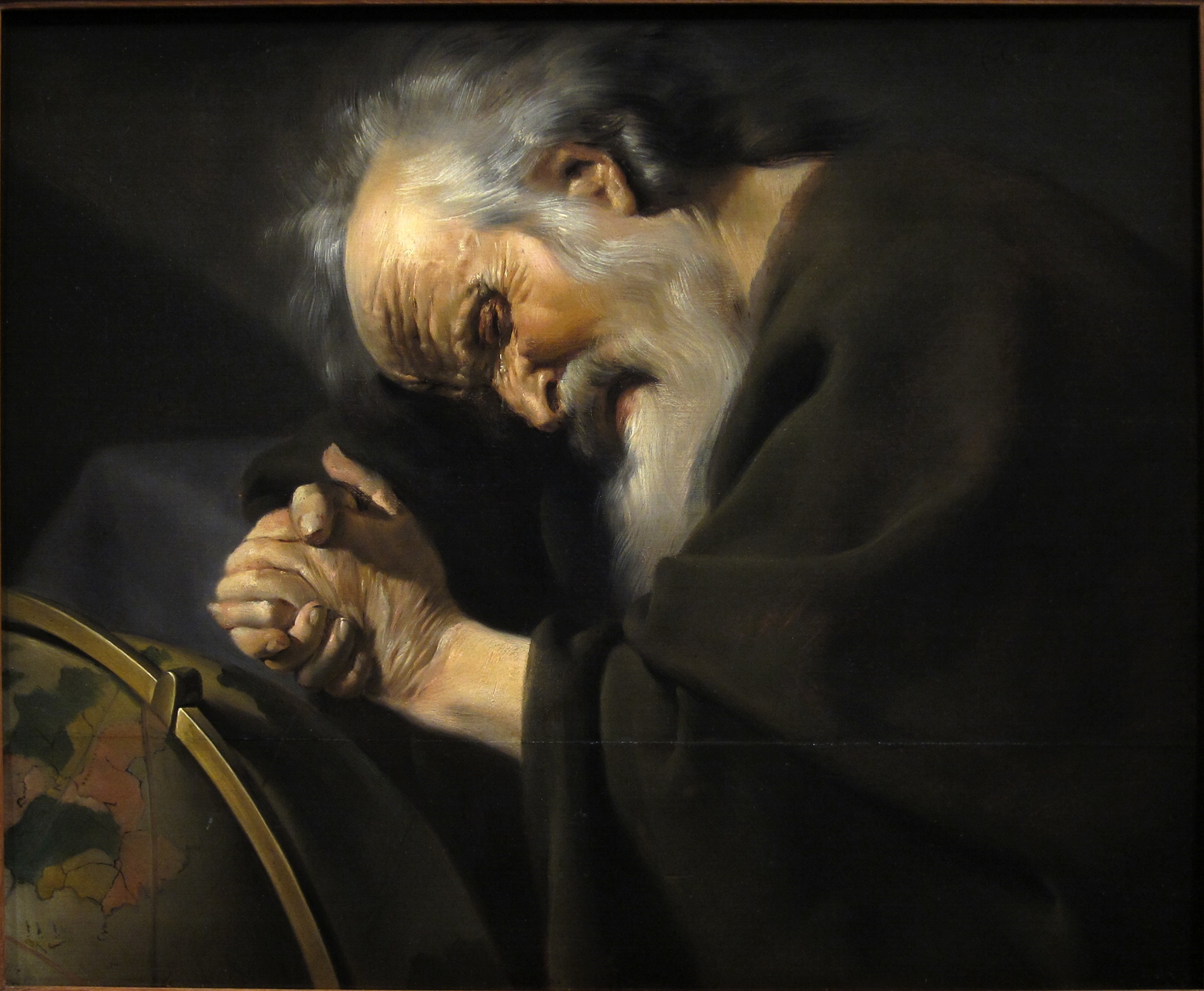
« Heraclitus. Johannes Moreelsee, 1630 »

« Wisdom is separate from everything »i said Heraclitus in his concise style.

For a start, I adopt here the translation of G.S. Kirkii. But the quote in the original Greekiii ,’Sophon esti pantôn kekhorismenon’, preserved in Stobaeus’ Anthology, allows several very significant variations, depending on how one understands the word sophon, – which is, grammatically, an adjective, with the neutral meaning: ‘wise’.

Here are two representative examples of quite alternative translations:

« What is wise is separate from all things. »

« To be wise is to be separated from all things. »

Both these interpretations lose the abstract idea of ‘wisdom’, and personalize the word sophon, in a more concrete way, by attributing it to an entity (‘what is wise’), seen as ‘separated from everything’, and therefore outside this world. Another way to personalize is to attribute it to a (wise) ‘being’, which could possibly belong to this world, therefore not separated, – but whose ‘being wise’ would separate it, somehow virtually.

Clémence Ramnoux, for her part, proposes: « Wise things are separated from everything. »

The spectrum of the meanings of sophon is thus very broad:

Wisdom. That which is wise. The Wise Being. The Wise Thing.

The word sophon has no definite article in this fragment, but it has it in other Heraclite fragments. Then, if one adds the definite article to the adjective sophon, it acquires an abstract meaning, and leads to other interpretations, including the idea of ‘Transcendence’, and even the idea of the ‘One’:

« Let us put the article in front of something wise, by identifying it with the One-Thing-Wise, then the formula touches the goal of knowing… a Transcendence! Let it be heard only in the sense of human wisdom, then the formula says that: for men, the way to be wise consists in keeping oneself separate from all or everything. It would be wise to live away from the crowds and their madness. It would be wise to live apart from the vain science of many things. The two are surely not incompatible. Put together, they would reform the ideal meaning of a vita contemplativa: retreat and meditation of the One. « iv

To justify these interpretations, Clémence Ramnoux studies the other occurrences of the word sophon, in fragments 32, 50 and 41 of Heraclitus.

From these comparisons, she draws the assurance that with sophon, Heraclitus wanted to « designate the divine with the words of fragment 32 », and « if not the divine, even better, Something in dignity to refuse this very name. »v

Fragment 32 uses the expression to sophon (‘the Wise One’, or ‘the Wise Being’, which C. Ramnoux renders as ‘the Wise Thing’):

« The Wise Thing (to sophon) alone is one: it wants and does not want to be said with the name of Zeus. »vi

In Greek, one reads : ἓν τὸ σοφὸν μοῦνον λέγεσθαι οὐκ ἐθέλει καὶ ἐθέλει ὄνομα.

Hen to sophon mounon legesthai ouk ethelei kai ethelei Zènos onoma.

By translating word for word: « One, the Wise One, alone, be said: He does not want, and He wants the name of Zeus ».

Fragment 50 opens another perspective:

οὐκ ἐμοῦ, ἀλλὰ τοῦ λόγου ἀκούσαντας ἀκούσαντας σοφόν ἓν πάντα εἶναί

Ouk émou, alla tou logou akousantas homologein sophon estin hen panta einai.

Word for word: « Not me, but the Logos, listening, saying the same, wise is one, all, being. »

Five words follow each other here: sophon estin hen panta einai. Wise, is, one, all, being. There are many ways to link them.

The most direct way of translating would be, using capital letters for emphasis:

« Wise is One, All, Being ».

The German edition by W. Kranz and the English edition by G.S. Kirk translate :

« Listening, not to me, but to the Logos, it is wise (sophon estin) to agree (homologein)vii: everything is One (hen panta eïnaï). »

In another interpretation, that of H. Gomperz :

« Listening not to me, but to the Logos, it is fair to agree that The One-The Wise One knows everything. »

Clémence Ramnoux suggests yet another interpretation:

« Listening not to me, but to the Logos, agreeing to confess the same lesson (everything is one?) is the Wise Thing. « viii

However, she adds a question mark to the expression ‘everything is one’, which shows indeed that a certain doubt is at work here.

In spite of the significant differences of interpretation that we have just seen, what stands out is the idea that to sophon undeniably possesses a magnified status, and that it can be qualified as ‘unique’ and even, implicitly, ‘divine’.

Fragment 41 reinforces the hypothesis of associating the idea of unity with to sophon:

« The wise thing is one thing (hen to sophon): to possess the meaning (epistasthai gnômèn), by virtue of which everything is led through everything. »

By linking the semantic fields of the four fragments, 32, 41, 50, 108, Ramnoux draws two possible interpretations of the essential message that Heraclitus is supposed to transmit: « A simple meaning would be: Wise Thing is One, and she alone. Another meaning would be: Wise Thing is separate from everything. « ix

These fragments, put together, carry a vision, aiming to grasp the ‘Wise Thing’, from different angles.

« That one gathers the fragments thus, and one will believe to reconstitute a recitative on the topic of the Wise Thing. Here is what should be recited all together while learning the same lesson! »x

The real difficulty is to avoid reading Heraclitus with much later, anachronistic representations of the world, starting with those of Plato and Aristotle.

In spite of the pitfalls, it is necessary to try to reconstruct the spirit of the philosophical community in the pre-Socratic era, the nature of its research :

« It is permissible to conjecturalize the way of being: it would consist in separating and reuniting. To separate from whom? Probably: the crowd and its bad masters. To reunite with whom? Probably: the best and the master of the best lesson. Separate from what? The vain science of many things. To find what again? The right way of saying things. It’s a two-way street! The Heracletian ethos does not alienate man from the present thing: on the contrary, it makes him better present, and as in conversation or cohabitation with the thing. (…) A master of discourse puts into words the meaning of things (…) But the authentically archaic way of thinking was probably still different. For a good master, (…) it is appropriate that discourse shows itself with an ambiguous face, hidden meanings, and two-way effects. »xi

According to Ramnoux, Heraclitus’ fundamental intention is to teach man « to stand far and near at the same time: close enough to men and things so as not to alienate himself in the present, far enough so as not to be rolled and tossed around in traffic. With the word as a weapon to defend oneself against the fascination of things, and things as a reference to better feel the full of words. Like a being between two, aiming through the crack at something untraceable, whose quest guarantees, without his knowledge, his freedom! « xii

Ambiguity? Darkness ? Double meaning ? Hidden sense ?

No doubt, but for my part I would like to put the spotlight on the only unambiguous word in fragment 108: kekhorismenon, ‘separate’, applying to a mysterious entity, named « Wise », whose attributes are unity, being and totality.

How can one be ‘separated’ if one has ‘unity’, and ‘totality’?

What does the idea of ‘separation’ really imply in a thought that claims to be thinking about the ‘origins’?

It is with these questions in mind that I set out to search for occurrences of the word ‘separate’ in a very different corpus, that of the biblical text.

The idea of ‘being separate’ is rendered in Biblical Hebrew by three verbs with very different connotations: בָּדַל badal, חָלַק ḥalaq, and פָּרַד pharad.

בָּדַל badal is used in two verbal forms, niphal and hiphil.

The niphal form is used with a passive or reflexive nuance:

1° ‘to separate, to move away’: « Separate yourselves from the peoples of the land » (Esdr 10,11).

2° ‘to be separated, distinguished, chosen’: « Aaron was chosen » (1 Chr. 23:13); ‘to be excluded’: « He shall be excluded from the congregation of those who returned from captivity » ( Esdr. 10:8 ).

The hiphil form has a causative, active nuance:

1° ‘To separate, tear off’: « The veil will separate you » (Ex 26:33); « Let it serve as a separation between the waters and the waters » (Gen 1:6).

2° ‘To know, to distinguish, to discern’: « To be able to distinguish between what is impure and what is pure » (Lev 11:47).

3° ‘To separate, choose; exclude’: « I have separated you from the other peoples » (Lev 20:26); « The Lord has chosen the tribe of Levi. « (Deut 10:8); « The Lord has excluded me from his people » (Is 56:3).

In this sense, ‘to separate’ means ‘to choose’, ‘to distinguish’, ‘to discern’, ‘to elect’ (or ‘to exclude’).

חָלַק ḥalaq brings another range of meanings, around the notions of ‘sharing’ and ‘division’:

1° ‘To share, to give, to give’: « They divided the land » (Jos 14:5); ‘To be divided’: « Their hearts are divided, or have separated from God » (Hosea 10:2).

2° ‘To divide and distribute’: « And at even he divided the prey » (Gen 49:27); « And he distributed to all the people » (2 Sam 6:19); ‘To scatter’: « I will divide them in Jacob » (Gen 49:7), « The face of YHVH has scattered them » (Lam 4:16).

As for the verb פָּרַד pharad, it is used in an intensive or reflexive sense.

1° (Niphal) ‘To separate’: « Separate yourself, I pray you, from me » (Gen 13:9), « He who separates himself (from God) seeks his desires » (Prov 18:1).

2° ‘To spread, to be scattered’: « These spread throughout the islands » (Gen 10:5).

3° ‘To separate’ with intensive or causative nuances (piel): « They separated from their wives » (Hosea 4:14), « A people that remains separated among the nations » (East 3:8); (hiphil) « Jacob separated the lambs » (Gen 30:40); and (hithpael): « all my bones were separated » (Ps 22:15).

To sum up, the biblical meanings attached to the verbs whose sense is ‘to separate’ include the following nuances: ‘to distance, choose, exclude’ but also ‘to know, distinguish, discern’, or ‘to share, distribute’, and ‘to be scattered’ or ‘to spread’.

One can quite easily apply all these nuances to an entity that would be (divine) Wisdom.

Wisdom, in fact, distinguishes, discerns, knows; she can be shared, spread, distributed;

she can distance herself, elect or exclude.

But yet, what is the truly original meaning that applies to Wisdom?

In an attempt to answer, I have consulted all the Bible verses that contain the word ‘wisdom’ (ḥokhma). There are several hundred of them.

I have selected those that are most ‘open’ – containing an implicit invitation to further research – and grouped them into four categories:

Wisdom as ‘mystery’ and ‘secret’;

Wisdom as ‘companion of the Creator’;

Wisdom as ‘person to dialogue with’;

and Wisdom as ‘faculty of the mind’.

For example, here are some verses assimilating wisdom (or Wisdom, with a capital letter) to mystery or secrecy:

« If he would reveal to you the secrets of Wisdom » (Job 11:6).

« But Wisdom, where does she come from? « (Job 28,12)

Do not say, « We have found wisdom » (Job 32:13).

« Be silent and I will teach you wisdom » (Job 33:33).

« In secret you teach me wisdom » (Ps 51:8).

« Then I began to reflect on wisdom » (Qo 2:12).

There are also verses in which Wisdom seems to accompany the Creator in his task:

« He made the heavens with wisdom » (Ps 136:6).

« Spirit of wisdom and understanding » (Is 11:2)

« Establish the world by his wisdom » (Jer 10:12).

« It is that you abandoned the Source of Wisdom! « (Bar 3,12)

« YHVH by wisdom founded the earth » (Pr 3:19).

There are also verses where Wisdom is presented as a person, capable of interacting with men:

« Tell wisdom: you are my sister! « (Pr 7,4)

« Wisdom cries out through the streets » (Pr 1,20)

« Doesn’t Wisdom call? « (Pr 8,1)

Finally, there are the verses where wisdom is considered a faculty of the mind:

« Give me now wisdom and knowledge » (2 Chr 1:10).

« Who gives wisdom to the wise » (Dan 2:21).

« Intelligence and wisdom like the wisdom of the gods » (Dan 5:11).

For good measure I add here some verses from biblical texts, which are not recognized by the Masoretes as part of the Canon of the Scriptures of Judaism, but which belong to the texts recognized by Catholicism – in this case the Book of Wisdom and the text of Sirach (Ben Sirach):

« Wisdom is a spirit friendly to men » (Wis 1:6) [Person].

« What Wisdom is and how he was born, I will reveal it; I will not hide the mysteries from you, but I will follow his footsteps from the beginning of his origin, I will bring his knowledge to light, without departing from the truth. « (Wis 6:22) [Mystery, Secret].

« For more than any movement, wisdom is mobile » (Wis 7:24) [Mystery, Secret].

« With you is Wisdom who knows your works » (Wis 9:9) [Companion of the Creator].

« But first of all wisdom was created » (Sir 1:4) [Companion of the Creator].

« The root of wisdom to whom was it revealed? « (Sir 1:6) [Mystery, Secret].

« Wisdom brings up her children » (Sir 4:11) [Person].

« Hidden Wisdom and Invisible Treasure » (Sir 20,3) [Mystery, Secret].

And finally, here are some excerpts from the New Testament, – especially from Paul’s texts:

« And Wisdom was justified by all his children » (Luke 7:35) [Companion of the Creator].

« It is of a wisdom of God, mysterious, hidden » (1 Cor 2:7) [Mystery, Secret].

« To give you a spirit of wisdom and revelation » (Eph 1:17) [Faculty of the Spirit].

« All the treasures of wisdom and knowledge » (Col 2:3) [Faculty of Spirit].

« Filled with the Spirit and with wisdom » (Act 6:3) [Faculty of the Spirit].

If we return to the intuition of « separate wisdom » as imagined by Heraclitus, we see that it is perfectly compatible with the representations of Wisdom as belonging to the Mystery, as a Companion of the Creator and as a Person]

But where Judaism plays with the idea of a kind of doubling of the divine between the function of the Creator and the role of Wisdom (which is, let us recall, one of the Sefiroth of the Jewish Kabbalah), the metaphysical mysticism of Heraclitus sees only divine Unity and Totality.

It is not the least result of this research, to find in one of the most eminent Greek pre-Socratic thinkers, such an extreme intuition of the transcendence of Wisdom, and of its Unity with the Divine.

Wisdom is par excellence ‘separate’, and is also that which is most ‘one’.…

______________

i Fragment B 108

ii Quoted by Clémence Ramnoux. Heraclitus or the man between things and words. Ed. Les Belles Lettres. Paris, 1968, p.247

iii Ἡρακλείτου. ὁκόσων λόγους ἤκουσα, οὐδεὶς ἀφικνεῖται ἐς τοῦτο, ὥστε γινώσκειν ὅτι σοφόν πάντων κεχωρισμένον. (Joannes Stobaeus, Anthologie, III, 1, 174)

iv Clémence Ramnoux. Heraclitus or the man between things and words. Ed. Les Belles Lettres. Paris, 1968, p.247

vClémence Ramnoux. Heraclitus or the man between things and words. Ed. Les Belles Lettres. Paris, 1968, p.248

vi ἓν τὸ τὸ σοφὸν μοῦνον λέγεσθαι οὐκ ἐθέλει καὶ ἐθέλει ὄνομα.

vii Or, if we play with the word homologein: ‘to say with the same voice’, or ‘to say the same as the Logos‘.

viiiClémence Ramnoux. Heraclitus or the man between things and words. Ed. Les Belles Lettres. Paris, 1968, p.243

ixClémence Ramnoux. Heraclitus or the man between things and words. Ed. Les Belles Lettres. Paris, 1968, p.248

xIbid.

xiIbid.pp. 248-249

xiiIbid.p. 249

Creation, Death, Life


According to Genesis, taken literally, man was created twice.

Genesis, in chapter 1, describes a first creation of « man » called ha-adam. The word ha-adam includes the definite article ha and literally means « the earth », metaphorically « the red » (for the earth is red), and by extension « man ».

In Chapter 2, Genesis describes a second creation of man (ish), accompanied by a creation of woman (isha). These two words are not preceded by the article ha.

The most immediately noticeable differences between the two creations are as follows.

First of all, the names given to the man differ, as we have just seen: ha-adam on the one hand, ish and isha on the other.

Secondly, the verbs used to describe the act of creation are not the same. In the first chapter of Genesis we read: « God said, ‘Let us make man in our image, in our likeness' » (Gen. 1:26). The Hebrew word for ‘let us make’ is נַעֲשֶׂה from the verb עֲשֶׂה, ‘asah, to do, to act, to work. In the second chapter of Genesis we read: « And the Eternal God planted a garden in Eden toward the east, and there he placed the man whom he had fashioned. « (Gen. 2:8) The Hebrew word for ‘fashioning’ is יָצָר , yatsara, to make, to form, to create.

Thirdly, in Genesis 1, God created man « male and female » (zakhar and nqebah). Man is apparently united in a kind of bi-sexual indifferentiation or created with « two faces », according to Rashi.

In contrast, in Genesis 2, the creation of woman is clearly differentiated. She is created in a specific way and receives the name ‘isha‘, which is given to her by the man. The man, ‘ha-adam‘, then calls himself ‘ish‘, and he calls his wife ‘isha‘, « because she was taken from ‘ish‘ ».

Rashi comments on this verse: « She shall be called isha, because she was taken from ish. Isha (‘woman’) is derived from ish (‘man’). From here we learn that the world was created with the holy language, [since only the Hebrew language connects the words ‘man’ and ‘woman’ with a common root]. (Berechith raba 18, 4).”

I don’t know if it can be said with impunity that only the Hebrew language connects the words « man » and « woman » to a common root. English, for example, displays such a link with « man » and « woman ». In Latin, « femina » (woman) would be the feminine counterpart of « homo » (« hemna« ).

But this is a secondary issue. However, it shows that Rashi’s interest is certainly not exercised here on the problem of double creation and on the triple difference between the stories of Genesis 1 and Genesis 2: two nouns (adam/ish), two verbs to describe creation (‘asah/yatsara), and two ways of evoking the difference between genders, in the form ‘male and female’ (zakhar/nqebah) and in the form ‘man and woman’ (ish/isha).

The double narrative of the creation of man and woman could be interpreted as the result of writing by independent authors at different times. These various versions were later collated to form the text of Genesis, which we have at our disposal, and which is traditionally attributed to Moses.

What is important here is not so much the identity of the writers as the possible interpretation of the differences between the two stories.

The two ‘ways’ of creating man are rendered, as has been said, by two Hebrew words, עֲשֶׂה ‘to make’ and יָצָר ‘to form’. What does this difference in vocabulary indicate?

The verb עֲשֶׂה ‘asah (to do) has a range of meanings that help to characterize it more precisely: to prepare, to arrange, to take care of, to establish, to institute, to accomplish, to practice, to observe. These verbs evoke a general idea of realization, accomplishment, with a nuance of perfection.

The verb יָצָר yatsara (to shape, to form) has a second, intransitive meaning: to be narrow, tight, embarrassed, afraid, tormented. It evokes an idea of constraint, that which could be imposed by a form applied to a malleable material.

By relying on lexicon and semantics, one can attempt a symbolic explanation. The first verb (עֲשֶׂה , to do) seems to translate God’s point of view when he created man. He « makes » man, as if he was in his mind a finished, perfect, accomplished idea. The second verb (יָצָר , to form) rather translates, by contrast, the point of view of man receiving the « form » given to him, with all that this implies in terms of constraints, constrictions and limits.

If we venture into a more philosophical terrain, chapter 1 of Genesis seems to present the creation of man as ‘essence’, or in a ‘latent’ form, still ‘hidden’ to some extent in the secret of nature.

Later, when the time came, man also appears to have been created as an existential, natural, visible, and clearly sexually differentiated reality, as chapter 2 reports.

S. Augustine devoted Part VI of his book, Genesis in the literal sense, to this difficult question. He proposes to consider that God first created all things ‘simultaneously’, as it is written: ‘He who lives for eternity created everything at the same time. « (Ecclesiasticus, 18,1) The Vulgate version says: « in aeternum, creavit omnia simul« . This word ‘simul‘ seems to mean a ‘simultaneous’ creation of all things.

It should be noted in passing that neither Jews nor Protestants consider this book of Ecclesiasticus (also called Sirach) to belong to the biblical canon.

For its part, the Septuagint translates from Hebrew into Greek this verse from Ecclesiasticus:  » o zon eis ton aiôna ektisen ta panta koinè « . (« He who lives for eternity has created everything together. »)

This is another interpretation.

So shall we retain ‘together’ (as the Greek koinè says) or ‘simultaneously’ (according to the Latin simul)? It could be said that it amounts to the same thing. However it follows from this difference that Augustine’s quotation from Sirach 18:1 is debatable, especially when it is used to distinguish between the creation of man in chapter 1 of Genesis and his second creation in chapter 2.

According to Augustine, God in the beginning created all things ‘in their causes’, or ‘in potency’. In other words, God in chapter 1 creates the idea, essence or principle of all things and everything in nature, including man. « If I say that man in that first creation where God created all things simultaneously, not only was he not a man in the perfection of adulthood, but was not even a child, – not only was he not a child, but was not even an embryo in his mother’s womb, but was not even the visible seed of man, it will be believed that he was nothing at all.”

Augustine then asks: what were Adam and Eve like at the time of the first creation? « I will answer: invisibly, potentially, in their causes, as future things are made that are not yet.”

Augustine takes the side of the thesis of the double creation of man, firstly in his ‘causal reason’, ‘in potency’, and secondly, ‘in act’, in an effective ‘existence’ which is prolonged throughout history.

This is also true of the soul of every man. The soul is not created before the body, but after it. It does not pre-exist it. When it is created, it is created as a ‘living soul’. It is only in a second stage that this ‘living soul’ may (or may not) become ‘life-giving spirit’.

Augustine quotes Paul on this subject: « If there is an animal body, there is also a spiritual body. It is in this sense that it is written: The first man, Adam, was made a living soul, the last Adam, the ‘newest Adam’ (novissimus Adam), was a life-giving spirit. But it is not what is spiritual that was made first, it is what is animal; what is spiritual comes next. The first man, who came from the earth, is earthly; the second man, who came from heaven, is heavenly. Such is the earthly, such are also the earthly; and such is the heavenly, such are also the heavenly. And just as we have put on the image of the earthly, so shall we also put on the image of him who is of heaven.”

And Augustine adds: « What more can I say? We therefore bear the image of the heavenly man from now on by faith, sure that we will obtain in the resurrection what we believe: as for the image of the earthly man, we have clothed it from the origin of the human race. »

This basically amounts to suggesting the hypothesis of a third ‘creation’ that could affect man: after adam, ish or isha, there is the ‘last Adam‘, man as ‘life-giving spirit’.

From all of this, we will retain a real intuition of the possible metamorphoses of man, certainly not reduced to a fixed form, but called upon to considerably surpass himself.

It is interesting, at this point, to note that Philo of Alexandria offers a very different explanation of the double creation.

Philo explains that in the beginning God « places » (וַיָּשֶׂם שָׁם ) in the Garden of Eden a « fashioned » man (‘The Eternal God planted a garden in Eden towards the east and placed the man he had fashioned in it’). Gen. 2:8). A little later he ‘established’ (וַיַּנִּח ) a man to be the worker and the guardian (‘The Eternal-God therefore took the man and established him in the Garden of Eden to cultivate and care for it’. Gen. 2:15).

According to Philo, the man who cultivates the garden and cares for it is not the « fashioned » man, but « the man [that God] has made« . And Philo says: « [God] receives this one, but drives out the other.”i

Philo had already made a distinction between the heavenly man and the earthly man, by the same verbal means. « The heavenly man was not fashioned, but made in the image of God, and the earthly man is a being fashioned, but not begotten by the Maker.”ii

If we follow Philo, we must understand that God drove the ‘fashioned‘ man out of the garden, after having placed him there, and then established the ‘made‘ man there. The man whom God ‘fashioned‘ was ‘placed‘ in the garden, but it seems that he was not considered worthy to cultivate and keep it.

Moreover, in the text of Genesis there is no evidence to support Philo’s thesis of a cross between a ‘fashioned’ man and a ‘made’ man.

Philo specifies: « The man whom God made differs, as I have said, from the man who was fashioned: the fashioned man is the earthly intelligence; the made man is the immaterial intelligence.”iii

Philo’s interpretation, as we can see, is metaphorical. It must be understood that there are not two kinds of men, but that there are rather two kinds of intelligence in man.

« Adam is the earthly and corruptible intelligence, for the man in the image is not earthly but heavenly. We must seek why, giving all other things their names, he did not give himself his own (…) The intelligence that is in each one of us can understand other beings, but it is incapable of knowing itself, as the eye sees without seeing itself »iv.

The ‘earthly’ intelligence can think of all beings, but it cannot understand itself.

God has therefore also ‘made‘ a man of ‘heavenly’ intelligence, but he does not seem to have had a happier hand, since he disobeyed the command not to eat of the fruit of the ‘tree of the knowledge of good and evil’.

But was this tree of ‘the knowledge of good and evil’ really in the Garden of Eden? Philo doubts it. For if God says, « But of the tree of the knowledge of good and evil, you shall not eat of it », then « this tree was not in the garden »v.

« You shall not eat of it.” This should not be interpreted as a prohibition, but as a simple prediction of an all-knowing God.

This can be explained by the nature of things, Philo argues. The tree could have been present in « substance », but not in « potency »…

The man ‘in the image’ could have eaten the substance of a fruit of this tree. But he did not digest all its latent potency, and therefore he did not benefit from it in any real way.

There is yet another possible interpretation. Knowledge is not found in life. It is found only in potency, not in life, but in death.

The day in which one eats from the fruit of the tree of knowledge is also the day of death, the day in which the prediction is fulfilled: « Thou shalt die of death » מוֹת תָּמוּת (Gen. 2:17).

In this strange verse the word « death » is used twice. Why is this?

« There is a double death, that of man, and the death proper to the soul; that of man is the separation of soul and body; that of the soul is the loss of virtue and the acquisition of vice. (…) And perhaps this second death is opposed to the first: this one is a division of the compound of body and soul; the other, on the contrary, is a meeting of the two where the inferior, the body, dominates and the superior, the soul, is dominated.”vi

Philo quotes fragment 62 of Heraclitus: « We live by their death, we are dead to their life.”vii He believes that Heraclitus was « right to follow the doctrine of Moses in this ». As a good Neoplatonist, Philo also takes up Plato’s famous thesis of the body as the ‘tomb of the soul’.

« That is to say that at present, when we live, the soul is dead and buried in the body as in a tomb, but by our death, the soul lives from the life that is proper to it, and is delivered from evil and the corpse that was bound to it, the body.”viii

There is nevertheless a notable difference between the vision of Genesis and that of the Greek philosophers.

Genesis says: « You shall die of death! « 

Heraclitus has a very different formula: « The life of some is the death of others, the death of some, the life of others.”

In Genesis death is deemed as a double death.

For Heraclitus, death is mixed with life.

Who is right?

iPhilo of Alexandria, Legum Allegoriae, 55

iiIbid., 31

iiiIbid., 88

ivIbid., 90

vIbid., 100

viIbid., 105

vii Philo quoted only a part of fragment 62. He omitted: « Immortals are mortal; mortals are immortal ».

viiiIbid., 106

Religion and plagiarism


Plagiarized Godhead©Philippe Quéau 2018

The word “plagiarism originally meant « the act of selling or buying a free person as a slave ». The word comes from the Latin plagiarius or plagiator, « thief of man ». This meaning is unused today. The word is now only used in a literary, artistic or scientific context. Plagiarism is the act of appropriating someone else’s ideas or words by passing them off as one’s own.

The Latin plagiator and plagiarists have one thing in common, and that is that they attack the very being of man. To steal a man’s ideas is to steal him as a being, to steal his substance.

« Plagiarising » means enslaving a man’s thought, putting it under the control of another man, making it a « slave ».

A Palestinian bishop, Eusebius of Caesarea (265-339), recognised as the « Father of the Church », brought a severe charge against the many plagiarisms and borrowings made by the Greeks at the expense of the many peoples who had preceded them in the history (of ideas).

Eusebius’ intention was apologetic. It was intended to diminish the prestige of Greek philosophy at a time when the development of the Christian religion needed to be reinforced.

« The Greeks took from the Barbarians the belief in multiple gods, mysteries, initiations, and furthermore the historical relations and mythical accounts of the gods, the allegorising physiologies of the myths and all idolatrous error ».i

Pillage is permanent, universal. The Greeks steal from everyone and steal from each other.

« The Greeks monopolised Hebrew opinions and plundered the rest of the sciences from the Egyptians and Chaldeans as well as from the other barbarian nations, and now they are caught stealing each other’s reputation as writers. Each of them, for example, stole from his neighbor passions, ideas, entire developments and adorned himself with them as his own personal labor.”ii

Eusebius quotes the testimony of Clement of Alexandria: « We have proved that the manifestation of Greek thought has been illuminated by the truth given to us by the Scriptures (…) and that the flight of truth has passed to them; well! Let us set the Greeks against each other as witnesses to this theft.»iii

The most prestigious names in Greek thought are put on the pillory of dishonor.

Clement of Alexandria quotes « the expressions of Orpheus, Heraclitus, Plato, Pythagoras, Herodotus, Theopompus, Thucydides, Demosthenes, Eschina, Lysias, Isocrates and a hundred others that it would be superfluous to enumerate.”iv

Porphyrus, too, accuses Plato of being a plagiarist in his Protagoras.

The accusation is clear, precise and devastating. « All the famous philosophical culture of the Greeks, their first sciences, their proud logic were borrowed by them from the Barbarians.”v

The famous Pythagoras himself went to Babylon, Egypt and Persia. He learned everything from the Magi and the priests. He even went to learn from the Brahmins of India, it is said. From some he was able to learn astrology, from others geometry and from others arithmetic and music.vi

Even the Greek alphabet was invented in Phoenicia, and was introduced to Greece by Cadmos, a Phoenician by birth.

As for Orpheus, he borrowed from the Egyptians his rites, his « initiations into the mysteries », and his « affabulations » about Hades. The cult of Dionysus is entirely modelled on that of Osiris, and the cult of Demeter on that of Isis. The figure of Hermes Psychopompe, the conductor of the dead, is obviously inspired by Egyptian myths.

It must be concluded, says Eusebius, that Hebrew theology must be preferred to the philosophy of the Greeks, which must be given second place, since it is nothing but a bunch of plagiarism.

The Greek gods form a cohort of second-hand gods, of eclectic borrowings, from Egypt to Mesopotamia and from India to Persia. Moses predates the capture of Troy and thus precedes the appearance of the majority of the gods of the Greeks and their sages.

Eusebius aims to magnify the Hebrew heritage by completely discrediting « Greek wisdom » and the pantheon of its imported gods.

So, Greek thought, — a plagiary thought?

First of all, the ideas of the Persian magi, the Egyptian priests and the Brahmins of India were not copied as such. Pythagoras or Plato digested them, transformed, even transmuted them into something entirely original.

Greek thought also added a level of freedom of thought by copying, augmenting, criticizing.

Then the so- called « Greek loans » represent a very long chain, which goes back to the dawn of time. And everyone was doing that. It is not at all certain, for example, that Moses himself was entirely free of plagiarism. Raised at the court of Pharaoh Amosis, – according to Tatian and Clement of Alexandria, it is very likely that Moses benefited from many Egyptian ideas about the hidden God (Ammon) and the one God (Aten).

Ammon, the ‘hidden’ God, had been worshipped in Egypt for more than two millennia before Moses. As for the « one » God Aten, he was celebrated by Amenophis IV, who took the name of Akhenaten in his honour several centuries before the Exodus. Several religious rites established by Moses seem to have been copied from the Egyptian rites, by means of a deliberate « inversion », taking the direct opposite side, which is, it is true, an original form of plagiarism. Thus the biblical sacrifice of sheep or cattle was instituted by Moses, as it were, as a reaction against the Egyptian cult which banned precisely blood sacrifices. It is not by chance that Moses had adopted as a « sacred » rite what seemed most « sacrilegious » to the Egyptians — since they accorded the bull Apis the status of a sacred, and even « divine » figure, and for whom it was therefore out of the question to slaughter cows, oxen or bulls on altars.

It is interesting to recall that this prohibition of bloody sacrifices had also been respected for several millennia by the Vedic cult in the Indus basin.

What can we conclude from this? That the essential ideas circulate, either in their positive expressions, or by provoking negative reactions, direct opposition.

As far as ideas are concerned, let us say provocatively, nothing is more profitable than plagiarism, in the long term. And as far as religion is concerned, the more we plagiarize, the closer we come, in fact, to a common awareness, and to a larval consensus, but one can hope for a slowly growing one, on the most difficult subjects.

World religion began more than 800,000 or a million years ago, as evidenced by the traces of religious activity found at Chou Kou Tien, near Beijing, which show that Homo sapiens already had an idea of the afterlife, of life after death, and therefore of the divine.

Moses and Plato are milestones in the long history of world religion. The shamans who officiated 40,000 years ago in the cave of Pont d’Arc, those who later took over in Altamira or Lascaux, were already human in the full sense of the word.

From the depths of the centuries, they have been announcing the coming of the prophets of the future, who will emerge, it is obvious, in the heart of an overpopulated planet, threatened by madness, death and despair.

iEusebius of Caesarea. Praeparatio Evangelica, X, 1,3

iiIbid. X, 1,7-8

iiiIbid. X,2,1

ivIbid. X,2,6

vIbid. X,2,6

viIbid. X,4,15

Finding Knowledge in Death


In the Book of Genesis, God creates man in two different ways. Two words, עֲשֶׂה ‘ésêh, « to make » and יָצָר yatsar, « to form » are used, at two distinct moments, to indicate this nuance.

« And God said: Let us make man in our image, after our likeness » (Gen. 1:26). The Hebrew word for « let us make » is נַעֲשֶׂה from the verb עֲשֶׂה ‘ésêh.

And in the second chapter of Genesis we read:

« And the Lord God planted a garden eastward in Eden, and there he put the man whom he had formed. « (Gen. 2:8) The Hebrew word for « formed » is: יָצָר , yatsar.

What does this difference in vocabulary teach us?

The verb עֲשֶׂה means “to make” but has several other nuances: “to prepare, arrange, care, establish, institute, accomplish, practice, observe.” This range of meanings evokes the general idea of realization, accomplishment, perfection.

The verb יָצָר means “to form, to fashion” but also has an intransitive meaning: “to be narrow, constricted, embarrassed, afraid, tormented”. It evokes an idea of constraint, of embarrassment.

It is as if the first verb (« to make ») translated the point of view of God creating man, and as if the second verb (« to form ») expressed the point of view of man who finds himself in the narrow « form » imposed to him, with all that it implies of constraint, tightness and torment.

The Book of Genesis twice cites the episode of the creation of man, but with significant differences.

Firstly, God « places » (וַיָּשֶׂם שָׁם ) a man “whom he had formed « (Gen. 2,8) in the Garden of Eden. A little later, God « establishes » (וַיַּנִּח ) a man there to be the worker and the guardian (Gen. 2,15).

Philo interprets this reference to two different “placement” or “establishment” of “man” as follows: the man who tills the garden and looks after it, is « the man [whom God] has made », and not the man whom he has « formed ». God « receives the former, but drives out the latter.”i

Philo introduces a distinction between the « heavenly » man and the « earthly » man. « The heavenly man was not formed, but made in the image of God, and the earthly man is a being formed, but not begotten by the Maker. »ii

One can understand thusly: God first « formed » a man and « placed » him in the garden. But this man was not deemed worthy to cultivate it. God drove him out of the Garden of Eden. Then He « established » the man whom He « made » in his place.

Philo adds: « The man whom God has made is different, as I have said, from the man who has been formed: the formed man is earthly intelligence; the man who has been made is immaterial intelligence. »iii

So it was just meant to be a metaphor. There are not two kinds of men, but rather two kinds of intelligence in the same man.

« Adam is the earthly and corruptible intelligence, for the man ‘in the image’ is not earthly but heavenly. We must seek why, giving all other things their names, he did not give himself his own name… The intelligence that is in each of us can understand other beings, but it is incapable of knowing itself, as the eye sees without seeing itself. »iv

The « earthly » intelligence thinks all beings but does not understand itself.

God takes up his work again, and endows man with a « celestial » intelligence. He then has new troubles, since this new man disobeys him and eats of the fruit of the « tree of the knowledge of good and evil ».

It can be argued that without this « heavenly » intelligence, man could not have eaten and known good and evil.

Another question: Was this tree really in the Garden of Eden?

Philo doubts it, because God has said: « But of the tree of the knowledge of good and evil, you shall not eat of it.”

This is (grammatically) not an order, but just a factual statement. Philo infers that « this tree was therefore not in the garden ».v

This can be explained by the nature of things, he argues: « It [the tree] is there by substance, it is not there in potency. »

In other words, the “tree” is apparently there, but not really its “fruit”.

More philosophically: knowledge is not to be found in life. Knowledge is only to be found “in potency”, i.e. in death.

For the day that one eats of the fruit of the tree of knowledge is also the day of death, the day of which it is said, « You shall die of death » מוֹת תָּמוּת, mot tamut, (Gen. 2:17).

Why this pleonasm, “to die of death”, in the biblical text?

« There is a double death, that of man, and the death proper to the soul; that of man is the separation of soul and body; that of the soul, the loss of virtue and the acquisition of vice. (…) And perhaps this second death is opposed to the first: this one is a division of the compound of body and soul; the other, on the contrary, is a meeting of the two where the inferior, the body, dominates, and the superior, the soul, is dominated. »vi

Philo quotes here the last part of the fragment 62 of Heraclitus: “ Immortals are mortal, mortals immortal, living their death, dying their life ».

He believes that Heraclitus was « right to follow the doctrine of Moses in this », and, as a good Neoplatonist, Philo takes up the famous thesis of the body, tomb of the soul, developed by Plato.

“That is to say, at the present time, when we live, the soul is dead and buried in the body as in a tomb, but by our death the soul lives of the life proper to it, and is delivered from evil and from the corpse that was bound to it, the body.”vii

The Book of Genesis says: “You shall die of death!”. Heraclitus has a formula which is less of such a pleonasm: “The life of some is the death of others, the death of some, the life of others.”

Who to believe? Is death double, that of the body and that of the soul? Or does death herald another life?

We can try to propose a synthesis, like Philo did.

Knowledge is not to be found in life. It is only there “in potency”, and it is probably to be found in “death”, which announces an “other” sort of life.

iPhilo of Alexandria, Legum Allegoriae, 55

iiIbid., 31

iiiIbid., 88

ivIbid., 90

vIbid., 100

viIbid., 105

viiIbid., 106

Non-Death and Breath


Who can tell us today the smell and taste of soma? The crackle of clarified butter, the rustle of honey in the flame, the brightness, the brilliance, the softness of the sung Vedic hymns? Who still remember the sounds of yesterday, the lights, the odors, the flavors, concentrated, multiplied, of the sacred rita?

In any religion, the most important thing is its living, immortal soul. The soul of Veda has crossed thousands of years. And it still inhabits some whispered, ancient words.

« Thou art the ocean, O poet, O omniscient soma… Thine are the five regions of the sky, in all their vastness! Thou hast risen above heaven and earth. Thine are the stars and the sun, O clarified soma!”i

As of today, scientists do not know if the soma was extracted from plants such as Cannabis sativa, Sarcostemma viminalis, Asclepias acida or from some variety of Ephedra, or even from mushrooms such as Amanita muscaria. The secret of soma is lost.

What is known is that the plant giving soma had powerful, hallucinogenic and « entheogenic » virtues.

Shamans all over the world, in Siberia, Mongolia, Africa, Central America, Amazonia, or elsewhere, still continue to use the psychotropic properties of their own pharmacopoeia today.

The « entheogenic » dives are almost indescribable. Often nothing can be told about them, except for some unimaginable, distant, repeated certainties. Metaphors multiply and stubbornly try, vainly, to tell the unspeakable. To poetry is given the recollection of past consciences so close to these worlds.

« The wave of honey has risen from the bosom of the ocean, together with the soma, it has reached immortal abode. It has conquered the secret name: ‘language of the gods’, ‘navel of the immortal’. »ii

One should believe it: these words say almost everything that can be said about what cannot be said. It is necessary to complete what they mean, by intuition, experience, or commentary.

For more than five thousand years, the Upaniṣad has been trying to do just that. They hide nuggets, diamonds, coals, gleams, lightning.

« He moves and does not move. He is far and he is near.

He is within all that is; of all that is, He is outside (…)

They enter into blind darkness, those who believe in the unknowing;

And into more darkness still, those who delight in knowledge.

Knowledge and non-knowledge – he who knows both at the same time,

he crosses death through non-knowledge, he reaches through knowledge the non-death.

They enter into blind darkness those who believe in the non-death;

and into more darkness still those who delight in the becoming (…)

Becoming and ceasing to be – the one who knows both,

he crosses death by the cessation of being, and by the becoming, he reaches non-death. » iii

These words were thought, quoted and contemplated more than two thousand years before the birth of Heraclitus of Ephesus. They must be read and spoken again.

Now it the time to drink the soma again, in a novel way, and to stare at the clear flame, which fills the air with new odors. The wind will then stir up the flame.

It is time to praise again the Breath! Breath is master of the universe, the master of all things. Breath founds the world. Breath is clamor and thunder, lightning and rain!

Breath breathes, Breath breathes in, Breath breathes out, Breath moves away, Breath moves closer!

Words also breathe, pant, keep moving away and coming closer.

And then they open up to other escapes.

Breath caresses beings, like a father his child.

Breath is the father of all that breathes and all that does not breathe.

i Rg Veda 9.86.29

ii Rg Veda 4.58.1

iii Īśāvāsya upaniṣad, 5-14

In the Mire, Drowning Angels.


We humans are fundamentally nomads, – with no nomosi. We are forever nomads with no limits, and no ends.

Always dissatisfied, never at peace, never at rest, perpetually on the move, forever in exile.

The Journey has no end. Wandering is meaningless, without clues. The homelands are suffocating. Landscapes are passing by, and we have no roots. No abyss fulfills us. The deepest oceans are empty. The skies, down there, are fading. The suns are pale, the moons dirty. The stars are blinking. We can only breathe for a moment.

Our minds would like to look beyond the diffuse background, behind the veiled Cosmos. But even an infinitely powerful Hubble telescope couldn’t show us anything of what’s behind. Cosmology is a prison, only vaster, but still finite, bounded, and we are already tired of endless, useless, multiverses, and weary of their aborted drafts.

The worried soul « pursues an Italy that is slipping away », but Virgil is not anymore our vigilante, and Aeneas is not our elder. Rome has forgotten itself. Athens has died out. Jerusalem, we already have returned there, – so they say.

Billions of people live, dream and die on the Promised Land.

They try, every night, to drink the water of the Lethe and the Cocyte, without being burnt by the Phlegethon. When they wake up, they are always thirsty for new caresses, they want again to smell myrrh, to taste nectars.

They try to avoid the icy skin of mirrors. They desperately scan the hairy mountains, the undecided rivers, the bitter oranges. They follow the hard curve of the fruits, the orb of the colors.

But at one point the heart hits, the body falls. At any moment, the final night will cover the sun. Forgetting all will come without fail.

Euripides called life: « the dream of a shadow ».ii

This shadow has two wings, – not six, like Ezekiel’s angels.

Intelligence and will are our wings, says Plato.

With one wing, the shadow (or the soul) sucks in, breathes in. The world comes into her.

With the other wing, she goes to all things, she flies freely, anywhere.

When the two wings flap together, then anything is possible. The soul can evade anywhere, even out of herself, and even from God Himself. As Marsilio Ficino says: « Animus noster poterit deus quidam evadere ».

There is a mysterious principle at the heart of the soul: she becomes what she’s looking for. She is transformed into what she loves.

Who said that? A litany of impressive thinkers. Zoroaster, King David. Plato, Porphyry, Augustine. Paul put it that way: « And we all, who with unveiled faces contemplate the Lord’s glory, are being transformed into his image with ever-increasing glory. »iii

It is indeed a mysterious principle.

The word ‘mystery’ comes from the Greek μύω, to close. This verb was originally used for the eyes, or for the lips. Closed eyes. Closed lips. The religious meaning, as a derivative, describes an ancient problem: how could what is always closed be ever opened?

Zoroaster found an answer, kind of: « The human soul encloses God in herself, so to speak, when, keeping nothing mortal, she gets drunk entirely on the divinity”.iv

Who still reads or pays attention to Zoroaster today?

Nietzsche? But Nietzsche, the gay barbarian, joyfully ripped away his nose, teeth and tongue. After that, he pretended he could speak on his behalf. Also Sprach Zarathustra. Ach so? Wirklich?

There are two kinds of thinkers.

There are the atrabilaries, who distill their venom, their suspicions, their despair, or their limitations, like Aristotle, Chrysippus, Zeno, Averroes, Schopenhauer or Nietzsche.

And there are the optimists, Heraclitus, Pythagoras, Socrates, Plato, or Apollonius of Thyana. They believe in life and in everything that may flourish.

We’ll rely on Heraclitus for a concluding line: “If you do not expect the unexpected you will not find it, for it is not to be reached by search or trail”. (Fragm. 18)

What can we learn from that fragment?

Without hope, everything is and will stay forever mud, mire, or muck. We have to search for the unexpected, the impossible, the inaccessible… What on earth could it be? – Gold in the mud, – or in the mire, drowning angels?

iNomos (Greek) = Law

ii Medea, 1224

iii2 Co 3,18

iv ChaldaicOracles V. 14.21

The Egyptian Messiah


Human chains transmit knowledge acquired beyond the ages. From one to the other, you always go up higher, as far as possible, like the salmon in the stream.

Thanks to Clement of Alexandria, in the 2nd century, twenty-two fragments of Heraclitus (fragments 14 to 36 according to the numbering of Diels-Kranz) were saved from oblivion, out of a total of one hundred and thirty-eight.

« Rangers in the night, the Magi, the priests of Bakkhos, the priestesses of the presses, the traffickers of mysteries practiced among men.  » (Fragment 14)

A few words, and a world appears.

At night, magic, bacchae, lenes, mysts, and of course the god Bakkhos.

The Fragment 15 describes one of these mysterious and nocturnal ceremonies: « For if it were not in honour of Dionysus that they processioned and sang the shameful phallic anthem, they would act in the most blatant way. But it’s the same one, Hades or Dionysus, for whom we’re crazy or delirious.»

Heraclitus seems reserved about bacchic delusions and orgiastic tributes to the phallus.

He sees a link between madness, delirium, Hades and Dionysus.

Bacchus is associated with drunkenness. We remember the rubicond Bacchus, bombing under the vine.

Bacchus, the Latin name of the Greek god Bakkhos, is also Dionysus, whom Heraclitus likens to Hades, God of the Infernos, God of the Dead.

Dionysus was also closely associated with Osiris, according to Herodotus in the 5th century BC. Plutarch went to study the question on the spot, 600 years later, and reported that the Egyptian priests gave the Nile the name of Osiris, and the sea the name of Typhon. Osiris is the principle of the wet, of generation, which is compatible with the phallic cult. Typhoon is the principle of dry and hot, and by metonymy of the desert and the sea. And Typhon is also the other name of Seth, Osiris’ murdering brother, whom he cut into pieces.

We see here that the names of the gods circulate between distant spheres of meaning.

This implies that they can also be interpreted as the denominations of abstract concepts.

Plutarch, who cites in his book Isis and Osiris references from an even more oriental horizon, such as Zoroaster, Ormuzd, Ariman or Mitra, testifies to this mechanism of anagogical abstraction, which the ancient Avestic and Vedic religions practiced abundantly.

Zoroaster had been the initiator. In Zoroastrianism, the names of the gods embody ideas, abstractions. The Greeks were the students of the Chaldeans and the ancient Persians. Plutarch condenses several centuries of Greek thought, in a way that evokes Zoroastrian pairs of principles: « Anaxagoras calls Intelligence the principle of good, and that of evil, Infinite. Aristotle names the first the form, and the other the deprivationi. Plato, who often expresses himself as if in an enveloped and veiled manner, gives to these two contrary principles, to one the name of « always the same » and to the other, that of « sometimes one, sometimes the other ». »ii

Plutarch is not fooled by Greek, Egyptian or Persian myths. He knows that they cover abstract, and perhaps more universal, truths. But he had to be content with allusions of this kind: « In their sacred hymns in honour of Osiris, the Egyptians mentioned « He who hides in the arms of the Sun ». »

As for Typhon, a deicide and fratricide, Hermes emasculated him, and took his nerves to make them the strings of his lyre. Myth or abstraction?

Plutarch uses the etymology (real or imagined) as an ancient method to convey his ideas: « As for the name Osiris, it comes from the association of two words: ὄσιοϛ, holy and ἱερός, sacred. There is indeed a common relationship between the things in Heaven and those in Hades. The elders called them saints first, and sacred the second. »iii

Osiris, in his very name, osios-hieros, unites Heaven and Hell, he combines the holy and the sacred.

The sacred is what is separated.

The saint is what unites us.

Osiris joint separated him to what is united.

Osiris, victor of death, unites the most separated worlds there are. It represents the figure of the Savior, – in Hebrew the « Messiah ».

Taking into account the anteriority, the Hebrew Messiah and the Christian Christ are late figures of Osiris.

Osiris, a Christic metaphor, by anticipation? Or Christ, a distant Osirian reminiscence?

Or a joint participation in a common fund, an immemorial one?

This is a Mystery.

iAristotle, Metaph. 1,5 ; 1,7-8

iiPlato Timaeus 35a

iiiPlutarch, Isis and Osiris.

Careful! Logic is misleading


« The most characteristic feature of the mystery is the fact that it is announced everywhere »i.

It is announced, but not revealed.

It is presented, but not disclosed. It is reported, but not visible.

« What is hidden is what is revealed »ii

I assume that « what is hidden » points not to the invisible but to the ineffable.

What is revealed is ineffable.

Between myth and mysticism, there are as many differences as there are between the invisible and the unspeakable.

Buried caches, deep caves, dark cellars, distant Hades, these are the founding places of the myth. Esoteric thinkers promise the vision of these secret places to the initiate, when the time comes.

Mysticism goes beyond myth in this: it claims to reveal nothing of the « mystery », which remains unspeakable, inexpressible, incommunicable. What mysticism teaches is not what cannot be said, but what testifies to it, what by signs takes the place of it.

« The god whose oracle is in Delphi does not reveal, does not hide, but gives a sign. « iii (Heraclitus)

You have to get used to thinking like crabs, to drifting towards the sea, running sideways, going sideways. Think by allusions, by paradoxes. « God exists, but not by existence. He lives, but not by life. He knows, but not by science » iv (Leibniz).

Words, syntax, grammars, are teeming with false leads. The researcher must look for other stars, to cross the unknown seas of the world.

Logic itself and its laws are misleading. It is better to follow Leibniz: « The more we succeed in abstracting ourselves from demonstrating God, the more we progress in His knowledge. »v

iS. John Chrysostom

ii Ignatius of Antioch, Ad. Eph. 19,1

iii Heraclitus, Frag. 93.

ivCf. Observations de Leibniz sur le livre du Rabbin Moïse Maïmonide intitulé le Guide des Égarés. §C57

v Ibid. §C59

Why are souls locked in earthly bodies?


« If the soul were not immortal, man would be the most unhappy of all creatures, » writes Marsile Ficin in his Platonic Theology of the Immortality of the Soul. In this treaty, which dates back to 1482, this argument is only mentioned in passing, as a matter of course. No need to insist, indeed: if one had absolute, irrefutable conviction, apodictic proof of the mortality of the soul, then the feeling of unhappiness of being nothing, the despair of a pitiful WTF, the assured evidence of the absurd, would invade the soul and suffocate it.

Questions about the origin and the end follow one another over the centuries, with strange resonances. There is no need for fine hearing or sharp eyesight. It is enough to visit the remains of sacred traditions, to connect them, and to place them side by side, to consider them together, with sympathy, in what they indicate in common, in what they reveal to be universal.

Marsile Ficin, a humanist and encyclopedic conscience, was interested in the beliefs of the Magi of Persia and Egyptian priests, the certainties of the Hebrew prophets, the visions of the Orphic, the truths of the Pythagorean and Platonician philosophers, the dogmas of the ancient Christian theologians and the revelations of the Brahmins of India.

Let’s look at the big picture, let’s breathe wide. The feeling of mystery is a stronger, more established, more significant anthropological constant than any of the truths hardly conquered by Gnostic and schizophrenic modernity. Among all peoples, the men most remarkable for their love of wisdom have devoted themselves to prayer, notes Porphyry.

For his part, Ficin, probably one of the remarkable men of his time, asked himself questions such as: « Why are souls locked in earthly bodies? »

Ficin proposes six answers to that question:

To be able to know the singular beings.

To unite the particular shapes with the universal shapes.

For the divine ray to be reflected in God.

To make the soul happier (the descent of the soul into the body contributes to the happiness of the soul itself).

For the powers of the soul to act.

So that the world may be embellished and God may be honored.

These answers can be summarized as follows: the soul unites what is a priori separate. The top and bottom. The world and the divine. The same and the other. It needs mediation, and it is itself mediation. It is in the process of becoming, it must increase, grow, mature, rise, to act, even if to do so it must first descend, to the point of becoming tiny like a germ again, remain for a very short time, decrease as much as possible, in order to observe better.

Why does such an infinite God bother with all these little supernumerary souls? Mystery, tsimtsum.

There are some leads, however, some indications, in the vast history of the world, that can be gleaned from the dismemberment of the body of Osiris, the Orphic hymns, the Book of the Dead, some verses from Homer, Virgil and Ovid, the fragments of Nag Hammadi, the cries and songs of the Vedas, the brevity of Heraclitus, the folds of Plato, the lengths of Kabbalah, the words of Christ, the figures of the shamans, – and in many other places…