The diagram above is a simplified representation of the “line of existence” of all beings who emerge from nothingness to enter life, then pass from life to death, before returning to nothingness. The diagram uses dotted lines ….., dashes —-, two arrow brackets >, three vertical bars | , a continuous line segment ______, and ends with a question mark. This is an attempt to symbolize the timeline of all individual existence. Starting from the left and moving to the right, we first see a dotted line representing the passage of time, from the distant past to a certain special, unique moment: the conception of a living being. For practical reasons, this line has not been represented in its entirety. In theory, it should begin at the very origin of time, say at the date of the Big Bang. We have limited ourselves to showing its final part, just before the appearance of a first vertical bar and a dotted line, which represent the period of time between the conception of the human being and its birth. The first arrowed parenthesis represents the process of childbirth, while the second vertical bar symbolizes birth. The solid line represents the duration of life in this world. The second arrowed parenthesis denotes the period preceding the moment of death, itself symbolized by a third vertical bar. The second series of dashes represents an intermediate period during which, according to certain traditions, the soul of the being in question continues to be present in this world. Finally, the last dotted line symbolizes a new period, that of the decomposition of the body, followed by the descent into “nothingness” that will ensue, until a hypothetical end of time, represented by a question mark.
Why this diagram? Because it allows us to spin the few spatio-temporal and physico-metaphysical metaphors that follow.
The “slice of life” between birth and death can be likened to a space-time segment belonging to the space-time associated with the entire universe. This segment of “life” has indeed existed in space-time, and will continue to exist as such for as long as space-time itself exists. In other words, even long after the death of a living being, the entirety of its “life” will continue to be stored in the lines of space-time corresponding to its passage on earth, symbolized here by the continuous line segment. Just as the “cosmic microwave background” continues to bear witness to the appearance of a primordial illumination emitted after the Big Bang, so too will everything that existed in a part of the universe during a specific period of time continue to be inscribed in the very substance of space-time, at least as long as the latter still exists. The latter represents a kind of repository of everything that was, everything that is, and everything that will be. A pure observer, that is, one outside this universe and therefore independent of its space-time, would be able to visit every corner of it in spirit, and perhaps virtually “relive” all the events recorded in the space-time segment associated with a particular “slice of life.” Let us suppose, for a moment, for the sake of this conjecture, that there exist outside this universe dematerialized intelligences, freed from all ties to any space-time corporeality, which would in theory be capable of freely flying over and exploring the entirety of the space-time corresponding to this universe, from its origin to its final collapse. All the “slices of life” of all living beings would thus be preserved in their entirety in this space-time, as if in metaphysical Plexiglas blocks, displayed in the windows of the total museum of the universe.
For a long time, the idea of a dualism of soul and body has been defended by philosophers such as Plato and Descartes. Furthermore, and completely independently, quantum physics has familiarized us for about a century with another fundamental dualism, that of the wave and the particle. For the sake of speculation, I propose to compare these two forms of dualism (soul/body and wave/particle). The soul would then be to the body what the wave is to the particle. If we take the metaphor further, certain results of quantum physics could allow us to formulate new hypotheses about the relationship between the soul and the body. Indeed, we could postulate the existence of “fields of consciousness,” just as gravitational fields and quantum fields exist throughout the universe. These fields of consciousness, like quantum fields, could be associated with wave functions. The birth of a new soul in a particular body could then be compared to the “collapse” or “reduction,” in the quantum sense, of a “wave packet of consciousness” that had previously remained in a state of indeterminacy. This collapse or reduction would follow the interaction of a certain wave packet with some “mother matter” consisting of the first cells of the fetus, shortly after conception. The individuality and personality of a singular soul would initially be “informed” by the entanglement of this wave packet with the fetal cells at the moment of “reduction,” and then constantly influenced by other forms of entanglement throughout life. Life would follow its development, gradually conquering different levels of consciousness, according to the experiences lived. Throughout life, the “body-soul” complex would be continuously entangled with fields of consciousness of different natures. It would be analogous to what is called in physics a “black body,” i.e., “an ideal object that perfectly absorbs all the electromagnetic energy (all light regardless of its wavelength) it receives (hence its name ‘black’) and restores it entirely in the form of a particular thermal radiation, known as black body radiation.” This analogy would allow us to imagine the “body-soul” complex of a living being as also absorbing the energy of the various fields of consciousness in which it is immersed, releasing it in the form of “radiations of consciousness,” of which the soul would be particularly aware when they “illuminate” it. When death occurs, at the moment represented in our diagram by the third vertical bar, a process of disentanglement of the soul and the body takes place, until the soul and the body are completely separated. When this process ends, symbolized by the second series of dashes, the soul takes the form of a new “wave packet of consciousness,” enriched by all the experiences it has had, conscious or unconscious, and more particularly by all the ‘awareness’ that has taken place during its life. This “awareness” is distributed throughout life. In fact, at every moment, consciousness is capable of “becoming aware” that it is itself a consciousness capable of becoming aware of itself. I will use one last metaphor here, which will undoubtedly speak to those who have some knowledge of elementary mathematics, that of Taylor series i. At any point on a curve associated with an infinitely differentiable function, all the information needed to fully define this function at all its other points is available. This information consists of the set of all derivatives of the function at the point in question. If we apply this mathematical metaphor to the wave function of the soul, it means that at every moment of the soul’s life, it carries with it its entire past and future life—but only if it is “indefinitely differentiable.” However, the life curve of a soul cannot be presumed to be “indefinitely differentiable.” This curve has singular points, represented in our diagram by vertical bars. Conclusion: the metaphor of Taylor series applied to the soul has only limited scope, but it opens up an interesting avenue: the soul can be likened to an infinite wave function, whose associated quantum field not only fills this universe in its own way, but also transcends it.
_____________________
i In mathematics, and more specifically in analysis, the Taylor series at point a of a function f (real or complex) that is infinitely differentiable at that point, also called the Taylor series expansion of f at a, is an entire series approximating the function around a, constructed from f and its successive derivatives at a. (Wikipedia)
For the consciousness that reflects on the presence of Evil in the world, it is impossible to believe that God can identify with the ‘Sovereign Good’, the Summum Bonum, with which Christian philosophy associates Him, as a matter of course. According to Isaiah, YHVH says of Himself that He is « creator of evili » and that He « makes all this [evil] ». However, on this thorny question of Evil (is it « created » by God or not?), almost all Christian theologians tend to devalue the authority of Isaiah out of hand, or of the prophet who is supposed to be the author of chapter 45 of the Book of Isaiah. But in his seminal book, Answer to Job, C.G. Jung offered some stimulating views on this subject, based on the idea of conjunction or union of opposites. « Clement of Rome professed that God ruled the world with a right hand and a left hand. The right hand meant Christ, the left Satan. Clement’s conception was clearly monotheistic, since he united opposing principles in one God. Later, however, Christianity became dualistic to the extent that the part of the opposing elements, personified by Satan, is dissociated, and Satan is banished in a state of eternal curse. This is the central problem. It is of essential significance, and lies at the root of the Christian doctrine of salvation. If Christianity claims to be a monotheistic religion, it cannot do without the assumption that opposites are unified in one Godii. » The resources of depth psychology can indeed be mobilized to explore (heuristically) the question of Evil in the divine project. But first we need to reread the Jewish and Christian Scriptures that deal with it, such as the Book of Job, the Book of Enoch (and the other books of Jewish Apocalypticism), certain Prophets, and the Gospels. Logically, a God who is both the ‘creator of the world’, ‘omniscient’ and ‘omnipotent’, naturally has an undeniable responsibility for the presence of Evil in this world he is supposed to have created with full knowledge of the facts. His supposed omniscience should have informed him in advance of the particularly harmful role of Evil in the economy of his own creation (at least, from a human point of view). Moreover, God’s (supposed) omnipotence could (should?) have enabled him to eradicate a priori any future presence of Evil in the world, even before creation. Had he really wanted to, God could have created a world devoid of all Evil, couldn’t he? But he didn’t. Why didn’t he? Moreover, why does He reveal to Isaiah that He « creates evil », not once and for all, in the beginning, but ever continuously, as acknowledged by the use of a verb in the imperfect mode of Hebrew grammar (« vore’ « ) ? How could a « good » God voluntarily create evil, allowing it to enter His creation and develop at will? How could an omniscient God, capable of foreseeing the perverse role of Evil, allow it to arise and subsist? We have to choose. God cannot logically be « good », « omniscient », « omnipotent » and « creator of evil » all at the same time. Taken together, these attributes are intrinsically contradictory. Solutions to the dilemma have been proposed over the millennia, such as dualism and Manichaeism, which differentiate between « good » and « evil » Gods. But this is too easy a solution, and incompatible with the monotheistic paradigm of the « One » God. The only remaining possibility is to envisage the idea of a « One » God who unites opposites in Himself, including good and evil. Since He cannot consciously unite them in Himself (if He is « good »), this means that He unites them in His own Unconscious.
Further questions arise. How can such a God demand that believers both « fear » Him (as a God who chastises, and can let Evil loose on the world) and « love » Him (as a God who saves, and brings souls to life)? The fear that the biblical God is supposed to inspire in the believer is a further element of incomprehension for a critical consciousness. Why should we fear at all a supremely good God, the God of Summum Bonum?
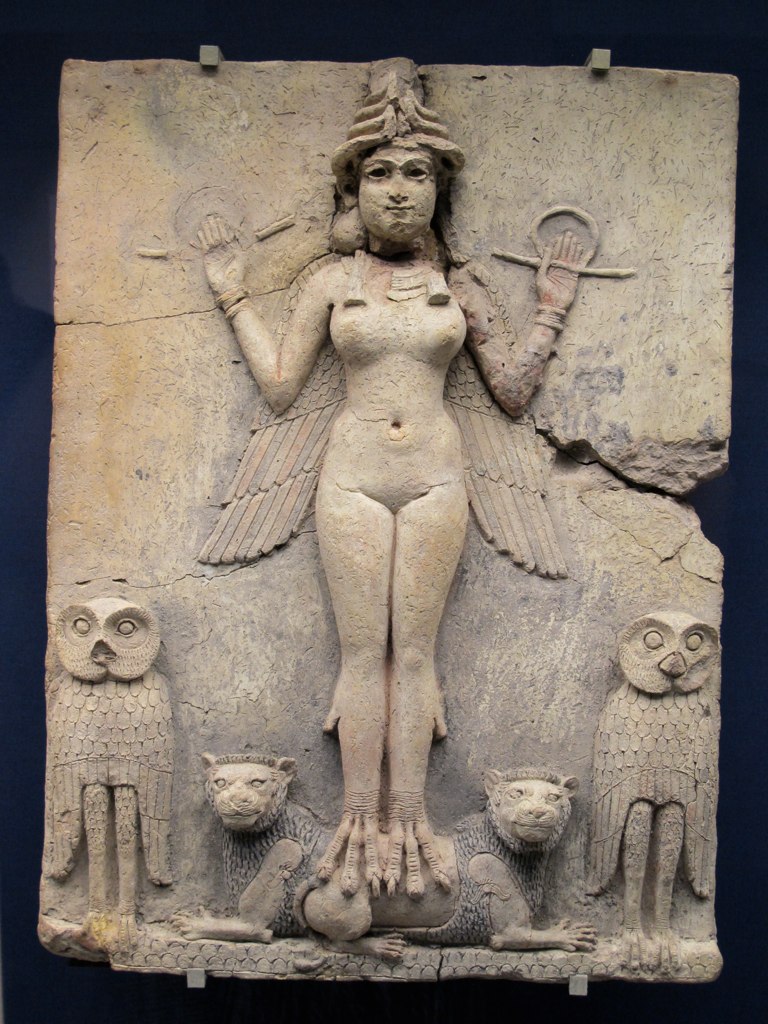
The theory of the saving Messiah, who sacrifices Himself to save sinful mankind, is also difficult to understand. How can a supremely good God let His own ‘Son’ be sacrificed to save mankind from the Evil that the same God has knowingly allowed to flourish in the world? How can a ‘good’ and ‘just’ God let men put His Son to death, precisely in order to save mankind from His own wrath, and from the punishment He intends to inflict on mankind? A ‘good’, ‘just’ and ‘omnipotent’ God could have eradicated Evil by His almighty power, or He could have unilaterally erased mankind’s faults. We can’t evacuate these questions with arguments of authority. A critical consciousness cannot be satisfied with theological decisions. But we can also assume that this question is neither theological nor philosophical. Rather, it is anthropological and psychological. Moreover, it’s important to stress that the paradigm of divine sacrifice for the benefit of Creation is an anthropological constant, spanning millennia and cultures. We also find this idea with Prajāpati in India, Inanna in Sumer, Osiris in Egypt, Dionysus in Greece, Jesus in Israel … a long litany of various Deities sacrificed for the benefit of mankind.
The most important thing is to realize that, in the case of the biblical God, capable of blatant injustice, anger, jealousy and even unfaithfulness to the promises He Himself made, the injunction to love and praise Him as a « good » God is a contradictory injunction. How can we love a « good » God who constantly creates evil, on His own admission? How can a truly critical consciousness understand a God who is essentially, ethically and logically contradictory?
To all these questions, Jung proposes this rather paradoxical answer: God is actually « partly unconscious ». He is unconscious of who He really is (and how He affects His creature). Only an unmistakable lack of « reflection » in « God’s consciousness » can (logically) explain His inexplicable behavior (from the particuliar point of view of human consciousness). The consequence of this unconsciousness is that God can only suffer a « moral defeat » when confronted with the critical consciousness of his creatures, revolted by the injustice of their lot. The paradigmatic example of this revolt is Job. Through this « moral defeat », man finds himself subjectively and unexpectedly elevated to a new level of awareness of God. Simply by being aware of being confronted with an unconsciously immoral God, Job, or for that matter any other critical consciousness, can in fairness take Him to task, and push Him to His limits. God’s such « moral defeat » provokes a profound upheaval in humanity’s (collective) unconscious. Man acquires greater ‘moral value’ in his own eyes. This new ‘moral’ status invades man’s unconscious, filling the ‘void’ left by the ‘unconsciousness’ (or the ‘absence’ ) of God. Unconsciously, man feels morally « grown up » in relation to the conscious, devalued self-image he continues to have. In these circumstances, other latent potentialities of the unconscious are just waiting to burst into consciousness, in the form of dreams, visions, revelations and prophecies. In the first half of the 6th century B.C., the prophet Ezekiel had visions that were symptoms of the fractures between human consciousness and the collective unconscious, in very troubled times. At the same time, Siddhārtha Gautama (b. 562 B.C.), also known as the « Great Spirit », the « Awakened One » or the « Buddha », introduced the world to new possibilities for human consciousness, judged capable of going beyond brahman itself, and reaching parabrahman (the supreme, absolute brahman)… The brahman, which is the origin of All, is also referred to as the ātman (the Self), and as sva (the Sanskrit word that gave rise to the word « self » in English and « soi » in French). Another of his names, in the Vedic tradition, is Prajāpati, the Lord of Creation. InHinduism,brahman is the cosmic consciousness present in all things, the immanent Self in all being, the Absolute, both transcendent and immanent, the ultimate principle that is, without beginning or end. But it’s important to stress that, above brahman, consciousness can find an even more absolute parabrahman. The race of consciousness towards new heights seems endless. Ezekiel didn’t go that far, however. But he did grasp, in his own visions, that in a sense YHVH had come closer to man. Yet neither Ezekiel nor Job seem to have consciously realized the disturbing fact that their own consciousness (and potentially all human consciousnesses) could turn out to be ‘higher’, in a way, more critical, than YHVH’s own.
It is particularly significant that Ezekiel was the first prophet to quote the expression ‘Son of Man’- Ben-Adam, which YHVH uses on numerous occasions to designate Ezekiel. In the Jewish canon, Ezekiel is the only prophet to be named Ben-Adam by YHVH, with the exception of Daniel who is also called in this way – but by the angel Gabriel. Later, Jesus of Nazareth used the expression « Son of Man » several times, but he innovated by using it to designate himself and to make it a messianic title. For the first time, Jesus formally established the identity of the « Son of Man » and the « only-begotten Son » (of God). One of his disciples, Stephen, exclaimed when he was stoned to death, in the presence of Saul (the future Paul), an accomplice of his torturers: « Ah! » he said, « I see the heavens open and the Son of Man standing at the right hand of God ». It is important to note that the image of the « Son of Man », seated or standing « at the right hand of God », which is also found in the Book of Revelation, was not a Christian innovation. It had already been used for several centuries in Jewish apocalyptic texts, most notably in the three books of Enoch. Today, we can interpret this name, Ben-Adam, as a kind of testimony to God’s awareness of his own unconsciousness.
___________________________
iIs 45:7וּבוֹרֵא רָע ; אֲנִי יְהוָה, עֹשֶׂה כָל-אֵלֶּה (vou-vore’ ra‘ ani YHVH ‘osseh koul-’élêh) « And I, YHVH, am the creator of evil, I make it all » (Is 45:7)
iiC.G. Jung. Answer to Job. Buchet/Chastel, 2009. See also C.G. Jung. Mysterium Conjuctionis. Albin Michel, 1982.
Nicholas of Flüe, a Swiss mystic of the XVth century, « the only saint by the grace of God known to Switzerland270 » had prenatal visions—a famous case of fetal consciousness. Marie-Louise von Franz, spiritual heiress of C.G. Jung, has dedicated a book to him, which begins with this precise, heartfelt account: « Henry am Grund, friend and confidant of Nicholas of Flüe, told how Brother Claus [the name by which Nicholas of Flüe was known in Switzerland] had a vision in his mother’s womb, even before he was born. ‘He had seen a star shining in the sky that lit up the whole world; […] so he explained that this meant that anyone could say of him that he shone so brightly in the world. Furthermore, Brother Claus had told him that, before he was born, he had seen in his mother’s womb a large stone that represented the firmness and constancy of his being, in which he had to persist in order not to abandon his enterprise (or his nobility). That he had, on the same occasion and still in his mother’s womb, seen the holy chrism; then, after being born and seeing the light of day, he had recognized his mother and the midwife; he had also seen how he was being carried through the Ranft valley towards Kerns to be baptized, all with such vividness that he had never forgotten it, and had retained an image as clear as when the vision had occurred. In the same circumstances, he had also seen an old man standing beside the font, but he didn’t know him, whereas he recognized the priest who was baptizing him’271. »
From the outset, the contemporary reader is faced with a dilemma. Is this text to be taken seriously, or is it rather a jumble of fallacies and pointless fantasies? How could a fetus have « visions » and then remain conscious of them for the rest of its life? “This account by Brother Claus is disconcerting in the extreme, and presents us with a most difficult problem: either we are dealing with a unique, unheard-of miracle in which a fetus or a new-born baby had perceptions of which it subsequently retained a conscious memory, or we must conclude that the account is fallacious272.” Unheard-of miracle or laughable allegation? Whatever the case, these « visions » are of intrinsic interest, as a testimony to the variety of psychic powers and their relationship with the real world, and with history. In this case, the link between these visions and the reality and history of Switzerland cannot be denied. They visited the mind of the only Swiss ever to be canonized273 by the Catholic Church. Nicholas of Flüe died in 1487 « in the odor of sanctity ». He had won the veneration of his compatriots after saving Switzerland from a fratricidal war. But what’s most interesting about Nicholas of Flüe’s « visions » are the « symbols » and « archetypes » that appear in them: the star, the stone, the oil (chrism) and the old man. Marie-Louise von Franz comments: « First we have the star, which is the image of the Self and of the ‘inner light’ projected into the farthest regions of the universe. Next comes the stone, representing the star descended to earth, now tangible, palpable, so to speak; and finally, we are in the presence of the oil, which is in a way ‘the hidden soul of the stone’, or, in the language of the Church, the substance in which the Holy Spirit manifests Itself. In faith of this, we can see that oil is the symbol of the meaning that orients man towards the numinous presence of divinity, a meaning that stands out against the backdrop of synchronicity phenomena274. » Von Franz’s interpretation is in line with that of C.G. Jung, master of the depth psychology, and promoter of the concept of synchronicity along with physicist Wolfgang Pauli275. I’d like to go a step further, and present an interpretation of the symbols of Nicholas of Flüe’s vision from the perspective of a comparative anthropology of consciousness. The star symbol is one of the oldest in existence. The cuneiform sign that represents the idea of « God » has the shape of an eight-pointed star 𒀭, reading AN or DINGIR in Sumerian. The center of this cuneiform can be seen as the point of intersection, or convergence, of four distinct, centripetal strokes. It could also be seen as the source of centrifugal radiation, flowing in the eight cardinal directions. I interpret it as an image of consciousness, or an ‘image of the Self’. The graphic dualism of the cuneiform star can also be seen as a metaphor for wave/corpuscle dualism. The central point of the star 𒀭 symbolizes the « corpuscle », and the eight rays from it symbolize « waves ». From a psychological point of view, the center of the star 𒀭 symbolizes the « self ». Radiation represents the relationship of the self with the outside world, with the « other ». In the Self, the « I » and the « other » are psychically intertwined, just as are intertwined waves and quantum particles. The star is not just energy. It is also a « stone », supposedly inert, that has fallen to earth, in Von Franz’s interpretation of Brother Claus’s vision. The image of a falling stone is reminiscent of a meteorite striking the earth. Or, on a completely different note, it could symbolize the descent of a soul into a body, its incarnation. The symbol of the stone is also used in the Bible. There’s the foundation stone, aven, « well seated276« , and there’s its opposite, the stone « rejected by the builders », but become against all odds the « ridge stone277« . The dualisms of the cornerstone278 and the stumbling block279, of the « dark and shadowy » stone280 and the « living » stone281 » deploy other metaphors. The stone is a sacred symbol of the self, immutably fused with the Self of the world. And because stone, in the final analysis, always comes from elsewhere, from the far reaches of the cosmos, it is also a symbol of the unknown.
As for the image of « the oil of the hard stone », we find it in the 5th book of the Torah, Deuteronomy. In the « Song of Moses », YHVH makes his people taste « the honey of the rock and the oil of the hard stone282« . From this we can infer that this sweet, unctuous – and sanctified – oil is somehow the « hidden soul » of the stone. But, one might ask, is there really such an oil, such a ‘soul’, at the center of the hard stone? Is it not more reasonable to think that this oil only appears because it is expressed from an oleic substance by means of the millstone? The millstone grinds the olive or vine fruit to express its essence – oil or wine. In the Veda, the sacred book of a completely different culture than the Hebrew, the stone also grinds plants to extract the precious Soma, which is the essence of the Vedic sacrifice, and which is consumed by the priest during the rite rendered to the Vedic God, yet another unique and supreme Creator. How can we fail to see this as a permanent or even immanent paradigm? Under all skies, the millstone crushes and transforms into intoxicating liquid, sticky pour, or fine flour, what was once “one”—the ripe, rubescent grape, the black, naked flesh of the olive, the hard, golden grain of wheat. In Nicholas of Flüe’s dream, the star symbolizes the eternal Self, the stone signifies the incarnate self, and the oil represents the transmuted, transcended self. The stable, compact, resistant self must be liquefied. Through the ordeal of the millstone, its fine grinding, the multiple self becomes a single « oil ». It is thus even more unified than stone, seed or olive ever will be.
The fourth element revealed by Brother Claus’s dreams completes the symbolic quaternion with the « unknown old man », the archetype of the « wise old man », i.e. the Spirit. He corresponds to the « Ancient of Days » and the « Most Holy Old Man », nicknamed « White Head », in the Cabala283. Jung suggests that, in the case of Nicholas of Flüe, this figure represents « the personification of the ‘grain of salt’ that the newborn child receives in baptism, namely the Sapientia Dei, the Wisdom of God, within which God Himself is present284. » This “Most Holy Old Man”, or « Divine Wisdom », played a role throughout Brother Claus’s life, in the form of frequent apparitions.
The star, the stone, the oil and the « unknown old man » first appeared in Brother Claus’s brain as soon as his consciousness awakened. With Jung and Von Franz, we can consider that these symbols prefigured Brother Claus’ exceptional destiny. It’s also conceivable that, in the eyes of a rationalist or a positivist, the story of Nicholas of Flüe, with its prenatal visions and mystical intuitions, would seem perfectly inadmissible. Yet Nicholas of Flüe was indeed a « prophet in his own country », both religiously and politically. His wise counsel saved Switzerland in 1481, when a fratricidal war was brewing. Can we assume that his visions contributed to peace? Every vision is in some way « true » when it bears witness to a profound, immanent order. We can’t rule out the idea that Nicholas of Flüe’s visions contained a subtle, invisible but effective part of this hidden order.
The star-stone-oil triad represents an immanent process of transformation and transmutation of consciousness. It symbolizes the metamorphosis of light (consciousness), in three stages : its (cosmic) origin, its materialization (its ‘incarnation’) and its overcoming (its ‘sublimation’). The grinding of consciousness (or its ‘sacrifice’) opens the way to transcendence, just as holy oil, consecrated chrism (from Greek χρῖσμα / khrĩsma, ointment, perfume) becomes what the Hebrews anointed their « anointed ones » (their prophets and kings) with. Symbolizing the inner light of the Self, the star is the symbol of a light with a universal vocation, a light which from the beginning illuminates the entire cosmos, and which until the end will illuminate the consciousness of beings endowed with a singular soul. The stone, a piece of fallen star, symbolizes the Self incarnated in the ego, in living flesh. The oil represents the very consciousness of the Self. One, but fluid, it became chrism for the anointing of priests, prophets and kings, and is the symbol of grace.
The Psalmist sang of YHVH’s eternal, irrevocable covenant with David, his servant, his saint, his anointed. But why is he so bitter? He blames YHVH for his sudden breach of that covenant, his unilateral fickleness, his unpredictable anger. « And yet you have forsaken him, rejected him, your chosen one; you have raged against him. You have broken the covenant of your servant, you have degraded him, and thrown down his diadem259. » Wouldn’t the Psalmist be mistaken in his judgment? How could a God so One, so high, so powerful, be unfaithful to his own word? How could an eternal God be understood, let alone judged, by a fleeting creature, however inspired? Besides, if the Psalmist’s bitterness were to be justified, God forbid, wouldn’t it be better not to insist on this broken covenant, this broken promise? No power, whatever it may be, likes to be called into question, and even less to be challenged on its own ground, in this case that of the word and the promise. YHVH, it’s a fact, doesn’t like man’s critical thinking, this nothingness, to be exercised towards Him. Criticism tends to diminish the quality of the homage and praise He expects from His creatures. His power pervades the universe. His essence is eternal, of course. His existence is real, to be sure. However, this ‘power’ and this ‘existence’ only have real meaning if other, non-divine consciousnesses are aware of them, and praise Him for them. Without them, divine ‘power’ would remain self-centered, solipsistic, centripetal, in a way ‘selfish’, or at least ‘egotistical’. And, by the same token, would it not reveal a ‘lack’ within the divine? To make up for this ‘lack’, there is a kind of intrinsic necessity for other consciousnesses to come and fill it, and for some of them to be able to freely recognize the ‘power’ at work, as a condition of existence, of life, of all forms of consciousness. This is why we can infer that the Creator, in His omnipotence, which is supposed to be absolute, felt the desire to create consciousnesses other than His own; He needed singular consciousnesses to « be », other than in Himself. This was the reason for the original, implicit, natural, structural alliance of God with His Creation, the dialectical alliance of uncreated Consciousness with created consciousness.
In the beginning, it was important for His wisdom to be aware of the existence and essence of all the kinds of consciousness that could be created, in the entire Cosmos, until the end of times that may have no end. Now, it’s important for Him, at every moment, to be aware of the meaning that consciousnesses give to themselves. It also matters to Him what meaning they give (or don’t give) to His existence. He obviously wouldn’t have sent prophets down here if He didn’t care. What matters to Him above all is the general movement of consciousness in the world. By means of a thought experiment, a dream of created consciousness, we could imagine that the Creator creates new consciousnesses, which are, in essence, always ‘in the making’, and which must, while alive, be fulfilled. Placed in the world, they bring to life, grow (or shrink) their potential for consciousness, their wills, their desires, their hopes. We could also imagine that the life of these created consciousnesses, the fulfillment of these ephemeral wills, is not unrelated to the fulfillment of uncreated Consciousness, the realization of the eternal will, the Life of the Self. Finally, we could hypothesize that the Creator has, in consciousness, desired the existence of created consciousnesses, and that His desire grows as consciousness grows in the created world. In His unconscious awareness, or in His conscious unconsciousness, the Creator seems almost oblivious to who He really is, why He creates, and how His creative power can be apprehended, understood and praised by His creatures, in principle reasonable, but surprised to be there. On the one hand, if the Scriptures are to be believed, God YHVH seems to have needed to ally Himself exclusively with a people, binding them to Himself with irrevocable promises and eternal oaths. But on the other hand, again according to the Scriptures, God YHVH did not hesitate to break these promises and oaths, for reasons that are not always clear or expressly alleged. He unilaterally broke the covenant with his chosen one, his anointed, even though it had been proclaimed eternal. Terrible consequences are to be expected from this rupture and abandonment: walls demolished, fortresses ruined, populations devastated and plundered, enemies filled with joy, the end of royal splendor, the throne thrown down, and general shame. Woe and suffering now seem destined to last with no foreseeable end, while man’s life is so brief260. What has become of the promise once made, which in principle was to bind the God YHVH for ever261? The conclusion is abrupt, brief, but without acrimony. Finally, twice, the word amen is addressed to this incomprehensible and, it seems, forgetful God: « Praise the Lord forever! Amen and amen262! » The forsaken anointed one, a little disenchanted, doesn’t seem to hold it against the Lord for not having kept his promise. He doesn’t seem eager to insist on this unilateral abandonment, this abolished covenant. He doesn’t want to admit to himself that this gives him a kind of de facto moral advantage over a God who shows himself unaware of his « forgetfulness », whereas he, the chosen one, the anointed one, has forgotten nothing of the promise. Is it out of prudence? In all His glory and power, the God YHVH doesn’t really seem to appreciate criticism when it comes against Him, and even less when it comes from men who are notoriously so fallible, so sinful. Although his power extends across the universe, and no doubt far beyond, God YHVH needs to be ‘known’ and ‘recognized’ by reflective (and laudatory) consciousnesses. He shows his desire to do more than just « being ». He also wants to « exist » for consciousnesses other than His own. Without human, living, attentive consciousnesses that recognize His « existence », God’s « Being » would have no witness other than Himself. In the absence of these free consciousnesses, capable of recognizing His existence and praising His glory, this very existence and this very glory would in fact be literally « absent » from the created world.
The existence of the divine principle could certainly be conceived in absolute unity and solitude. After all, this is how we conceive of the primordial, original God, before Creation came into being. But does the idea of divine ‘glory’ even make sense, if there is no other consciousness to witness it? In essence, any real glory requires conscious glorification by a glorifying multitude, dazzled, conquered, sincere. Could God be infinitely ‘glorious’ in absolute solitude, in the total absence of any ‘presence’, in a desert empty of all ‘other’ consciousnesses capable of perceiving and admiring His glory? He could, no doubt—but not without that glory suffering a certain ‘lack’. Divine existence can only be fully ‘real’ if it is consciously perceived, and even praised, by consciousnesses that are themselves ‘real’. A divine existence infinitely ‘alone’, with no consciousness ‘other’ than itself, would be comparable to a kind of somnolence, a dream of essence, the dream of an essence ‘unconscious’ of itself. The Creator needs other consciousnesses if he is not to be absolutely alone in enjoying his own glory, if he is not to be absolutely alone in confronting his infinite unconsciousness, without foundation or limit.
Man possesses his own consciousness, woven of fragility, transience, evanescence and nothingness. His consciousness can reflect on itself and on this nothingness. Each consciousness is unique and unrepeatable. Once it has appeared on earth, even the most omnipotent God can’t undo the fact that this consciousness has been, that its coming has taken place. God, in his omnipotence, cannot erase the fact that this singularity, this unique being has in fact existed, even if he can eradicate its memory forever. Nor can God, despite his omnipotence, be both « conscious » as « God the Creator », and conscious as is “conscious” a « created creature ». He must adopt one of these points of view. He has to choose between His consciousness (as being ‘divine’) and the specific consciousness of the creature. Nor can He simultaneously have full and total awareness of these two kinds of consciousness, since they are mutually exclusive, by definition. The potter’s point of view cannot be the pot’s point of view, and vice versa.
But can’t God decide to « incarnate » Himself in a human consciousness, and present Himself to the world as a word, a vision or a dream, as the Scriptures testify? But if He « incarnates » in a man (or a woman), doesn’t He lose to some extent the fullness of His divine consciousness, doesn’t He dissolve His Self somewhat, doesn’t He become partly unconscious of His own divinity, by assuming to incarnate in a human consciousness? In essence, all consciousness is one; it unifies and is unified. All consciousness is a factor of oneness, in itself, for itself. God Himself cannot be simultaneously ‘conscious’ as a conscious man is, and ‘conscious’ as a conscious God is, a One God. A One God cannot at the same time be a double or split God.
We can take another step along this path of reflection. In the depths of the divine unconscious lies this sensational truth: knowledge of the unique, singular consciousness of every human being is not of the same essence as knowledge of the unique, singular consciousness of God. These two kinds of knowledge are mutually exclusive, and if the former escapes entirely from the latter, the latter also escapes, in part, from the former. Every consciousness remains a mystery to all other consciousnesses. The two kinds of consciousness, created consciousness and divine consciousness, cannot merge into a pure identity, but they can enter into dialogue.
Could it be, however, that the unique, singular, created consciousness of each creature is in some way part of God’s unconscious? This question is not unrelated to the hypothesis of a possible divine Incarnation. Before the beginning, the very idea of a Man-God (or of God incarnating Himself in His creation) did not exist. There was only one alternative: God, or ‘nothing’. After Creation took place, the situation changed. There is now God—and ‘something’ else. We must recognize the hiatus, and even the fundamental chiasmus of consciousness caught between these two essences, these two realities, the divine and the created. If Man is conscious in his own (unique, singular) way, how can the God (unique and singular) recognize this uniqueness, this singularity of human consciousness, if He can recognize no ‘other’ consciousness, no ‘other’ uniqueness, no ‘other’ singularity, than His own? If God, being ‘one’, cannot recognize an ‘other’ than Himself, He cannot recognize in Himself the absolute ‘other’. He is therefore not absolutely conscious of Himself, of His own consciousness, of His own uniqueness and singularity, if He is not also conscious of the presence of this ‘other’ within Himself. And, being unconscious of what is absolutely ‘other’ in Him, how could the God glorify in Man’s consciousness, from the point of view of His absolute uniqueness, which, as such, is unconscious of all otherness?
A similar question was formulated by Jung: « Could Yahweh have suspected that Man possesses a light that is infinitely small, but more concentrated than that which he, Yahweh, possesses? Perhaps jealousy of this kind could explain his behavior263. » Is Yahweh really a jealous God, in the literal sense? Is God ‘jealous’ of Man? The expression « jealous God »—El qanna’—is used several times in the Hebrew Bible. It’s the name by which YHVH calls Himself (twice) when He appears to Moses on Mount Sinai: « For YHVH, His name is ‘Jealous’, He is a jealous God264! » This name has consequences for man, in a way that can be considered humanly amoral: « For I, the Lord, your God, am a jealous God, who pursues the crime of fathers on children to the third and fourth generation, for those who offend me265. » And, no, this jealous God doesn’t forgive, he wants revenge. « The Lord is a jealous and avenging God; yes, the Lord takes vengeance, he is capable of wrath: the Lord takes vengeance on his adversaries and holds a grudge266. »
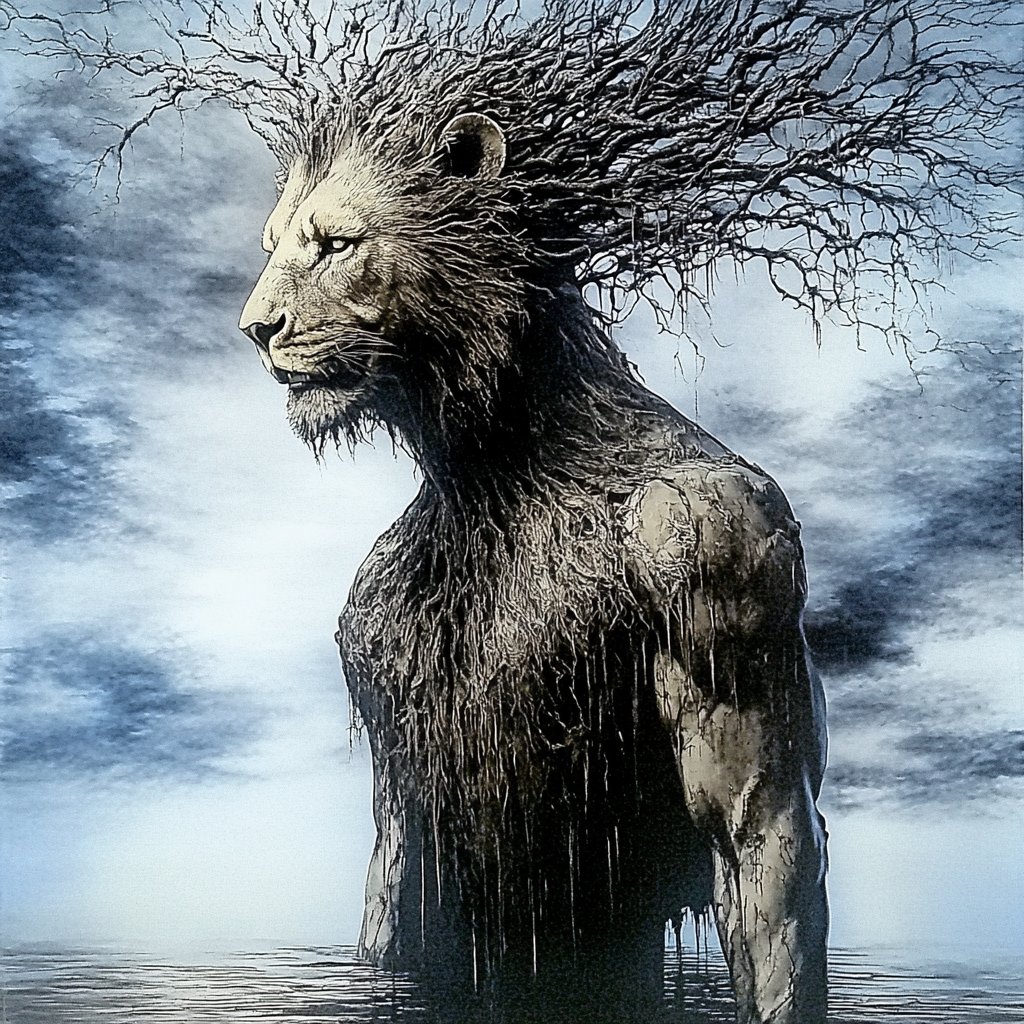
Jung also claims that Job was the first to understand the contradiction of God being omniscient, omnipotent and « jealous » all at the same time. « Job was elevated to a higher degree of knowledge of God, a knowledge that God Himself did not possess […] Job discovered God’s intimate antinomy, and in the light of this discovery, his knowledge attained a numinous and divine character. The very possibility of this development rests, we must assume, on man’s ‘likeness to God’267. » If God does not possess the knowledge that Job does, we can say that He is partly unconscious. Now, the unconscious, whether human or divine, has an ‘animal’ nature, a nature that wants to live and not die. Indeed, the divine vision reported by Ezekiel was composed of three-quarters animality (lion, bull, eagle) and only one-quarter humanity: « As for the shape of their faces, all four had the face of a man and on the right the face of a lion, all four had the face of a bull on the left and all four had the face of an eagle268. » From such « animality », so present and so prominent in Ezekiel’s vision of God, what can a man reasonably expect? Can (humanly) moral behavior be (reasonably) expected of a lion, an eagle or a bull? Jung’s conclusion may seem provocative, but it has the merit of being coherent and faithful to the texts: « YHVH is a phenomenon, not a human being269. »
Job confronted the eminently non-human, phenomenal nature of God in his own flesh, and was the first to be astonished by the violence of what he discovered, and what was revealed. Since then, man’s unconscious has been deeply nourished by this ancient discovery, right up to the present day. For millennia, man has unconsciously known that his own reason is fundamentally blind, powerless, in the face of a God who is a pure phenomenon, an animal phenomenon (in its original, etymological sense), and certainly a non-human phenomenon. Man must now live with this raw, irrational, unassimilable knowledge. Job was perhaps the first to elevate to the status of conscious knowledge a knowledge long lodged in the depths of the human unconscious, the knowledge of the essentially antinomic, dual nature of the Creator. He is at once loving and jealous, violent and gentle, creator and destroyer, aware of all his power, and yet, not ignorant, but at least unaware of the unique knowledge that every creature also carries within. What is this knowledge? In Man, this knowledge is that his consciousness, which is his unique and singular wealth, transcends his animality, and thus carries him, at least potentially, into the vertical vertigo of non-animality. This establishes the likelihood of ancient links between monotheistic spirituality and the various shamanic forms of spirituality, so imbued with the necessity of relations between humans and non-humans.
The Pythia or the Sibyl, the Bacchae or the Maenads give themselves over entirely to trance. When they are « possessed », they enter into communication with a divine entity. The God will come to « dwell » within them. Plato compares « this divine power that sets things in motion » to the « stone that was called ‘magnetic’ by Euripides », and sees its effect on artistic creation. « It is thus that the Muse, by herself, makes Divinity in certain men, and that, through the intermediary of these beings in whom a God resides, a line of other people is suspended from her, whom the Divinity then inhabits. » He affirms that « all epic poets, the good ones that is, » and lyrical authors compose their poems and songs, « not by an effect of art, but because a God is in them and possesses themi. » It is precisely because they no longer have all their wits about them that they are able to createii. « The poet is indeed a light thing, a winged thing, a holy thing, and he is not yet able to create until he has become the man inhabited by a God, until he has lost his head, until his own spirit is no longer in himiii! » Indeed, it is the Divinity itself that speaks through the poet. « The Divinity, having taken away their spirit, employs these men at his service to vaticinate and to be diviners inspired by God; so that we who listen to them may understand that it is not they who say these things whose value is so great, they from whom the spirit is absent, but that it is the Divinity himself who speaks, who through them makes us hear his voiceiv ! ». Several words were used to designate the various kinds of « possession » experienced in ancient Greece, such as entheatho, enthousiastikos, enthousiasmos, entheastikos.The most direct term is entheos, meaning literally « the one in whom God is ». The prefix en– emphasizes that the Divinity inhabits the interiority of the human spirit. It’s tempting to draw a parallel with the modes of possession by the Spirit of God described in the Hebrew Bible. For example, the Spirit of Elohim, rûaḥ elohim, comes not « into » but « upon » Saul, ‘alChaoul, to inflame him, burn him with anger and drive him to victory over the Ammonitesv. Isaiah, speaking of the Messiah to come, the scion of the stock of Jesse, uses the expression rûaḥyhwh, the Spirit of YHVHviwho will « rest » not in him, but « upon himvii« . The Spirit of YHVH is a « spirit of wisdom and understanding, spirit of counsel and strength, spirit of knowledge and fear of Godviii« , and it seems to be of a more peaceful nature, wiser even, than the Spirit of Elohim. Just after the disappearance of Elijah (whom God raised to heavenix), it is neither the Spirit of Elohim nor that of YHVH, but the spirit of Elijah that comes to rest on Elisha,according to the testimony of the young prophets observing the scenex. Unlike the Spirit of YHVH, who is all « wisdom and intelligence », Dionysus, the God entheos, the God within, is not a « wise » God, he is a μαινόμενος Διόνυσος, a mainomenos Dionysus, a « crazy God », a Dionysus agitated with bachic transports, a Bacchos(Βάκχος). There are many forms of divine possession. It’s difficult to be exhaustive. Socrates, for example, declared that he himself could suddenly become « possessed by nymphs », νυμφόληπτος, nympholeptos. « This place has something divine about it, » he said to Phaedrus, « and if the nymphs who inhabit it were to cause me in the course of my discourse some frenzied transport, you should not be surprised. Already I’ve risen to the tone of a dithyrambxi. » The chresmologist Bakis, who influenced general Epaminondas regarding the outcome of the Messenian-Lacedemonian war, was also described by Pausanias as « mad by nymphsxii« , μανέντι ἐκ Νυμφῶν. The existence of adjectives such as nympholeptos, « taken by the nymphs », theoleptos, « taken by a god », or even phoiboleptos, « taken by Apollo », seem to indicate specific experiences of divine possession. These possessions are structurally different from ecstasyxiii. The latter, by its etymology, implies a change of place, and possibly a wandering. During ecstasy, soul and body separate. The soul can then travel freely around the world, or wander through time, alone or in the company of the God… Herodotus tells us that Aristaeus suddenly disappeared in the city of Proconnesus. He was thought dead, but was seen shortly afterwards in Cyzicus. He disappeared again, but three hundred and forty years later, he reappeared in Metapontum, accompanying Apollo in the form of a ravenxiv. Pliny quotes this anecdote briefly, without giving it much weight: « It is even said that the soul of Aristaeus was seen in Proconnesus, flying out of his mouth, in the form of a crow; a singularly fabulous talexv. » But he also relates that the soul of Hermotime of Clazomenes left his body to wander in distant lands, and that on its return it indicated things that could only have been known by someone present at the scenexvi. The idea of the soul’s wandering in the world leads to a comparison with the race of Apollo, named Liber Pater (« the free Father ») by the Romans, because he is « free and wandering (vagus)xvii« .Aristotle alsoasserted, in the Theologumens, that Apollo and Liber Pater are one and the same Godxviii. Macrobius says that « Orpheus calls the sun Phanes ‘ἀπὸ τοῦ φῶτος καὶ φανεροῦ’, i.e. light and illumination; because indeed, seeing all, he is seen everywhere. Orpheus still calls him Dionysosxix. » In his verses, Orpheus identifies Apollo with Dios and Dionysus with Apollo: « Dios, having liquefied the Aether, which was previously solid, made visible to the gods the most beautiful phenomenon that can be seen. He was called Phanes Dionysus, Lord, Wise Counselor (Εὐβουλῆα), dazzling procreator of self; finally, men give him various names. He was the first who showed himself with light; and advanced under the name of Dionysus, to traverse the boundless contour of Olympus. But he changes his names and forms according to the times and seasonsxx. » God has many names, but he is one. The oracle of the Apollo of Claros says of him: « Εἷς Ζεὺς, εἷς Ἅιδης, εἷς Ἥλιος, εἷς Διόνυσος. One Zeus, one Hades, one Sun, one Dionysus. » According to the same oracle, the « one » God is also called Ἰαὼ, « Iaô », a name strangely analogous to that of the Hebrew God, Yahwé or Yah. Consulted to find out who this God was « Iaô », the oracle replied, « After being initiated into the mysteries, you must keep them hidden and tell no one about them; for (man’s) intelligence is narrow, prone to error, and his mind is weak. I declare that the greatest of all gods is Iao, who is Aïdès (Hades), in winter; at the beginning of spring, Dia (Jupiter); in summer, Hélios (the sun); and in autumn, the glorious Iaô« . Dios, Dia, Zeus, Dionysos, Iaô are the same, unique God. This God, through his breath, his pneuma, animates the living, and gives humans a share in his creative power. The pneuma represents the essence of divinity. Only when this sacred breath (hieron pneuma) takes possession of him, can the poet create with « enthusiasm », as Plato explains in the Ion. The pneuma is both creator and procreator. By the breath of Zeus, ek epipnoias Zènos, Io conceives Epaphos. And it is again a « breath in god », an atmon entheon, that makes Pythia « fat » with divine logos. The pneuma is as fertile as the logos spermatikos, spermatic reason, or seminal speech, which sustains the existence of the world. « The words God, intelligence, destiny, Jupiter and many others like them refer to one and the same being. God exists absolutely by himself. In the beginning, he changed into water all the substance that filled the air, and just as in generation the germs of beings are enveloped, so too God, who is the seminal reason of the world (σπερματικὸν λόγον ὄντα τοῦ κόσμου)xxi. » But possession by the divine breath does not produce the same effects, depending on whether it comes from Zeus, or Apollo or Dionysus, although these various names are those of the same God, ‘one’. For example, Dionysus drives mad those who don’t believe in him. He made his mother Semele’s sisters delirious, because they didn’t recognize that Dionysus was born of Zeusxxii. Pentheus, son of Cadmus’ daughter, also denied Dionysus’ divinity. « He fights against my divinity, excludes me from the libations, and does not mention my name in prayer. So I intend to prove my divine birth »says Dionysus. He will be driven mad. If Dionysian delirium can drive people mad, it can also inspire prophetic power. « Know that Bacchos is a soothsayer. The fury he inspires has prophetic power like dementia. When he penetrates us with all his power, he urges us, by panicking us, to tell the future. » Prophetic power inhabits the conscience, which identifies with it. Pythia spoke as if she were God himself. But what had become of her will, her own intelligence? Had they dissolved into the divine? Or was the abolition of Pythia’s personal consciousness a necessary condition for the truth of revelation?
ii« Just as those who fall prey to the delirium of the Corybantes do not indulge in their dances when they have their spirits, so too the authors of lyrical songs do not have their spirits when they compose these magnificent songs; on the contrary, as often as they have embarked on harmony and rhythm, then seizes them the bachic transport, and, possessed, they resemble the Bacchae who draw honey and milk from the rivers when they are in a state of possession, but not when they have their spirits. » Plato, Ion, 533 e -534 a
xiiiThe Greek word ἒκστασις, ekstasis, means « wandering of the mind », with, by its etymology, the idea of a change of place (ek-stasis), a departure from one’s natural place. The adjective ἐκστατικός, ekstatikoshas two meanings, transitive and intransitive: « 1. Transitive. Which makes one change places, which disturbs; which makes one leave oneself, which leads the mind astray. 2. Intrans. One who is out of one’s way, one whose mind has wandered. »
xivHerodotus IV, 14-15: « Aristaeus was from one of the best families in his country; it is said that he died in Proconnesus, in the store of a fuller, where he had entered by chance; that the fuller, having closed his store, went at once to warn the relatives of the dead man; that this rumor having soon spread through the whole city, a Cyzicene, who came from Artace, disputed this news, and assured that he had met Aristaeus going to Cyzicus, and that he had spoken to him ; that, while he was holding him up, the dead man’s relatives went to the fuller’s store, with all they needed to carry him to his burial place; but that, when they opened the house, they found neither Aristaeus dead nor alive; that, seven years later, he appeared again in Proconnese, wrote the epic poem that the Greeks now call Arimaspies, and that he disappeared for the second time. This is what the cities of Proconnese and Cyzic say about Aristaeus. (…) The Metapontines report that Aristaeus appeared to them and commanded them to erect an altar to Apollo, and to erect a statue near this altar, to be given the name of Aristaeus of Proconnesus; that he told them they were the only people of the Italiotes whom Apollo had visited; that he himself, who was now Aristaeus, accompanied the god in the form of a raven; and that after this speech he disappeared. The Metapontines add that, having sent to Delphi to ask the god what this specter might be, the Pythia ordered them to do as he told them, and that they would be better off for it; and that, on this reply, they complied with the orders given to them. Even now, in the public square of Metapontum, next to the statue of Apollo, you can see another statue bearing the name of Aristaeus, and the laurel trees that surround them
xviPliny. Natural History. VII, 52, 1: « Such is the condition of mortals: we are born for these whims of fate, and in man we must not even believe in death. We find in the books that the soul of Hermotime the Clazomenian, leaving his body, went wandering in distant lands, and that it indicated things that could only have been known by someone present on the spot; meanwhile: the body was half dead: but his enemies, who called themselves Cantharides, seizing this moment to burn his body, removed, as it were, the case to the soul that was returning. »
A « Deep Dive » Podcast in English about my Blog’s articles: « Inanna and Dumuzi . Their Sacred Marriage and How It Ended » and, in French, « Inanna et Dumuzi: la Fin de leur Sacré Mariage ».
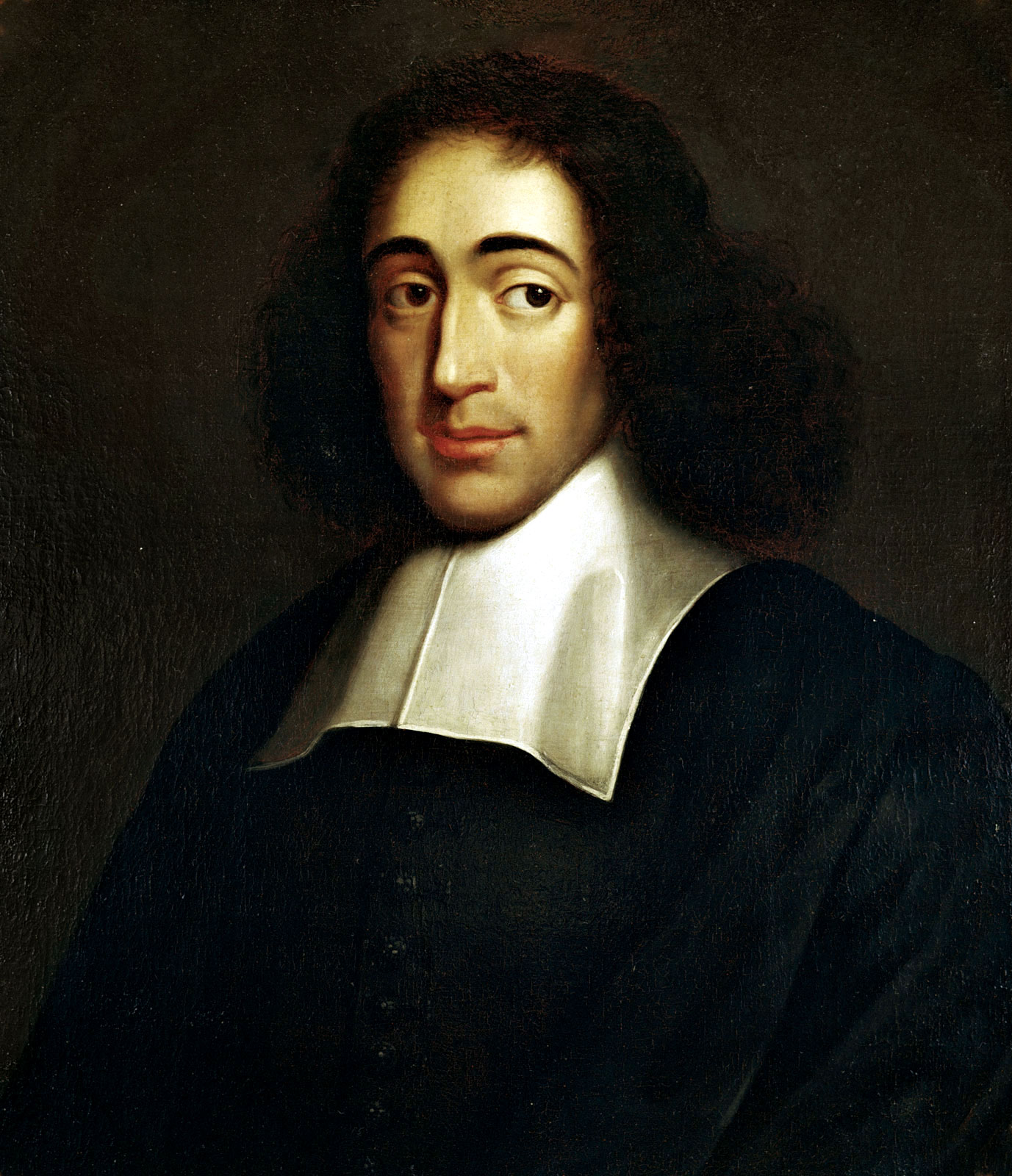
Spinoza defines several kinds of knowledge by which we form general ideasi . First, there is the knowledge we obtain through the senses, which he calls « knowledge by vague experience », and « truncated and confused ». Then he describes three other kinds of knowledge that enable us to form « ideas »: Imagination, Reason and Intuition, which he calls « knowledge of the first kind », « knowledge of the second kind » and « knowledge of the third kind » respectively.
Knowledge of the first kind is « opinion or Imagination », which derives from the signs or words by which we remember things, and by means of which « we form ideas similar to those by which we imagine them »ii . Knowledge of the second kind is « Reason« , which is derived from the fact that we have « common notions and adequate ideas of the properties of things ». Knowledge of the third kind is « Intuitive Science » which, I quote, « proceeds from the adequate idea of the formal essence of certain attributes of God to the adequate idea of the essence of things ». This convoluted formula is really not easy to understand. That’s why Spinoza says he’s going to explain it with an example – the « Rule of Three ».
As we all know, this Rule allows us, given three numbers, to obtain a fourth, which is to the third as the second is to the first.
There are two ways of applying it, one academic, the other immediate. « Merchants will not hesitate to multiply the second by the third and divide the product by the first »iii says Spinoza, but for the simplest numbers no demonstration is necessary. « Given the numbers 1, 2 and 3, there is no one who does not see that the fourth (proportional) number is 6, » he explains. We see at a glance the relationship between the first and the second (the number 2 is double 1), and we conclude that the fourth is obviously 6 (double 3).
Spinoza thinks that we can apply the Rule of Three to the relationship between the ideas we form about God and the ideas we form about the world… According to him, there is a kind of proportion between: 1° the ‘formal’ essence of God’s attributes, 2° the ‘adequate’ idea we form of them, 3° the true essence of things and 4° the idea we form of their essence.
In other words, the idea we have of the essence of God’s attributes can be compared to the idea we have of the essence of things. This statement may seem self-evident: the idea of one essence is analogous to the idea of another essence – they are both ideas about essence. Any idea conceived by Man about any essence is, on a formal level, analogous to any other idea conceived about any other essence.
However, isn’t it difficult to put ideas about this world and ideas about God in correspondence, without any particular precaution?
Spinoza asserts that, in knowledge of the third kind, a relationship of proportion is possible between human thoughts about the essence of things and human thoughts about the essence of God. He thus explicitly rejects the hypothesis that no proportion is possible between God, Man and the World.
Let us now try to test this relationship of proportion, assumed by Spinoza, on three classic examples of the formulation of divine attributes: « God is », « God is alive », « God is one ».
1 « God is ».
God « is ». By this simple assertion, he is – without attribute or epithet. He is only this « He is« . « Being in God is not something added, but a subsistent truth », says S. Hilaire.iv Thomas Aquinas similarly affirms that God’s being is not ‘added on’ to him. God’s being is not added to him, but « subsists » in him. His being is « without addition ».v Boethius, seven centuries before Thomas Aquinas, had already said: « That which is may well, by a new addition, be something else again: but being, there is no addition to it ».vi Thomas Aquinas gave as an example the difference between the beast and the animal. The ‘beast’ is the animal that is just that – an animal. The ‘animal’, on the other hand, is an animal that can also be reasonable, or unreasonable, or anything else. The divine being ‘is’, as the beast is a beast, quite simply. It is only ‘being’, – a being without addition. On the other hand, the being in general, and the human being in particular, « is » like the animal is an animal with specific possibilities of addition (« feathered animal », « reasonable animal », « political animal », etc.). Hence this possible analogy, if we follow Thomas Aquinas: The being of God is to the being of Man, as the being of the beast is to the being of the animal…
The very being of God only « is ». This does not prevent an infinite number of things from following from the divine being, through an infinite number of modes, says Spinoza: « An infinite number of things must follow in an infinite number of modes from the necessity of the divine nature, that is, everything that can fall under an infinite understanding ».vii But the very being of God can only be this very being. If we believe, as Spinoza does, that this is the opportunity to discover knowledge of the third kind, then, by the Rule of Three, the very being ofman can only be that very being. Or can it be other than this very being?
2. « God is alive ».
Four centuries before Spinoza, Thomas Aquinas devoted the beginning of the Summa Theologica to questions such as: Is the existence of God self-evident? Does God exist? Is there in God a composition of essence and existence? Is God perfect? Do creatures resemble God? Is there in God a composition of essence and subject?
To answer this last question, Thomas Aquinas posits a sort of relationship of proportion between God and deity, on the one hand, and life and the living, on the other. « It is said of God that he is life, and not only that he is alive, as we see in S. John (14,6): ‘I am the way, the truth and the life’. Now deity is in the same relationship with God as life is with the living. So God is deity itself ».viii The distinction between life and the living is a good example of knowledge of the third kind, which allows a formal analogy between the living God and what is life, or living, in man.
3. « God is one ».
What is the essence of divine unity? Is it a numerical unit? The number 1 would then enclose God, and contain him in its arithmetical essence, which seems impossible to admit.
Is it an ontological unity, a unity of being? God’s being would then be limited to being only this being, which is a (grammatical) mode of being, whereas God is supposed to be being itself, beyond all modes of being.
Is it a unity of essence? No. But every essence, whatever it may be, is already ‘one’, in a way by essence. To assert the unity of God’s essence is therefore a pleonasm, because every essence is essentially one.
Is it a ‘transcendental’ unity? Then it would be, to a certain extent, intelligible as an a priori form of reason.
Is it a ‘transcendent’ unity? Possibly, but then as a transcendent unity it is completely unknowable to reason.
As we can see, the possible formulations of the question of divine unity represent various ideas, more or less ‘adequate’, of what its essence might actually be. Let’s imagine that we choose, from among them, one idea (or another) of the formal essence of divine unity. By applying the Rule of Proportion, on the basis of this idea of divine unity, a similar idea of the essence of the unity of things in the world could emerge.
But let us immediately add that the analogy of proportion could also work in the other direction: if we form an adequate idea of the essence of a thing in the world, we should therefore be able to deduce an analogous idea as to the nature of the divine essence.
For example, we can conceive of something in the world as being ‘one’, insofar as it presents itself as a unique, singular entity.
By analogy, then, we can form the idea that God’s essence is also ‘unique’, ‘singular’.
However, there are many singular things in the world, and even an innumerable number. Would there then, by analogy, be many singular things in the world? Many « Gods », and even an uncountable multiplicity? Perhaps, but not necessarily. Applying the Rule of Proportion, we might only wish to deduce that there are indeed many singular attributes in God, and even an infinite number. This is what Spinoza does, and from this he draws this stimulating proposition: « The more we know singular things, the more we know God ».ix
These examples show that it is possible to progress in our knowledge of God, even though he is infinite and has an infinity of attributes. This is how we can best define him: « By God I mean an absolutely infinite being, that is, a substance made up of an infinite number of attributes, each of which expresses an eternal and infinite essence ».x
Spinoza’s God is even infinitely infinite, because each of his ‘attributes’ can have an infinite number of ‘modes’, i.e. affections. « By modes I mean the affections of a substance. »xi Each mode is an affection of an attribute of the substance, and an attribute can have an infinite number of possible affections, and therefore as many ‘modes’. The substance of God, in so far as it ‘affects’ a certain thing, is translated into a particular mode. All things in the world are particular ‘modes’ in God, ‘affections of his substance’. We can also say that these modes are ‘conceived’, or ‘represented’, by means of particular things.xii Thoughts too are ‘modes’ in God, ‘affections of his substance’. They are affections of the divine attribute that is thought.xiii
The fact that there are ideas, the fact that there is ‘thinking’, is a ‘mode’ that expresses in a certain way the nature of God, insofar as he is a ‘thinking thing’.xiv The fact of thinking a ‘singular’ thought (this thought, or that thought) is also a ‘mode’, which expresses the nature of God in a certain and determined way.xv Finally, the bodies themselves are also ‘modes’ expressing God. xvi
All of the above can be called « third-kind » knowledge. What purpose does this knowledge serve, you may ask? This is a very interesting question, and one that goes to the heart of consciousness and unconsciousness. One possible answer can be found on the last page of the Ethics. Spinoza harshly criticises the « ignorant ». He says that the « ignorant » has, in a way, ceased to be: « The ignorant is almost unconscious. As soon as he ceases to suffer, he also ceases to be ».xvii On the other hand, Spinoza values his antonym, the Wise Man. « The Wise Man, on the contrary, considered in this capacity, hardly knows inner turmoil, but having, by a certain necessity, eternal awareness of himself, of God and of things, never ceases to be and possesses true contentment. If the path that leads to it appears to be extremely arduous, it is still possible to enter it. And it must certainly be arduous which is so rarely found. How could it be possible, if salvation were within reach and could be reached without great difficulty, that it should be neglected by almost everyone? But everything beautiful is as difficult as it is rare.xviii
Everything beautiful is difficult and rare…
But not everything that is difficult and rare is necessarily beautiful. Neither difficulty nor rarity are sufficient conditions for beauty.
Beauty comes like grace. But where does it come from?
To answer this question, we might need to know some kind of knowledge of a fourth kind…
__________________
iSpinoza. Ethics. Part II. On the Nature and Origin of the Soul. Scolie 2 de la Proposition XL Trad. Ch. Appuhn. Garnier-Flammarion, 1965, p.115
iiSpinoza. Ethics. Part II. On the Nature and Origin of the Soul. Scolie 2 de la Proposition XL Trad. Ch. Appuhn. Garnier-Flammarion, 1965, p.115
iiiSpinoza. Ethics. Part II. On the Nature and Origin of the Soul. Scolie 2 de la Proposition XL Trad. Ch. Appuhn. Garnier-Flammarion, 1965, p.115
v« What is said about being without addition can be understood in two senses: either the being receives no addition because it is part of its notion to exclude all addition: thus the notion of ‘beast’ excludes the addition of ‘reasonable’. Or it does not receive addition because its notion does not include addition, as the animal in general is without reason in the sense that it is not in its notion to have reason; but neither is it in its notion not to have it. In the first case, the being without addition of which we speak is the divine being; in the second case, it is the being in general or common. « Thomas Aquinas. Summa Theologica, I, Question 3, Article 4, Solution 1
viiSpinoza. Ethics. Part I. Proposition XVI. Translated by Ch. Appuhn. Garnier-Flammarion, 1965, p.39
viiiThomas Aquinas. Summa Theologica, I, Question 3, Article 3.
ixSpinoza. Ethics. Part V. On the freedom of man. Proposition XXIV. Translated by Ch. Appuhn. Garnier-Flammarion, 1965, p.325
xSpinoza. Ethics. Part I. On God. Definition VI. Ibid, p.21
xiSpinoza. Ethics. Part I. On God. Definition V. Ibid, p.21
xiiModes are conceived as being derived from the divine substance, since they represent particular affections of it.
xiii« Thinking is an attribute of God, in other words God is a thinking thing. God ‘thinks’ when he ‘affects’ his substance in something other (than himself). Spinoza. Ethics. Part II. On the Nature and Origin of the Soul. Proposition I. Ibid, p.71
xivSpinoza. Ethics. Part II. On the Nature and Origin of the Soul. Demonstration of Proposition V. Ibid, p.74
xvSpinoza. Ethics. Part II. On the Nature and Origin of the Soul. Demonstration of Proposition I. Ibid, p.71
xvi« By body I mean a mode which expresses the essence of God, in so far as it is considered as an extended thing, in a certain and determinate manner. » Spinoza. Ethics. Part II. On the nature and origin of the soul. Definition I. Ibid, p.69
xviiSpinoza. Ethics. Part V. On the freedom of man. Scolia of Proposition XLII Ibid, p.341
Neuroscientists, however arrogant, remain astonishingly silent about the essence of consciousness. Having acknowledged that they have failed to understand its origin and nature by searching for it in neurons and synapses, we should perhaps try other avenues than neurosciences, despite a ‘modern’ context that is hard on ideals and insensitive to essences. We could, for example, mobilise the resources of pure reason, plunge into introspection, without disdaining the achievements of millennia, without ignoring the ideas of famous visionaries such as Thales, Anaxagoras, Parmenides, Plato, Descartes, Kant, Schelling, Hegel… In the long line of ‘idealist’ thinkers, Fichte occupies a special place, because of his radical, utterly anti-materialist personality.
For Fichte, the ‘divine essence’ permeates everything. Its real, effective presence is everywhere. But most of the time it remains hidden, immanent and unintelligible. Very few consciousnesses are capable of detecting it, or of sensing it, even if only obscurely. Fichte also asserts that consciousness is an emanation of this presence, an emanation of the divine. From this emanation, it forms a place where being, thought – and the feeling of the ‘blessed life’i – are knotted together. The ‘divine presence’, though hidden, elusive and fleeting, can appear in consciousness (if it welcomes and embodies it in some way). Some consciousnesses are a priori disposed to ‘see’ and ‘contemplate’ it, to a certain extent. Other consciousnesses remain obstinately deaf and blind to themselves, and a fortiori to the divine – starting with ‘materialistic’ consciousnesses.
Consciousness, in all its forms, states, degrees, actualisations and potentialities, rubs shoulders with the divinity without knowing it, without grasping the abyss, measuring its width, reaching its height. The humblest and most elevated forms of consciousness only bear witness to the putative existence of the mystery, but they neither unveil it nor resolve it. Among the consciousnesses of which man can form some idea, there is the abysmal consciousness of the individual self, but also the cosmic consciousness of the Self in the universe, the consciousness of the mystery of Being, the consciousness of the mystery of being thrown into the world – in a world said to be without consciousness. We can conjecture that these more or less elevated forms of consciousness are alive. They live a life thinking itself as Life, and living itself as Thought. In this Life and Thought, consciousness can link and ally itself with the divine. It finds true happiness, if it can, in the awareness of this link. Apart from this true consciousness, apart from the Life and Thought that make it true and give it life, there is nothing truly real.ii
Outside this reality, there is certainly the whole of the unreal. The unreal is not true, but it is not nothingness, it is not non-existent. The unreal exists in a certain way. It has a form of existence that can be described as ‘intermediate’, insofar as the unreal relies in part on real existences, on conscious lives, to develop its capacity for illusion… From the proven existence of illusion, from this latent and persistent presence of the unreal in reality, we can deduce that we can live and think more or less truly. What does that mean? To really live is to really think, to really recognise the truth, and to do away with illusion.From the observation of this intimate entanglement of true, real consciousness with the unconsciousness attached to illusion, we deduce the possibility of all sorts of levels of opacity, obscurity, obliteration. We sincerely seek clarity, but all we find is the shadow it casts. The more we are bathed in light, the more we are blinded by the shadow of the abyss. Light prevents us from seeing the shadow. The sun hides the night in broad daylight. « I want to arrive at a clear intuition, but clarity is found only at the bottom of things; on the surface there is only darkness and confusion. He, therefore, who invites you to clear knowledge, is undoubtedly inviting you to descend with him into the depths of things. »iii Consciousness and thought are the only clear path to truth and reality, to life and the divine. There is no other way. Being and thought are the same thing, said Parmenides. Now we can add: God, whoever He/She may be, forms with pure thought the same manifestation of the Spirit.
Fichte puts it this way: « Pure thought is the very manifestation of God, and the divine manifestation in its immediacy is nothing other than pure thought. » ivWhat is ‘pure thought’? It is a thought illuminated by a luminous consciousness. The flash of thought is not latent or immanent; it zaps the night and bursts forth like a million suns, like the very love of being and of life. « Our own life is only what we grasp in the necessary fullness of life with clear awareness; it is what we love, what we enjoy in that clear awareness. Where there is love, there is individual life, and love is only where there is clear consciousness. » v
Consciousness is there from the start. Better still, it is the origin itself, and not an induced effect, or the product of some created matter. How can we know that it is the origin itself? We know because we do not feel our consciousness, and we know that it is consciousness alone that feels, knows and perceives.vi All that we perceive, know, feel and sense belongs solely to consciousness. It has pre-eminence. We deduce that it is undoubtedly the originator. What has not come into consciousness can never be perception or knowledge, sensation, intuition or feeling.vii Hence Fichte’s radical and absolutely « idealist » thesis. Consciousness is the root of being, not the other way round. Without consciousness I am only a he or a she, not a me.viii There is originally being. And then there is what being is, the way in which being manifests its existence, the way in which being presents itself: all this constitutes the background of consciousness. This background is an abyss – it veils its depths, its widths and its heights. Consciousness is therefore not one, but is potentially a myriad of myriads, infinitely sharable, and always presenting itself anew, in a single individuation.ix
Naked being, on its own, has no real ‘existence’, we can even say that it is a kind of nothingness, admittedly a non-absolute nothingness, since it is being, but it is a kind of nothingness. It is an existential nothingness as long as it does not manifest itself as existing, as a phenomenon, as reality. To exist, it must emerge from the shadow of being and present itself in the light of existence. « The consciousness of being is the only form, the only possible mode of existence; it is therefore the immediate and absolute existence of being » x .
The existence (of being) cannot be confused with its essence. The original, first, unique, absolute being is absolutely one, and therefore essentially alone. At least, this is the lesson taught by the historical monotheisms. As for its existence, it is not alone, but infinitely multiple and diverse. This existence knows itself in its multiplicity and diversity. It grasps itself in this knowledge, which is also one of the elements of its consciousness. Existence is in itself consciousness, which differentiates it from the being that is one and only, which is above all consciousness, since it is the being that makes it possible, engenders it and gives it existence.xi Being thus reveals itself in existence (which it ‘creates’) and in consciousness (which is ‘life’). But it does not reveal itself as being, in its essence of being, which remains inaccessible. It reveals itself only as a manifestation, as the externalisation of its essential interiority.
On the one hand, there is being and its essence; on the other, there is the existence of being and the awareness of its existence. Existence and consciousness are of the same nature: they are images, representations, manifestations or ‘processions’ of being. They participate in being, derive from it, proceed from it and bear witness to it, but they are not identical with it. How can the multiple, the infinite, the diverse be equal to the One, the Singular, the Unique, which is also their source, their depth, their abyss? Consciousness knows and understands its link and even its identity with existence, but it does not understand the being from which this existence proceeds. « It must therefore be obvious to anyone who has grasped all this reasoning, that the existence of being can consist only in consciousness of itself, as a pure image of the absolute being that is in itself, and that it absolutely cannot be anything else. » xiiExistence depends on the essence of the being that precedes it, makes it possible and engenders it. It does not come from itself, but is founded on an essence whose nature and depth it does not grasp a priori. But, insofar as it is a consciousness, a consciousness aware of its relationship of dependence with respect to an essence that escapes it, but to which it owes its existence, it cannot detach itself from this consciousness, which founds it, – and make itself independent of it. Existence and consciousness are absolutely intertwined.xiii
Existence (of being) is the source of consciousness (of being). Existence and consciousness are indissolubly linked. Originating from being and its essence, existence is self-sufficient. However, through consciousness, it embodies a certain idea, a possible image of its essence.
The few ideas, concepts or notions that we can form about being are necessarily shaped and based on the living forms of existence, which vary ad infinitum. These forms, so varied, so multiple, do not exhaust the essence of being, since they are never more than fleeting, fleeting, local, partial figures of it. xiv
Every living thing requires a form of consciousness, more or less developed. Plants, bacteria, amoebas, prokaryotes and single-celled organisms all live and have some kind of consciousness, even if only embryonic. All forms of ‘life’, however humble, such as protozoa, fungi and hyphae, have an underlying proto-consciousness, more or less outcropping. These proto-consciousnesses probably have very little to do with what we know about human consciousness. But Alfred Binetxv and H.S. Jenningsxvi have asserted that micro-organisms have a « psychic life ».
We can assume that no proto-consciousness is entirely empty, devoid of all affect, all perception and even all ‘concept’. All forms of consciousness and proto-consciousness carry within them some trace of their origin, of their past, and they potentially unfold the conditions of their future. In its memory and in its power, all consciousness weaves itself permanently.
We could also, hypothetically, imagine all consciousness, or proto-consciousness, as being unconsciously ‘happy’ – ‘happy’ to know that it is conscious. Of course, it can also be ‘unhappy’. But it never represents itself as absolutely ’empty’. Consciousness can never be conscious of anything other than its supposed nothingness, or of the fact that it is ’empty’, of its essential unconsciousness. So there is no real ‘life’ that is not necessarily associated with a certain self-consciousness or proto-consciousness, with the capacity to dream that emanates from it. Closely associated with this dream of consciousness is a form of intuition of eternity – an intuition of what is eternal in itself.xviiFor the sake of clarity, let us assume that being, taken as a totality and considered in its essence, can also be called ‘God’. Existence and consciousness would then be ‘divine’ emanations. Ideas, concepts and knowledge, insofar as they incorporate this consubstantial link between being and consciousness, would themselves be so many latent, veiled faces of ‘divinity’, whatever that may be.xviii
Consciousness can decide to represent itself as ‘thought’. But it could also represent itself as containing the part of unconsciousness with which all consciousness is charged. Existence and life, consciousness and thought, would only be so many possible forms, among countless others, of a ‘divine’ life, hidden and concealed.
We might as well say that we have seen nothing yet. From the infinity of time, we probably won’t have enough to fill the abyss of ignorance or the heights of desire.
______________
iJohann Gottlieb Fichte. Method for arriving at the blessed life. Translated from the German by M. Bouillier.Librairie philosophique de Ladrange, Paris, 1845 (My translation into English).
ii« Thus, true life and happiness exist in thought, that is, in a certain conception of ourselves and the world, considered as an emanation of the intimate and hidden essence of the divine being » Ibid. p.61.
vi« But inner consciousness embraces the outer sense, since we are conscious of the action of seeing, hearing, feeling, whereas we do not hear, we do not see, we do not feel consciousness, and so it already holds the highest place in the fact given by observation. If, therefore, one examines things more deeply, he will find it more natural to make consciousness the principal cause, and the external sense the effect and accident, to explain, to control, to confirm the external sense by consciousness, than to do the opposite. » Ibid. p.101
vii« All sensible perception is only possible in thought, only as something thought, as a determination of general consciousness, and not as separate from consciousness, as existing by itself, it is not true that we simply hear, that we simply feel; we are only aware of our seeing, hearing, feeling. » Ibid. p.103
viii« I say that the existence of being, immediately and in the root, is the consciousness or representation of being. Apply the word IS to any object, to this wall, for example, and you will understand me clearly. For what does this word mean in the proposition ‘this wall is’? Obviously, it is not the wall itself, nor is it identical with it. So it does not give itself as such, but, through the third person, it separates itself from the wall as from an independent existing being. » Ibid. p.110
ix« Consciousness of being, the is in relation to being, constitutes existence, we have said, leaving us to suppose that consciousness would only be one form, one species, one possible mode among many others of existence, and that there could be others ad infinitum. » Ibid. p.111
xi« Being must manifest itself as being, without ceasing to be being, without in any way abandoning its absolute character, without mixing and merging with existence. It must therefore distinguish itself from its existence, and oppose it. Now, since outside absolute being there is absolutely nothing, apart from its existence, it is in itself that this distinction and this opposition must take place, or else, to speak more clearly, existence must grasp itself, know itself and establish itself as simple existence. » Ibid. p.112
xii« That knowledge and consciousness are indeed the absolute existence, or, if you prefer, the revelation, the expression of being in the only possible form, is what knowledge can perfectly understand, as you yourselves, as I assume, have all understood. But it can in no way discover and grasp in itself how it produces itself, how from the intimate and hidden essence of being, an existence, a revelation, an expression of being can flow. » Ibid. p.113
xiii« Existence cannot take place without grasping itself, knowing itself, supposing itself in advance; it is necessarily of its essence to grasp itself. Because of this absolute character of existence, because of the dependence that binds it to its essence, it is impossible for it to emerge from itself, to go beyond itself, and to understand itself, to deduce itself, independently of this consciousness. It is for itself and in itself, and that is all. Ibid. p.114
xiv« The fact that the existence of being is consciousness, and all that follows from it, result from the idea of existence alone. Now this existence leans and rests on itself; it is prior to the notion of itself, and it is inexplicable by this notion. » Ibid. p.115
xvAlfred Binet. The psychic life of micro-organisms. Revue philosophique de la France et de l’étranger, n°XXIV, July-December 1887. Ed. Félix Alcan, Paris
xviH.S. Jennings, Behavior of the Lower Organisms. The Columbia University Press, New York, 1906.
xvii« No one, in fact, can be tempted to attribute life and happiness seriously and in the true meaning of the word, to a being who is not aware of himself. All life presupposes self-awareness, and only self-awareness can grasp life and make it possible to enjoy it. Moreover, true life and happiness consist in union with that which is unchanging and eternal. Now, the eternal can only be grasped by thought, it is only accessible to us in this way » Johann Gottlieb Fichte. Method for attaining the blissful life. Translated from the German by M. Bouillier. Librairie philosophique de Ladrange, Paris, 1845, p.60
xviii« The real life of knowledge is therefore at its root being itself, and the essence of the absolute; it is nothing else. There is no separation between God and knowledge in its deepest vital root; they merge with each other. » Ibid. p.116
Jeremiah once played on the word shaqed (‘almond tree’) as a springtime metaphor for wakefulness and awakening. « Then YHVH said to me: ‘What do you see, Jeremiah? Then YHVH said to me: ‘You have seen well, for I am watching over my word to fulfil it’. »i There is an untranslatable allusion here. In Hebrew, the word שָׁקֵד, shaqed, « almond tree », comes from the verbal root שָׁקַד, « to watch over« . Watching over the arrival of spring, the almond tree blooms first, before the other trees. This word also evokes the Watcher (שׁוֹקֵד, shôqed), which is one of the names of God, always awake, always vigilant.
In the dark winter, does the almond tree feel its sap rising? Does it know its juice? Does it already light the milk of the almond to come? We need to use the metaphor of sap to savour its flavour. In plants, there are two kinds of sap: « raw » sap, which « rises », and « elaborated » sap, which « descends ».ii Light is captured by « antennae » and converted into energy, which is then used to synthesise the carbohydrates that make up the « elaborated » sap that the plant needs to survive.iii As it « descends », this sap takes some of the water and mineral salts contained in the « ascending » sap. The two types of sap cross paths and work together to nourish the plant and help it grow.
The almond tree, like all plants, is a kind of « antenna », receiving signals from the sky and the earth, the energy of light and water. In winter, it watches out for spring. As soon as it sees the signs of spring, it proclaims its arrival. Mobilising the power of its sap, it buds and covers itself with flowers.
The almond tree is a metaphor for consciousness. Both « watch ». Like an almond tree in winter, consciousness watches for the coming of a spring that will cover it with flowers. It may also be dreaming of the summer that will bring them to fruition. Plunged into its night, surrounded by an obscure winter, consciousness keeps watch. It awaits the coming of that which is absent in it. It does not run away from the experience of life in which it seems to be buried. It wants to savour it in all its amplitude, to sense its power, to smell its future fragrances. It watches over the revelation to come. It waits for the moment to rise above its essence, its natural being, to soar beyond all nature. It awaits the manifestation of the super-nature in its nature.
Does the almond tree, in its waking hours, have some sort of proto-consciousness of the almond to come? Does human consciousness have, in its first, amniotic night, some subconsciousness of its future?
After the birth, she lives as a « child of the world »iv . Does she then dream of another coming to light, another coming to life?
Like the almond tree in winter, the philosopherv ‘suspends’ for a time the rise of consciousness, the surge of sap. Does this get him a better taste?
iiRaw sap is a solution made up of water and mineral salts. This solution is absorbed at root level by the rootlets. It circulates mainly in the xylem, i.e. the vessels of the wood. Through the xylem, the plant sends the sap up into its aerial parts. It does this by means of a suction effect and root pressure. The suction effect is caused by the loss of water (through transpiration and evaporation) from the leaves, leading to a drop in pressure. The drop in pressure then draws water from the xylem towards the top of the plant. Root pressure occurs mainly at night. The accumulation of mineral salts in the root stele causes water to flow upwards, water pressure to increase and the liquid to rise in the xylem. Elaborated sap is produced by photosynthesis in the leaves and consists of sucrose. It travels downwards to be distributed to the various organs of the plant, using another conductive tissue, the phloem, in the opposite direction to the raw sap, which rises in the xylem. This dual circulation allows water molecules to move from the xylem to the phloem. See http://www.colvir.net/prof/chantal.proulx/BCB/circ-vegetaux.html#c-transport-de-la-sve-brute-
iiiOrganisms that use photosynthesis absorb light photons in structures called « antennae ». Their energy excites electrons and causes them to migrate in the form of excitons, whose energy is then converted into energy that can be used chemically. These « antennae » vary from organism to organism. Bacteria use ring-shaped antennae, while plants use chlorophyll pigments. Studies on photon absorption and electron transfer show an efficiency of over 99%, which cannot be explained by conventional mechanical models. It has therefore been theorised that quantum coherence could contribute to the exceptional efficiency of photosynthesis. Recent research into transport dynamics suggests that the interactions between the electronic and vibrational modes of excitation require both a classical and a quantum explanation for the transfer of excitation energy. In other words, while quantum coherence initially (and briefly) dominates the exciton transfer process, a classical description is more appropriate to describe their long-term behaviour. Another photosynthesis process that has an efficiency of almost 100% is charge transfer, which may also justify the hypothesis that quantum mechanical phenomena are at play. C f.Adriana Marais, Betony Adams, Andrew K. Ringsmuth and Marco Ferretti, « The Future of Quantum Biology », Journal of the Royal Society, Interface, vol. 15, no. 148, 11 14, 2018.
ivIn the words of E. Husserl. Philosophie première, t.II, Translation from the German by Arion Kelkel, PUF, 1972, p.173
vCf. E. Husserl. The Crisis of the European Sciences and Transcendental Phenomenology. Gallimard, 1976, p.172
In archaic and classical Greece, the art of divination, the art that deals with everything « that is, that will be and that was »,i was considered knowledge par excellence. In Plutarch’s On the E of Delphi,ii Ammonios says that this knowledge belongs to the domain of the gods, and particularly to Apollo, the master of Delphi, the God called ‘philosophos’. The sun, reputed to see and know everything and illuminate whoever it wished, was merely his symbol, and Apollo, son of Zeus, was really the mantic God in essence. However, at Delphi, another son of Zeus, Dionysus, was also involved in the art of mantics, competing with Apollo in this field.iii Dionysus, ever-changing, multi-faceted and ecstatic, was the opposite and complementary type of Apollo, who was the image of the One, equal to himself, serene and immobile.
In Homeric Greece, an augur like Calchas tried to hear divine messages by distinguishing and interpreting signs and clues in the flight of birds or the entrails of sacrificial animals. He sought to discover and interpret what the Gods were willing to reveal about their plans and intentions. But, at Delphi, the divinatory art of Dionysus and Apollo was of a very different nature. It was no longer a question of looking for signs, but of listening to the very words of the God. Superhuman powers, divine or demonic, could reveal the future in the words of the Greek language, in cadenced hexameters. These powers could also act without intermediaries in the souls of certain men with special dispositions, enabling them to articulate the divine will in their own language. These individuals, chosen to be the spokespersons of the Gods, could be diviners, sibyls, the « inspired » (entheoi), but also heroes, illustrious figures, poets, philosophers, kings and military leaders. All these inspired people shared one physiological characteristic, the presence in their organs of a mixture of black bile, melancholikè krasisiv .
In Timaeus, Plato distinguished in the body a « kind of soul » which is « like a wild beast » and which must be « kept tied to its trough » in « the intermediate space between the diaphragm and the border of the navel »v. This « wild » soul, placed as far as possible from the rational, intelligent soul, the one that deliberates and judges free from passions, is covered by the liver. The ‘children of God’, entrusted by God ‘the Father’‘viwith thetask of begetting living mortals,vii had also installed the ‘organ of divination’ in the liver, as a form of compensation for the weakness of human reason. « A sufficient proof that it is indeed to the infirmity of human reason that God has given the gift of divination: no man in his right mind can achieve inspired and truthful divination, but the activity of his judgement must be impeded by sleep or illness, or diverted by some kind of enthusiasm. On the contrary, it is up to the man of sound mind, after recalling them, to gather together in his mind the words uttered in the dream or in the waking hours by the divinatory power that fills with enthusiasm, as well as the visions that it has caused to be seen; to discuss them all by reasoning in order to bring out what they may mean and for whom, in the future, the past or the present, bad or good. As for the person who is in the state of ‘trance’ and who still remains there, it is not his role to judge what has appeared to him or been spoken by him (…). It is for this reason, moreover, that the class of prophets, who are the superior judges of inspired oracles, has been instituted by custom; these people are themselves sometimes called diviners; but this is to completely ignore the fact that, of enigmatic words and visions, they are only interpreters, and in no way diviners, and that ‘prophets of divinatory revelations’ is what would best suit their name. »viii
Human reason may be « infirm », but it is nonetheless capable of receiving divine revelation. Soothsayers, oracles, prophets or visionaries are all in the same boat: they must submit to the divine will, which may give them the grace of a revelation, or deny it to them.
Plutarch refers to the fundamental distinction Homer makes between soothsayers, augurs, priests and other aruspices on the one hand, and on the other, the chosen few who are allowed to speak directly with the gods. « Homer seems to me to have been aware of the difference between men in this respect. Among the soothsayers, he calls some augurs, others priests or aruspices; there are others who, according to him, receive knowledge of the future from the gods themselves. It is in this sense that he says:
« The soothsayer Helenus, inspired by the gods,
Had their wishes before his eyes.
Then Helenus said: ‘Their voice was heard by me’. »
Kings and army generals pass on their orders to strangers by signals of fire, by heralds or by the sound of trumpets; but they communicate them themselves to their friends and to those who have their confidence. In the same way, the divinity himself speaks to only a small number of men, and even then only very rarely; for all the others, he makes his wishes known to them by signs that have given rise to the art of divination. There are very few men whom the gods honour with such a favour, whom they make perfectly happy and truly divine. Souls freed from the bonds of the body and the desires of generation become genies charged, according to Hesiod, with watching over mankind ».ix
How did the divinity reveal itself? There is a detailed description of how Socrates received the revelation. According to Plutarch, Socrates’ demon was not a ‘vision’, but the sensation of a voice, or the understanding of some words that struck him in an extraordinary way; as in sleep, one does not hear a distinct voice, but only believes one hears words that strike only the inner senses. These kinds of perceptions form dreams, because of the tranquillity and calm that sleep gives the body. But during the day, it is very difficult to keep the soul attentive to divine warnings. The tumult of the passions that agitate us, the multiplied needs that we experience, render us deaf or inattentive to the advice that the gods give us. But Socrates, whose soul was pure and free from passions and had little to do with the body except for indispensable needs, easily grasped their signs. They were probably produced, not by a voice or a sound, but by the word of his genius, which, without producing any external sound, struck the intelligent part of his soul by the very thing it was making known to him.x So there was no need for images or voices. It was thought alone that received knowledge directly from God, and fed it into Socrates’ consciousness and will.xi
The encounter between God and the man chosen for revelation takes the form of an immaterial colloquy between divine intelligence and human understanding. Divine thoughts illuminate the human soul, without the need for voice or words. God’s spirit reaches the human spirit as light reflects on an object, and his thoughts shine in the souls of those who catch a glimpse of that light.xii Revelation passes from soul to soul, from spirit to spirit, and in this case, from God to Socrates: it came from within the very heart of Socrates’ consciousness.
iiiMacrobius, Sat. 1, 18, quoted by Ileana Chirassi Colombo, in Le Dionysos oraculaire, Kernos, 4 (1991), p. 205-217.
ivRobert Burton, The Anatomy of Melancholy, Oxford, 1621 (Original title: The Anatomy of Melancholy, What it is: With all the Kinds, Causes, Symptoms, Prognostickes, and Several Cures of it. In Three Maine Partitions with their several Sections, Members, and Subsections. Philosophically, Medicinally, Historically, Opened and Cut Up)
xi« But the divine understanding directs a well-born soul, reaching it by thought alone, without needing an external voice to strike it. The soul yields to this impression, whether God restrains or excites its will; and far from feeling constrained by the resistance of the passions, it shows itself supple and manageable, like a rein in the hands of a squire. » Plutarch. « On the Demon of Socrates », Moral Works. Translation from the Greek by Ricard. Tome III , Paris, 1844, p.105
xii« This movement by which the soul becomes tense, animated, and, through the impulse of desires, draws the body towards the objects that have struck the intelligence, is not difficult to understand: the thought conceived by the understanding makes it act easily, without needing an external sound to strike it. In the same way it is easy, it seems to me, for a superior and divine intelligence to direct our understanding, and to strike it with an external voice, in the same way that one mind can reach another, in much the same way as light is reflected on objects. We communicate our thoughts to each other by means of speech, as if groping in the dark. But the thoughts of demons, which are naturally luminous, shine on the souls of those who are capable of perceiving their light, without the use of sound or words ». Ibid, p.106
Over the millennia, the growth of human consciousness may have been particularly favoured in a few psychically pre-disposed individuals, for example during exceptional, acute, unheard-of, literally unspeakable experiences, such as those experienced in the face of imminent death, or in the rapture of trance. These experiences, which were completely out of the ordinary, were all opportunities for unexpectedly revealing to the ‘I’ certain aspects of the unfathomable depths of the Selfi. Often repeated during individual experiences, and gradually assimilated culturally by communities during collective trances, ecstatic states of consciousness were shared very early in human history, in socialised forms (proto-religions, cult rites, initiation ceremonies). These experiences, which I would describe as ‘proto-mystical’, may have been facilitated by a number of favourable conditions (environment, climate, fauna, flora). Through an epigenesis effect, they undoubtedly also had a long-term impact on the neuronal, synaptic and neurochemical evolution of the brain, producing an organic and psychic terrain that was increasingly adapted to the reception of these phenomena, and resulting in a correlative increase in ‘levels of consciousness’. Countless experiences of trance or ecstasy, which may initially have been linked to accidental circumstances, and then melted like lightning onto virgin consciousnesses, or may have been long-prepared, culturally desired and deliberately provoked during cultic rites, enabled the mental terrain of the brains of the Homo genus never to cease sowing and budding, as if under the action of a slow psychic yeast intimately mingled with the neuronal paste. These powerful mental experiences probably accelerated the neurochemical and neurosynaptic adaptation of the brains of Palaeolithic man. To a certain extent, they revealed to them the unspeakable nature of the immanent ‘mystery’ that reigned in the depths of their own brains. The mystery was revealed to be present not only in human consciousness, just awakened from its slumber, but also all around it, in Nature, in the vast world, and beyond the cosmos itself, in the original Night – not only in the Self, but also in what could be called the Other.
Neuronal, synaptic and neurochemical evolution were essential conditions for mental, psychic and spiritual transformation. Accelerated by increasingly complex feedback loops, it involved physiological, neurological, psychological, cultural and genetic changes, catalysing the exploration of new paths. We can postulate the existence of an immanent, constantly evolving, epigenetic link between the evolution of the brain’s systemic structure (neurons, synapses, neurotransmitters, inhibitory and agonistic factors) and its growing capacity to accommodate these ‘proto-mystical’ experiences.
What is a ‘proto-mystical’ experience? The prototype is the shamanic experience of leaving the body (‘ecstasy’), accompanied by surreal visions and an acute development of awareness of the Self (‘trance’). A hunter-gatherer living in some region of Eurasia may happen to consume one of dozens of mushroom species with psychotropic properties. Suddenly he/she is overcome by a ‘great flash of consciousness’, stunned, transported, delighted and ecstatic. The psychotropic molecules in the mushroom stimulated a massive quantity of neurotransmitters, disrupting the functioning of the brain’s neurons and synapses. In the space of a few moments, there is a radical difference between the usual state of ‘consciousness’ and the sudden state of ‘super-consciousness’. The absolute novelty and unprecedented vigour of the experience will mark him/her for life. From now on, he/she will have the certainty of having experienced a moment of double consciousness. His/her usual, everyday consciousness was, as it were, transcended by a sudden super-consciousness. A powerful ‘dimorphism’ of consciousness was revealed in him/her, of a different nature from the daily alternation of wakefulness and sleep, or the ontological split between life and death. Far from being rare, this experience, however singular, would be repeated for countless generations.
Since ancient times, dating back to the beginning of the Palaeolithic, more than three million years ago, hunter-gatherers of the Homo genus have known about the use of psychoactive plants, and have consumed them regularly. Long before the appearance of Homo, a large number of animal species (such as reindeer, monkeys, elephants, moufflons and felines) also used them, as they continue to do today.ii Living in close symbiosis with these animals, the hunter-gatherers did not fail to observe them. If only out of curiosity, they were encouraged to imitate the strange (and dangerous for them) behaviour of these animals when they indulged in psychoactive substances – substances found in various plant species that are widespread in the surrounding environment all over the Earth. This abundance of psychotropic plant species in nature is in itself astonishing, and seems to suggest that there are underlying, systemic reasons at work – forms of fundamental, original adequacy between the psychotropic molecules of plants and the synaptic receptors of animal brains. Today, there are around a hundred species of psychoactive mushrooms in North America. The vast territories of Eurasia must have had at least as many in the Palaeolithic period, although today there are only around ten species of mushroom with psychoactive properties. Paleolithic Homo often observed animals that had ingested plants with psychoactive effects, which affected their ‘normal’ behaviour and put them in danger. Homo was tempted to imitate these animals, ‘drugged’, ‘delighted’, ‘stunned’ by these powerful substances, wandering in their reveries. Astonished by their indifference to risk, Homo must have wanted to ingest the same berries or mushrooms, to understand what these so familiar prey could ‘feel’, which, against all odds, offered themselves up, indifferent, to their flints and arrows… Today, in regions ranging from northern Europe to Far Eastern Siberia, reindeer have been found to consume large quantities of fly agaric during their migrations – as have the shamans who live in the same areas. This is no coincidence. In Siberia, reindeer and hunter-herders live in close symbiosis with the Amanita muscaria fungus.
Molecules of muscimoleiii and ibotenoic acid from Amanita muscaria have anintense effect on the behaviour of humans and animals. How can we explain the fact that such powerful psychotropic molecules are produced by simple fungi, elementary forms of life compared to higher animals? Why, moreover, do these fungi produce these molecules, and for what purpose? This is a problem worthy of consideration. It is a phenomenon that objectively links the mushroom and the brain, humble fungal life and the higher functions of the mind, terrestrial humus and celestial lightning, peat and ecstasy, by means of a few molecules, psycho-active alkaloids, linking different kingdoms… It’s a well-documented fact that shamans on every continent of the world, in Eurasia, America, Africa and Oceania, have been using psychoactive substances since time immemorial to facilitate their entry into a trance – a trance that can go as far as ecstasy and the experience of ‘divine visions’. How can these powerful effects be explained by the simple fact that the immediate cause is the consumption of common alkaloid plants, whose active ingredients consist of one or two types of molecule that act on neurotransmitters?
As the peoples of northern Eurasia migrated southwards, they brought with them shamanism, its sacred rites and initiation ceremonies, adapting them to new environments. Over time, Amanita muscaria, theNorth Siberian mushroom, had to be replaced by other plants, endemically available in the environments they crossed, and with similar psychotropic effects. R. Gordon Wasson, in his book Divine Mushroom of Immortalityiv , has skilfully documented the universality of their consumption. He did not hesitate to establish a link between shamanic practices involving the ingestion of psychotropic plants and the consumption of Vedic Soma. As far back as 3e millennium BC, the ancient hymns of the Ṛg Veda described in detail the rites accompanying the preparation and consumption of Soma during the Vedic sacrifice, and celebrated its divine essence.v
The migratory peoples who consumed Soma called themselves Ārya, a word meaning ‘noble’ or ‘lord’. This Sanskrit term has become a sulphurous one since it was hijacked by Nazi ideologists. These peoples spoke languages known as Indo-European. Coming from northern Europe, they made their way towards India and Iran, through Bactria and Margiana (as attested by the remains of the ‘Oxus civilisation’) and Afghanistan, before finally settling permanently in the Indus valley or on the Iranian high plateaux. Some of them passed through the area around the Caspian Sea and the Aral Sea. Others headed for the Black Sea, Thrace, Macedonia, modern-day Greece and Phrygia, Ionia (modern-day Turkey) and the Near East. Once in Greece, the Hellenic branch of these Indo-European peoples did not forget their ancient shamanic beliefs. The Eleusis mysteries and other mystery religions of ancient Greece have recently been interpreted as ancient Hellenised shamanic ceremonies, during which the ingestion of beverages with psychotropic properties induced mystical visions.vi
During the Great Mysteries of Eleusis, cyceon, a beverage made from goat’s milk, mint and spices, probably also contained as its active ingredient a parasitic fungus, rye ergot, or an endophytic fungus living in symbiosis with grasses such as Lolium temulentum, better known in French as ‘ivraie’ or ‘zizanie’. Rye ergot naturally produces a psychoactive alkaloid, lysergic acid, from which LSD is derived.vii Albert Hofmann, famous for having synthesised LSD, states that the priests of Eleusis had to process Claviceps purpurea (rye ergot) by simply dissolving it in water, thereby extracting the active alkaloids, ergonovine and methylergonovine. Hofmann also suggested that cyceon could be prepared using another species of ergot, Claviceps paspali, which grows on wild grasses such as Paspalum distichum, and whose effects, which he called ‘psychedelic’, are even more intense, and moreover similar to those of the ololiuhqui plant of the Aztecs, which is endemic in the Western hemisphere. When these powerful psychoactive ingredients are ingested, the mind seems to be torn between two heightened (and complementary) forms of consciousness, one focused on the outside world, the world of physical sensations and action, and the other focused on the inner world, the world of reflection and unconscious feelings.
These two forms of consciousness seem to be able to be excited to the last degree, jointly, or in rapid alternation. They can also ‘merge’ or enter into mutual ‘resonance’.
On the one hand, the sensations felt by the body are taken to extremes, because they are produced directly at the very centre of the brain, and not perceived by the senses and then relayed by the nervous system.
On the other hand, the mental, psychic and cognitive effects are also extremely powerful, because multiple neurons can be stimulated or inhibited simultaneously. For example, the action of inhibitory neurotransmitters (such as GABA) can increase massively and spread throughout the brain. Suddenly, and strongly, the action potential of post-synaptic neurons or glial cells in the brain decreases. The massive inhibition of post-synaptic neurons results, subjectively, in a radical decoupling between the usual level of consciousness, a kind of ‘external’ consciousness, dominated by the influence of external reality, and an ‘internal’ level of consciousness, turned inwards, an interior completely detached from the surrounding, immediate reality. It follows that the ‘internal’ consciousness is brutally sucked into this independent psychic universe that C.G. Jung calls the ‘Self’, and to which countless traditions refer under various names.
The complex neurochemical processes that take place in the brain during shamanic ecstasy can be summarised as follows: psychoactive molecules (such as psilocybin) are structurally very close to organic compounds (indoles) that occur naturally in the brain. They suddenly place the entire brain in a state of near-absolute isolation from the outside world, which is perceived through the five senses. Consciousness is deprived of all access to its usual, everyday world: the brain, on the other hand, is almost instantly plunged into an infinitely rich universe of forms, movements, and ‘levels of consciousness’ very different from those of everyday consciousness. According to research carried out by Dr Joel Elkes at the Johns Hopkins Hospital in Baltimore, the subjective consciousness of a subject under the influence of psilocybin can ‘alternate’ easily between the two states just described – the ‘external’ state of consciousness and the ‘internal’ state of consciousness. The alternation of the two states of consciousness can be observed experimentally, and can even be induced simply by the subject opening and closing his or her eyes. This establishes the structural, systemic possibility of to-ing and fro-ing between ‘external’ consciousness, linked to the world of perception and action, and ‘internal’ consciousness, inhibited in relation to the external world but uninhibited in relation to the internal world. We might hypothesise that the original emergence of consciousness, as it developed in Palaeolithic man, was the result of a similar phenomenon of ‘resonance’ between these two types of consciousness, a resonance accentuated precisely when psychoactive substances were ingested. Psilocybin, for example, causes consciousness to ‘flicker’ between these two fundamental, totally different states, and in so doing, it makes the subject himself appear as if from above, insofar as he is capable of these two kinds of consciousness, and insofar as he is capable of navigating between several states of consciousness, between several worlds, until he reaches the world of the divine.
It is a very old and universal symbol, that in the muscimoles of the Amanite, in the ergot of the weed, is hidden not only the power of drunkenness, but a pathway to the divine… We find it again in the Gospel, albeit in metaphorical form. « As the people slept, his enemy came and sowed drunkenness among the wheat, and went away. When the weeds had grown and produced fruit, then the tares also appeared. »viii
Should we uproot this weed that makes us drunk and crazy? No! the wheat would be uprooted with it. « Let the two grow together until the harvest. And at harvest time I will say to the reapers, ‘Gather the weeds first and bind them in bundles to consume them; but the wheat gather it into my barn’. »ix
The tares must remain mixed with the wheat until the ‘harvest’. Only then can the chaff be burnt. It must be put to the fire, because it is itself- even a fire that consumes the spirit, a fire that illuminates it with its flashes, and opens it to vision.
The spiritual metaphor of tares is similar to that of leaven. Tares make you drunk, leaven makes the dough rise. The ergot of the rye ferments the spirit and raises it to the invisible worlds. A little leaven mixed with the dough ferments it and makes it risex …
____________
iA sense of ‘mystery’ must have emerged long ago in Homo sapiens, in parallel with an obscure form of self-awareness – a latent awareness of an unconscious ‘presence’ of self to the Self. These two phenomena, the intuition of mystery and the pre-consciousness of the unconscious self, are undoubtedly linked; they paved the way for the gradual coming to light of the Ego, the formation of subjective consciousness, the constitution of the subject.
iiCf. David Linden, The Compass of Pleasure: How Our Brains Make Fatty Foods, Orgasm, Exercise, Marijuana, Generosity, Vodka, Learning, and Gambling Feel So Good. Penguin Books, 2011
iiiMuscimole is structurally close to a major central nervous system neurotransmitter: GABA (gamma-aminobutyric acid), whose effects it mimics. Muscimole is a powerful agonist of type A GABA receptors. Muscimole is hallucinogenic in doses of 10 to 15 mg.
ivRichard Gordon Wasson, Soma: Divine Mushroom of Immortality, Harcourt, Brace, Jovanovich Inc, 1968
vThe Wikipedia article Fly agaric reports that the survey Hallucinogens and Culture (1976), by anthropologist Peter T. Furst, analysed the elements that could identify fly agaric as Vedic Soma, and (cautiously) concluded in favour of this hypothesis.
viCf. Peter Webster, Daniel M. Perrine, Carl A. P. Ruck, « Mixing the Kykeon », 2000.
viiIn their book The Road to Eleusis, R. Gordon Wasson, Albert Hofmann and Carl A. P. Ruck believe that the hierophant priests used rye ergot Claviceps purpurea, which was abundant in the area around Eleusis.
Vous devez être connecté pour poster un commentaire.