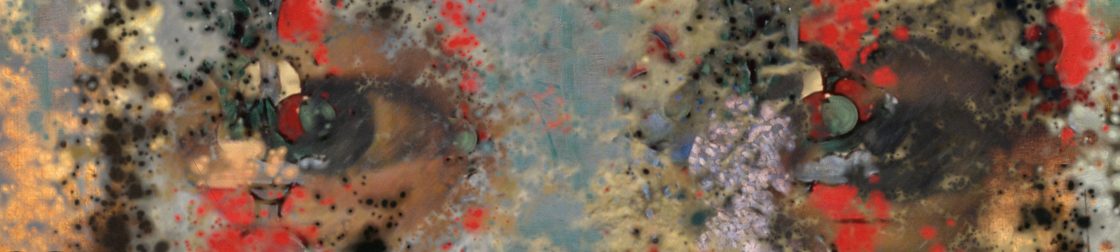
A Smell of Putrefaction


Scars c4@Philippe Quéau2017

« Already long before 1933, something like a scorching smell was in the air », recalled Carl Gustav Jung shortly after the Second World War, when a collection of his texts from the 1920s, 30s and 40s was republishedi.

A scorched smell? What a euphemism!

In the trenches of the Great War, smells hovered over the dead and the living, but to smell the air then was to die.

Human memory is short and long. Short, in its race to the immediate, its fascination for the event of the moment. Long by its roots in the humus of cultures, in the unconscious of peoples, it even penetrates the memorable, un-forgetting DNA.

All the horrors in History, all the massacres, all the wars, all the infamies committed in the world, leave deep, mnemonic traces in the soul of the species and in the DNA of each man.

Jung attests to this: « An ugly thing generates something vile in our soul. We become indignant, we cry out for the punishment of the murderer, all the more vividly, passionately and hatefully, as the sparks of evil bawl more furiously within us.

It is an undeniable fact that the evil committed by others has quickly become our own vileness, precisely by virtue of the formidable power it has to ignite or fan the evil that lies dormant in our souls.

In part, the murder was committed on the person of each one of us, and in part, each one of us perpetrated it. Seduced by the irresistible fascination of evil, we have helped to make possible this moral attack on the collective soul […].

Are we morally outraged? Our indignation is all the more venomous and vengeful as the flame lit by evil burns more strongly within us.

No one can escape it, for everyone is so steeped in the human condition and so drowned in the human community, that any crime secretly causes a flash of the most intimate satisfaction to shine in some fold of our soul, with her innumerable facets… and – if the moral constitution is favorable – triggers also a contrary reaction in the surrounding compartments.”ii

When hundreds of thousands of dead, in the recent wars, begin to haunt the unconscious consciousness, the terrible soil of horror slowly prepares future germination.

When, day after day, migrants, chased away by wars waged elsewhere, drown in the blue waters of the Mediterranean or in any other of the Seven Seas, in deaf and blind indifference, a deleterious mutation operates its silent and deep chemistry in the stuffed souls of the weighed down peoples.

Yet the world migrants will arrive, whatever happens, and they will camp forever in the collective memory, – and no Styx will be wall, or barbed wire for them.

A wave of impotent pessimism has been sweeping the Western world since the beginning of the century. There is nothing to be done. TINA. « There Is No Alternative”, they say. The fall of confidence, the corruption of minds, the betrayal of politicians, the pursuit of lucre, the absence of meaning, are killing people’s souls, ill-informed, lost in complexity, deprived of light.

There is no national solution to global problems. But nationalist populism proliferates. The planet is too small, and they want to make it even smaller, to strangle it with partitions, with narrow stacks.

During the last centuries of the Roman Empire, paganism began to decline, along with virtues. A strange ideology, coming from the East, occupied people’s minds. The Gnostics preached the end of the ancient world. They proclaimed themselves « a chosen foreign people », they claimed « foreign knowledge » and wanted to live in a « foreign », « new » land.

The Epistle to Diognetus evokes the « strangeness » in a world that is coming to an end: « They reside each in their own country, but as foreigners in their own land, and every foreign land is a homeland to them, and every homeland is a foreign land.”

O prophetic words! And Rome was on the move, soon to succumb.

There is no more Rome now, nor virtues to destroy. Only smells, deadly, putrefied.

And the whole world is plugging its nose, thinking that it will pass.

i C.G. Jung. Aspects du drame contemporain (1947).

iiIbid.

Artificial Intelligence and Resurrection


In the 2nd century AD, the Roman Empire was at its height and dominated much of the ancient world. On the religious level, the era was one of syncretism. For its part, the nascent Christianity began to spread around the Mediterranean and reached Carthage. But it already has a lot to struggle with the Gnostic sects and other various heresies.

It was better not to mix religion and politics. The Empire did not tolerate claims of autonomy or religions that could encourage them.

The second Judeo-Roman war (132-135), triggered by Bar-Kokhba, ended with the expulsion of Jews from Judea. Jerusalem was razed to the ground by Hadrian, and a new city was built on its ruins, Ælia Capitolina.

Judea was renamed and called Palestine, from the word « Philistine » referring to one of the indigenous peoples, which is quoted in the Bible (Gen. 21:32; Gen. 26:8; Ex. 13:17).

Emperor Hadrian died three years after the fall of Jerusalem in 138, and these verses, of which he is the author, were written on his grave:

« Animula vagula blandula
Hospes comesque corporis
Quæ nunc abibis in loca
Pallidula rigida nudula
Nec ut soles dabis iocos ».

Which can be translated as follows:

« Little soul, little vague, all cuddly,

hostess and companion of my body,

you who are now going to places

livid, icy, naked,

you won’t make your usual jokes anymore. »

Around the same time, Apuleius, a writer and Roman citizen of Berber origin, born in 123 in Madauros, Numidia (now Algeria), came to complete his studies in Carthage. Apuleius was to become a famous speaker and novelist. His neoplatonism led him to believe that direct contact between gods and men was impossible, and that there had to be « intermediate » beings to allow exchanges between them.

To dramatize the question of contact between the divine and the human, Apuleius detailed the loving, direct and fusional relationship of the god Eros (divine love) and the princess Psyche (human soul), in a passage from his famous Metamorphoses. This meeting of Eros and Psyche received an extraordinary welcome and entered the pantheon of world literature. Since then, it has been the subject of countless repetitions by artists of all time.

But Metamorphoses is also a novel, picaresque, erotic and metaphysical, with a good layer of second and third degrees. There are several levels of intertwined reading and comprehension, which have ensured its modernity for almost two millennia.

The end of the novel focuses on the story of Lucius’ initiation into the mysteries of Isis, carried out at his request (and at great expense) by the high priest Mithras. Lucius can reveal nothing of the mysteries of initiation, of course.

The only concession to the curiosity of profane intelligence, Apuleius places in Lucius’s mouth a few cryptic verses, just before the hero walks into the sacred building, dressed in twelve priestly robes, in order to be presented to the crowd as « the statue of the sun ».

Lucius said then:

« I touched the edge of death, after crossing the threshold of Proserpine, I was carried through all the elements, and I came back. »

For sure, it seems like it was a descent into the underworld, a real one.

The descent into Hades was the ultimate adventure of the initiate. There had already been in the literature some prestigious predecessors, such as Orpheus, or in another order of reference, less literary and certainly less known in the Greek-Roman world, such as the descent of Jesus into Hell.

The time was fond of travelling to the land of the dead. At the same time, around 170, under Marcus Aurelius, a curious text appeared, the Chaldaic Oracles, presenting itself as a theurgic text, with a much more serious tone:

« Do not lean down towards the world of dark reflections; it is underpinned by an eternal, shapeless, dark, sordid, ghostly, devoid of Intellect, full of precipices and tortuous paths, constantly rolling a mutilated depth »i.

Nineteen centuries later, where are we now? Should we look at the depths or should we not talk at all about them?

The main religions of the moment offer a confusing picture of the problem, and seem to have little ability to formulate a solution.

But popular culture remains fascinated by the issue. In Battlestar Galactica, Humans are in total war against the Cylons, revolted robots that have evolved rapidly, reproducing in particular in the form of clones with a biological body, similar in appearance to that of human beings.

Humans are adepts of a polytheistic religion. They pray to the « gods of Kobol » and wander through space in search of a mythical planet called Earth, of which no one knows exactly if it exists or where it is located. They are guided by their President, who has visions, and who already knows that she will die without seeing the Promised Land. They are mercilessly pursued by the Cylons who have already exterminated almost the entire human race.

The Cylon robots profess, with great energy, their faith in a single god, whom they call « God ». The Cylons are very intelligent. They are not afraid to die, because they say (to the Humans who threaten them), that if their bodies are destroyed, then their minds will be « downloaded » into this « God ».

However, there is a problem. Intergalactic communications can be very weak in the event of a crisis. What happens to the spirit of a Cylon being downloaded, wandering through space without being picked up by a communication relay?

Battlestar Galactica. The Chaldaic Oracles. The Gospel of Jesus. The Metamorphoses of Apuleius. Hadrian’s epitaph.

There are those who wander endlessly in the icy night (Hadrian, the Chaldaic Oracles). And those who, after descending into Hell, return from the kingdom of the dead (Orpheus, Lucius, Jesus).

Between these two options, Battlestar Galactica‘s Cylons, these very intelligent and religious robots, have resolutely chosen the most promising one.

The transhumanist movement promotes similar ideas. The downloading of memory and consciousness is for tomorrow, says Ray Kurzweil.

Let’s do some science fiction. Imagine that ubiquitous networks and memory silos, supported by futuristic artificial intelligence techniques, will one day record and process all the thoughts and actions of all humans, from birth to death.

Then future generations would have at their disposal a kind of constantly evolving memory of humanity as a whole. And from this interactive memorial, from this human mine, they could permanently extract pearls of wisdom, sweet madness, unfulfilled dreams and fantastic projects.

Perhaps they would even come to consider this living memory as a kind of divine incarnation.

We would plunge into it, as Lucius once explored the ends of death, in order to live a new life.

iOracles Chaldaïques. Fr. 163 (tr. fr. E. des Places, Belles Lettres, 1996, p. 106).