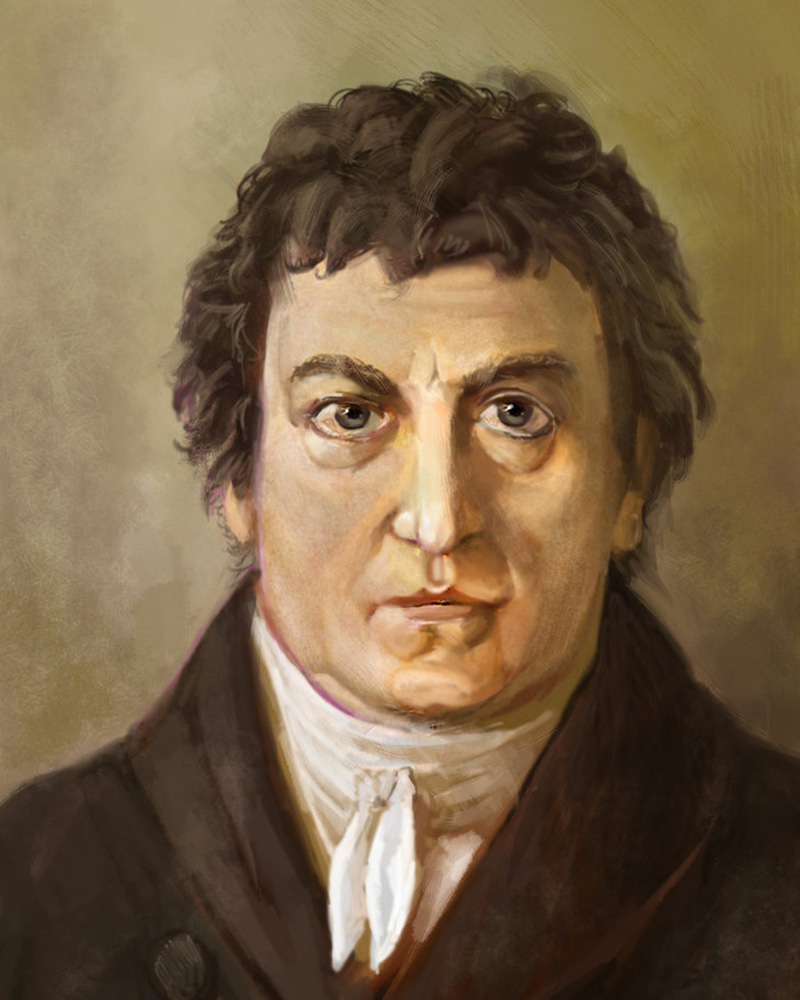
Being and Fichte


« Johann Gottlieb Fichte »

Neuroscientists, however arrogant, remain astonishingly silent about the essence of consciousness. Having acknowledged that they have failed to understand its origin and nature by searching for it in neurons and synapses, we should perhaps try other avenues than neurosciences, despite a ‘modern’ context that is hard on ideals and insensitive to essences. We could, for example, mobilise the resources of pure reason, plunge into introspection, without disdaining the achievements of millennia, without ignoring the ideas of famous visionaries such as Thales, Anaxagoras, Parmenides, Plato, Descartes, Kant, Schelling, Hegel… In the long line of ‘idealist’ thinkers, Fichte occupies a special place, because of his radical, utterly anti-materialist personality.

For Fichte, the ‘divine essence’ permeates everything. Its real, effective presence is everywhere. But most of the time it remains hidden, immanent and unintelligible. Very few consciousnesses are capable of detecting it, or of sensing it, even if only obscurely. Fichte also asserts that consciousness is an emanation of this presence, an emanation of the divine. From this emanation, it forms a place where being, thought – and the feeling of the ‘blessed life’i – are knotted together. The ‘divine presence’, though hidden, elusive and fleeting, can appear in consciousness (if it welcomes and embodies it in some way). Some consciousnesses are a priori disposed to ‘see’ and ‘contemplate’ it, to a certain extent. Other consciousnesses remain obstinately deaf and blind to themselves, and a fortiori to the divine – starting with ‘materialistic’ consciousnesses.

Consciousness, in all its forms, states, degrees, actualisations and potentialities, rubs shoulders with the divinity without knowing it, without grasping the abyss, measuring its width, reaching its height. The humblest and most elevated forms of consciousness only bear witness to the putative existence of the mystery, but they neither unveil it nor resolve it. Among the consciousnesses of which man can form some idea, there is the abysmal consciousness of the individual self, but also the cosmic consciousness of the Self in the universe, the consciousness of the mystery of Being, the consciousness of the mystery of being thrown into the world – in a world said to be without consciousness. We can conjecture that these more or less elevated forms of consciousness are alive. They live a life thinking itself as Life, and living itself as Thought. In this Life and Thought, consciousness can link and ally itself with the divine. It finds true happiness, if it can, in the awareness of this link. Apart from this true consciousness, apart from the Life and Thought that make it true and give it life, there is nothing truly real.ii

Outside this reality, there is certainly the whole of the unreal. The unreal is not true, but it is not nothingness, it is not non-existent. The unreal exists in a certain way. It has a form of existence that can be described as ‘intermediate’, insofar as the unreal relies in part on real existences, on conscious lives, to develop its capacity for illusion… From the proven existence of illusion, from this latent and persistent presence of the unreal in reality, we can deduce that we can live and think more or less truly. What does that mean? To really live is to really think, to really recognise the truth, and to do away with illusion. From the observation of this intimate entanglement of true, real consciousness with the unconsciousness attached to illusion, we deduce the possibility of all sorts of levels of opacity, obscurity, obliteration. We sincerely seek clarity, but all we find is the shadow it casts. The more we are bathed in light, the more we are blinded by the shadow of the abyss. Light prevents us from seeing the shadow. The sun hides the night in broad daylight. « I want to arrive at a clear intuition, but clarity is found only at the bottom of things; on the surface there is only darkness and confusion. He, therefore, who invites you to clear knowledge, is undoubtedly inviting you to descend with him into the depths of things. »iii Consciousness and thought are the only clear path to truth and reality, to life and the divine. There is no other way. Being and thought are the same thing, said Parmenides. Now we can add: God, whoever He/She may be, forms with pure thought the same manifestation of the Spirit.

Fichte puts it this way: « Pure thought is the very manifestation of God, and the divine manifestation in its immediacy is nothing other than pure thought. » iv What is ‘pure thought’? It is a thought illuminated by a luminous consciousness. The flash of thought is not latent or immanent; it zaps the night and bursts forth like a million suns, like the very love of being and of life. « Our own life is only what we grasp in the necessary fullness of life with clear awareness; it is what we love, what we enjoy in that clear awareness. Where there is love, there is individual life, and love is only where there is clear consciousness. » v

Consciousness is there from the start. Better still, it is the origin itself, and not an induced effect, or the product of some created matter. How can we know that it is the origin itself? We know because we do not feel our consciousness, and we know that it is consciousness alone that feels, knows and perceives.vi All that we perceive, know, feel and sense belongs solely to consciousness. It has pre-eminence. We deduce that it is undoubtedly the originator. What has not come into consciousness can never be perception or knowledge, sensation, intuition or feeling.vii Hence Fichte’s radical and absolutely « idealist » thesis. Consciousness is the root of being, not the other way round. Without consciousness I am only a he or a she, not a me.viii There is originally being. And then there is what being is, the way in which being manifests its existence, the way in which being presents itself: all this constitutes the background of consciousness. This background is an abyss – it veils its depths, its widths and its heights. Consciousness is therefore not one, but is potentially a myriad of myriads, infinitely sharable, and always presenting itself anew, in a single individuation.ix

Naked being, on its own, has no real ‘existence’, we can even say that it is a kind of nothingness, admittedly a non-absolute nothingness, since it is being, but it is a kind of nothingness. It is an existential nothingness as long as it does not manifest itself as existing, as a phenomenon, as reality. To exist, it must emerge from the shadow of being and present itself in the light of existence. « The consciousness of being is the only form, the only possible mode of existence; it is therefore the immediate and absolute existence of being » x .

The existence (of being) cannot be confused with its essence. The original, first, unique, absolute being is absolutely one, and therefore essentially alone. At least, this is the lesson taught by the historical monotheisms. As for its existence, it is not alone, but infinitely multiple and diverse. This existence knows itself in its multiplicity and diversity. It grasps itself in this knowledge, which is also one of the elements of its consciousness. Existence is in itself consciousness, which differentiates it from the being that is one and only, which is above all consciousness, since it is the being that makes it possible, engenders it and gives it existence.xi Being thus reveals itself in existence (which it ‘creates’) and in consciousness (which is ‘life’). But it does not reveal itself as being, in its essence of being, which remains inaccessible. It reveals itself only as a manifestation, as the externalisation of its essential interiority.

On the one hand, there is being and its essence; on the other, there is the existence of being and the awareness of its existence. Existence and consciousness are of the same nature: they are images, representations, manifestations or ‘processions’ of being. They participate in being, derive from it, proceed from it and bear witness to it, but they are not identical with it. How can the multiple, the infinite, the diverse be equal to the One, the Singular, the Unique, which is also their source, their depth, their abyss? Consciousness knows and understands its link and even its identity with existence, but it does not understand the being from which this existence proceeds. « It must therefore be obvious to anyone who has grasped all this reasoning, that the existence of being can consist only in consciousness of itself, as a pure image of the absolute being that is in itself, and that it absolutely cannot be anything else. » xii Existence depends on the essence of the being that precedes it, makes it possible and engenders it. It does not come from itself, but is founded on an essence whose nature and depth it does not grasp a priori. But, insofar as it is a consciousness, a consciousness aware of its relationship of dependence with respect to an essence that escapes it, but to which it owes its existence, it cannot detach itself from this consciousness, which founds it, – and make itself independent of it. Existence and consciousness are absolutely intertwined.xiii

Existence (of being) is the source of consciousness (of being). Existence and consciousness are indissolubly linked. Originating from being and its essence, existence is self-sufficient. However, through consciousness, it embodies a certain idea, a possible image of its essence.

The few ideas, concepts or notions that we can form about being are necessarily shaped and based on the living forms of existence, which vary ad infinitum. These forms, so varied, so multiple, do not exhaust the essence of being, since they are never more than fleeting, fleeting, local, partial figures of it. xiv

Every living thing requires a form of consciousness, more or less developed. Plants, bacteria, amoebas, prokaryotes and single-celled organisms all live and have some kind of consciousness, even if only embryonic. All forms of ‘life’, however humble, such as protozoa, fungi and hyphae, have an underlying proto-consciousness, more or less outcropping. These proto-consciousnesses probably have very little to do with what we know about human consciousness. But Alfred Binetxv and H.S. Jenningsxvi have asserted that micro-organisms have a « psychic life ».

We can assume that no proto-consciousness is entirely empty, devoid of all affect, all perception and even all ‘concept’. All forms of consciousness and proto-consciousness carry within them some trace of their origin, of their past, and they potentially unfold the conditions of their future. In its memory and in its power, all consciousness weaves itself permanently.

We could also, hypothetically, imagine all consciousness, or proto-consciousness, as being unconsciously ‘happy’ – ‘happy’ to know that it is conscious. Of course, it can also be ‘unhappy’. But it never represents itself as absolutely ’empty’. Consciousness can never be conscious of anything other than its supposed nothingness, or of the fact that it is ’empty’, of its essential unconsciousness. So there is no real ‘life’ that is not necessarily associated with a certain self-consciousness or proto-consciousness, with the capacity to dream that emanates from it. Closely associated with this dream of consciousness is a form of intuition of eternity – an intuition of what is eternal in itself.xvii For the sake of clarity, let us assume that being, taken as a totality and considered in its essence, can also be called ‘God’. Existence and consciousness would then be ‘divine’ emanations. Ideas, concepts and knowledge, insofar as they incorporate this consubstantial link between being and consciousness, would themselves be so many latent, veiled faces of ‘divinity’, whatever that may be.xviii

Consciousness can decide to represent itself as ‘thought’. But it could also represent itself as containing the part of unconsciousness with which all consciousness is charged. Existence and life, consciousness and thought, would only be so many possible forms, among countless others, of a ‘divine’ life, hidden and concealed.

We might as well say that we have seen nothing yet. From the infinity of time, we probably won’t have enough to fill the abyss of ignorance or the heights of desire.

______________

iJohann Gottlieb Fichte. Method for arriving at the blessed life. Translated from the German by M. Bouillier. Librairie philosophique de Ladrange, Paris, 1845 (My translation into English).

ii« Thus, true life and happiness exist in thought, that is, in a certain conception of ourselves and the world, considered as an emanation of the intimate and hidden essence of the divine being » Ibid. p.61.

iiiIbid. p.71

ivIbid. p.75

vIbid. p.98

vi« But inner consciousness embraces the outer sense, since we are conscious of the action of seeing, hearing, feeling, whereas we do not hear, we do not see, we do not feel consciousness, and so it already holds the highest place in the fact given by observation. If, therefore, one examines things more deeply, he will find it more natural to make consciousness the principal cause, and the external sense the effect and accident, to explain, to control, to confirm the external sense by consciousness, than to do the opposite. » Ibid. p.101

vii« All sensible perception is only possible in thought, only as something thought, as a determination of general consciousness, and not as separate from consciousness, as existing by itself, it is not true that we simply hear, that we simply feel; we are only aware of our seeing, hearing, feeling. » Ibid. p.103

viii« I say that the existence of being, immediately and in the root, is the consciousness or representation of being. Apply the word IS to any object, to this wall, for example, and you will understand me clearly. For what does this word mean in the proposition ‘this wall is’? Obviously, it is not the wall itself, nor is it identical with it. So it does not give itself as such, but, through the third person, it separates itself from the wall as from an independent existing being. » Ibid. p.110

ix« Consciousness of being, the is in relation to being, constitutes existence, we have said, leaving us to suppose that consciousness would only be one form, one species, one possible mode among many others of existence, and that there could be others ad infinitum. » Ibid. p.111

xIbid. p.112

xi« Being must manifest itself as being, without ceasing to be being, without in any way abandoning its absolute character, without mixing and merging with existence. It must therefore distinguish itself from its existence, and oppose it. Now, since outside absolute being there is absolutely nothing, apart from its existence, it is in itself that this distinction and this opposition must take place, or else, to speak more clearly, existence must grasp itself, know itself and establish itself as simple existence. » Ibid. p.112

xii« That knowledge and consciousness are indeed the absolute existence, or, if you prefer, the revelation, the expression of being in the only possible form, is what knowledge can perfectly understand, as you yourselves, as I assume, have all understood. But it can in no way discover and grasp in itself how it produces itself, how from the intimate and hidden essence of being, an existence, a revelation, an expression of being can flow. » Ibid. p.113

xiii« Existence cannot take place without grasping itself, knowing itself, supposing itself in advance; it is necessarily of its essence to grasp itself. Because of this absolute character of existence, because of the dependence that binds it to its essence, it is impossible for it to emerge from itself, to go beyond itself, and to understand itself, to deduce itself, independently of this consciousness. It is for itself and in itself, and that is all. Ibid. p.114

xiv« The fact that the existence of being is consciousness, and all that follows from it, result from the idea of existence alone. Now this existence leans and rests on itself; it is prior to the notion of itself, and it is inexplicable by this notion. » Ibid. p.115

xvAlfred Binet. The psychic life of micro-organisms. Revue philosophique de la France et de l’étranger, n°XXIV, July-December 1887. Ed. Félix Alcan, Paris

xviH.S. Jennings, Behavior of the Lower Organisms. The Columbia University Press, New York, 1906.

xvii« No one, in fact, can be tempted to attribute life and happiness seriously and in the true meaning of the word, to a being who is not aware of himself. All life presupposes self-awareness, and only self-awareness can grasp life and make it possible to enjoy it. Moreover, true life and happiness consist in union with that which is unchanging and eternal. Now, the eternal can only be grasped by thought, it is only accessible to us in this way » Johann Gottlieb Fichte. Method for attaining the blissful life. Translated from the German by M. Bouillier. Librairie philosophique de Ladrange, Paris, 1845, p.60

xviii« The real life of knowledge is therefore at its root being itself, and the essence of the absolute; it is nothing else. There is no separation between God and knowledge in its deepest vital root; they merge with each other. » Ibid. p.116
Secrets still Buried in the Dark Depths


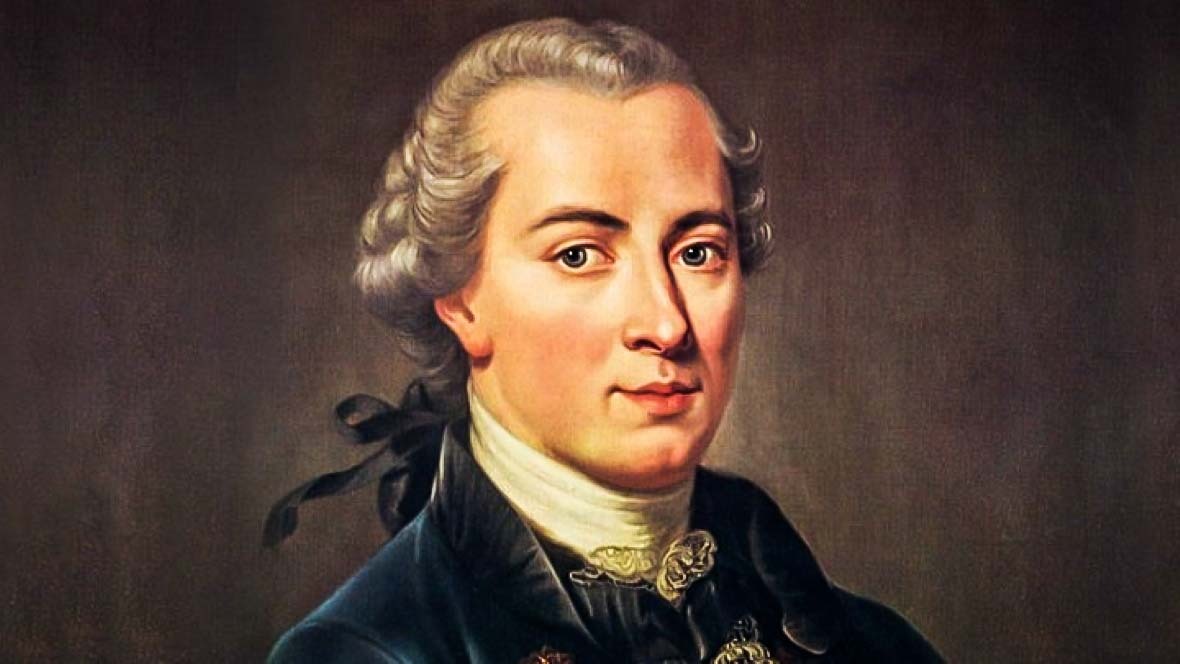
« Kant »

Consciousness is capable of grasping abstract, immaterial ideas – for example, the principle of non-contradiction or the concept of universal attraction. Can we deduce from this that it is itself immaterial in nature?

Materialists deny this. Consciousness is not immaterial, they say; it is only ever the material emanation of the material substance of material bodies.

But then how can we explain the fact that ‘material’ entities are capable of conceiving pure abstractions, abstract ‘essences’ that are essentially unconnected with the material world? How could a consciousness that is only ‘material’ link up and interact adequately with the infinity of the various natures that make up the world, with all the beings of unknown essences that surround or subsume it?

What could be the nature of the links between a ‘material’ consciousness and natures, with beings a priori totally unrelated to its own matter?

In particular, how can a material consciousness, confined in a material body, interact effectively with other consciousnesses, confined in other bodies? How can we imagine that it could link up (materially) with beings existing in act, or in potential, throughout the world, and that it could penetrate (materially) their essence?

All these difficult questions were dealt with by Kant in his lively little work, Dreams of a Man Who Sees Spiritsi . In it, he asserts that consciousness (which he calls the ‘soul’) is immaterial, just as what he calls the ‘intelligible world’ (mundus intelligibilis), the world of ideas and thoughts, is immaterial. This ‘intelligible world’ is the proper ‘place’ of the thinking self, because the latter can go there at will, detaching itself from the material, sensible world. Kant also asserts that human consciousness, although immaterial, can be linked to a body, the body of the self, from which it receives material impressions and sensations from the organs of which it is composed. Consciousness therefore participates in two worlds, the material (sensible) world and the immaterial (intelligible) world, – the world of the visible and that of the invisible.

The representation that consciousness has of itself as being a spirit (Geist), when it considers itself in its relations with other consciousnesses, is quite different from the representation it has when it sees itself as being attached to a body. In both cases, it is undoubtedly the same subject who belongs at the same time to the sensible world and to the intelligible world; but it is not the same person, because the representations of the sensible world have nothing in common with the representations of the intelligible world, says Kant. What I think of myself as a living, feeling, carnal being is not on the same level, and has nothing to do with my representation as (pure) consciousness.

Conversely, the representations that I may hold of the intelligible world, however clear and intuitive they may be, are not sufficient to give me a representation of my consciousness as a human being. The representation of oneself as (pure) consciousness can be acquired to a certain extent by reasoning or induction, but it is not naturally an intuitive notion, and it is not obtained through experience.ii

Consciousness does indeed belong to a single subject, who participates in both the « sensible world » and the « intelligible world », but it is also twofold. It is not « the same person » when it represents itself as « pure consciousness » and when it represents itself as « attached to a (human) body ». The fact that it is not « the same » in these two cases implies an inherent, profound duality – it is a dual being.

Here, for the first time, Kant explicitly introduces the expression « duality of the person » (or « duality of the soul in relation to the bodyiii « ).

This duality can be inferred from the following observation. Some philosophers believe they can refer to the state of deep sleep when they want to prove the reality of ‘obscure representations’.

We can only observe that they are no longer clearly present in us when we wake up, but not that they were really ‘dark’ when we were asleep. We can only observe that they are no longer clearly present in us when we wake up, but not that they were really ‘obscure’ when we were asleep.

For example, we might well think that they were actually clearer and more extensive than the clearest representations we have in the waking state. This is indeed what we might expect of consciousness when it is perfectly at rest, and separated from the external senses, Kant concludes in a noteiii.

Hannah Arendt found this note ‘bizarre’iv , without further explaining or justifying this trenchant judgement. Perhaps it is indeed ‘bizarre’ to assert that consciousness thinks more clearly and more extensively in deep sleep, and that it is then more ‘active’ than in the waking state? Or does it seem ‘bizarre’ to present consciousness not as ‘one’ but as ‘dual’, this duality implying a contradiction with the unified idea that consciousness might a priori have of its own nature? Consciousness feels the intrinsic unity it possesses as a ‘subject’, and it also feels, as a ‘person’, endowed with a double perspective, one sensible and the other intelligible. It may therefore seem ‘strange’ that the soul should think of itself as both one and two, – ‘one’ (as subject) and ‘two’ (as person).

This intrinsic duality creates a distance between consciousness and itself, an inner gap within itself. It reflects a gap between the ‘waking’ state (where the feeling of duality is revealed) and the ‘deep sleep’ state, where the feeling of duality evaporates, revealing the true nature of consciousness.

To ward off this ‘oddity’, Hannah Arendt proposed an explanation, or rather a paraphrase of Kant’s note: « Kant compares the state of the thinking self to a deep sleep in which the senses are at complete rest. It seems to him that, during sleep, the ideas ‘may have been clearer and more extensive than the clearer ideas of the waking state’, precisely because ‘the sensation of man’s body was not included in it’. And when we wake up, none of these ideas remain.v

What seems ‘bizarre’ to Hannah Arendt, we then understand, is that after consciousness has been exposed to ‘clear and extensive’ ideas, none of this remains when it wakes up. Awakening erases all traces of the activity of consciousness (or of the ‘soul’) in the deep sleep of the body. Even if there is nothing left, there is at least the memory of an immaterial activity, which, unlike activities in the material world, does not encounter any resistance or inertia. There also remains the obscure memory of what was then clear and intense… There remains the (confused) memory of having experienced a feeling of total freedom of thought, freed from all contingencies. All these memories cannot be forgotten, even if the ideas conceived at the time seem to escape us. It is possible to conjecture that the accumulation of these kinds of memories, these kinds of experiences, will end up reinforcing the idea of the existence of a consciousness that is independent (of the body). By extension, and by analogy, these memories and experiences of deep sleep constitute in themselves an experience of ‘spirituality’, and reinforce the idea of a spirit world, an ‘intelligible’ world, separate from the material world. The consciousness (or spirit) that becomes aware of its power to think ‘clearly’ (during the body’s dark sleep) also begins to think of itself as being able to distance itself from the world around it, and from the matter that constitutes it. But its power to think ‘clearly’ does not allow it to leave this world, nor to transcend it (since waking up always happens – and with it forgetting the ‘clear’ thoughts of deep sleep).

What does this sense of distance from the world bring to consciousness?

Consciousness can see that reality is woven from appearances (and illusions). In spite of the very profusion of these appearances (and illusions), reality paradoxically remains stable, it continues unceasingly, it lasts in any case long enough for us to be led to recognise it not as a total illusion, but as an object, and even the object par excellence, offered to our gaze as conscious subjects.

If we do not feel able to consider reality as an object, we may at least be inclined to consider it as a state, durable, imposing its obviousness, unlike the other world, the ‘intelligible world’, whose very existence is always shrouded in doubt, and improbability (since its kingdom can only be reached in the night of deep sleep).

As subjects, we demand real objects in front of us, not chimeras or conjectures – hence the insignificant advantage given to the sensible world. Phenomenology teaches that the existence of a subject necessarily implies that of an object. The object is what embodies the subject’s intention, will and consciousness. The two are linked. The object (of intention) nourishes consciousness, more than consciousness can nourish itself – the object ultimately constitutes the very subjectivity of the subject, presenting itself to his attention, and even instituting itself as his conscious intention. Without consciousness, there can be neither project nor object. Without an object, there can be no consciousness. Every subject (every consciousness) carries intentions that are fixed on objects; in the same way, the objects (or ‘phenomena’) that appear in the world reveal the existence of subjects endowed with intentionalities, through and for whom the objects take on meaning.

This has a profound and unexpected consequence.

We are subjects, and we ‘appear’, from the very beginning of our lives, in a world of phenomena. Some of these phenomena also happen to be subjects. We then gradually learn to distinguish between phenomena that are merely phenomena (requiring subjects in order to appear), and phenomena that eventually reveal themselves to us as being not just phenomena, of which we would be the spectators, but as other subjects, and even ‘other’ subjects, subjects whose consciousness can be conjectured as ‘any other’. The reality of the world of phenomena is thus linked to the subjectivity of multiple subjects, and innumerable forms of consciousness, which are both phenomena and subjects. The world represents a ‘total phenomenon’, whose very existence requires at least one Subject, or Consciousness, that is not merely a ‘phenomenon’.

In other words, if a thought experiment were to presuppose the absence of any consciousness, the non-existence of any subject, in the original states of the world, would we necessarily have to conclude that the ‘phenomenal’ world did not exist in this time of ‘genesis’? Undoubtedly. The ‘phenomenal’ world would not then exist, insofar as ‘phenomenon,’ since no subject, no consciousness, would be able to observe it.

But another conjecture is still possible. Perhaps, in this time of ‘genesis’, there are subjects (or consciousnesses) that are part of another world, a non-‘phenomenal’ world, a ‘noumenal’ world, the ‘intelligible world’ evoked by Kant?

Since there can be no doubt that the world and reality began to exist long before any human subject appeared, we must conclude that other kinds of consciousness, other kinds of ‘subjects’ already existed then, for whom the world in the state of phenomenon, total and inchoate, constituted an ‘object’ and embodied an ‘intention’. In this case, the world has always been an object of subjectivity, of ‘intentionality’, of ‘desire’, right from its genesis.

It remains to try and imagine for which subjects, for which consciousnesses, the emerging world could then reveal itself as an object and as a phenomenon. We can hypothesise that this primal subjectivity, endowed with an ‘intentionality’, a ‘desire’, pre-existed the appearance of the world of phenomena, in the form of an original power to will, to desire, and to think. Man retains a ‘mysterious’ trace of this ancient, primal power, insofar as he is ‘thought made flesh’. « For the philosopher, speaking from the experience of the thinking self, man is, quite naturally, not only the Word, but thought made flesh; the always mysterious incarnation, never fully elucidated, of the ability to think ».vi Why is this incarnation ‘mysterious’? Because no one knows where thinking consciousness comes from, and even fewer can guess at the multiplicity of forms it has taken in the universe since the beginning, and may yet take in the future.

Since our only guide in this search is consciousness itself, we must return to it again and again. Every consciousness is unique because it recreates (in its own way) the conditions of the spirit’s original freedom. This freedom was not only that of the first man, but also of all that preceded him, of all that was before him and without him – of all that was non-human.

All consciousness is singular, and the solitary thinker recreates in his own way the absolute solitude of the first Man, the first Thinker. « While a man lets himself go and simply thinks, about anything for that matter, he lives totally in the singular, that is to say in complete solitude, as if the Earth were populated by a Man and not by men ».vii

Who was the first man, the first thinker to be « alone »? The one the Bible calls Adam? The one the Veda calls Puruṣa? Or some primal, original Spirit, creating in the thinker the living object of his living thought, and thereby creating the conditions for the engendering of a living multitude of other ideas (and other minds)?

We owe it to Parmenides and Plato, thinkers of the first depths, to have celebrated a few primordial spirits, among the most ancient of whom the world has preserved a memory. They admiringly quoted those sages who had lived long before them in ‘the life of intelligence and wisdom’, that life of Noûs and Sophia, which not all men know, but which all may wish to know.

Intelligence and wisdom indeed « live », in the literal sense, for they live by the life of the Spirit. From the beginning, Socrates asserts, the Spirit, the Noûs, has been the « King of heaven and earth »: νοῦς ἐστι βασιλεὺς ἡμῖν οὐρανοῦ τε καὶ γῆς.viii

In this the Sirach agrees with Socrates, and goes back even further: « Wisdom was created before all things, and the light of understanding from eternity ».ix

Paradoxically, this very ancient idea, both Greek and Hebrew, now seems to have once again become one of those « secrets still buried in the dark depths ».x

_______________

iKant. Dreams of a man who sees spirits, – explained by dreams of metaphysics (1766). Translated by J. Tissot. Ed. Ladrange, Paris, 1863

iiIbid. p.27

iiiIn a note appended to Dreams of a man who sees spirits, – explained by dreams of metaphysics.

ivH. Arendt. The life of the mind. Thought. The will. Translated in French by Lucienne Lotringer. PUF, 1981, p.68-69

vIbid.

viIbid. p.72

viiIbid.

viiiPlato, Philebus, 28c

ixSir. 1.4

x « Gods, whose empire is that of souls, silent shadows,

And Chaos, and Phlegethon, silent in the night and the limitless places,

May I have permission to say what I have heard,

May I, with your permission, reveal the secrets

buried in the dark depths of the earth.

Di, quibus imperium est animarum, umbraeque silentes

et Chaos et Phlegethon, loca nocte tacentia late,

Sit mihi fas audita loqui, sit numine vestro,

pandere res alta terra et caligine mersas.

Virgil, Aeneid VI, 264-7

About Secrets still Buried in the Dark Depths of the Earth


« Immanuel Kant »

Consciousness, obviously, is capable of grasping abstract, immaterial ideas – for example, the principle of non-contradiction or the concept of universal attraction. Can we deduce from this that consciousness is itself immaterial in nature? Materialists deny it. Consciousness is not immaterial, they say; it is only ever the material emanation of the material substance of material bodies. But then, how can we explain the fact that purely ‘material’ entities are capable of conceiving pure abstractions that are essentially unconnected with the material world? How could a consciousness that is only ‘material’ link up and interact adequately with all the beings of unknown essences that make up the world, with the various natures that surround or subsume it? What could be the stuff of the links between a ‘material’ consciousness with beings a priori totally unrelated to its own ‘matter’? In particular, how can a ‘material’ consciousness, confined in a ‘material’ body, interact effectively with other consciousnesses, themselves confined in other bodies? How can we imagine that a consciousness could link up (materially) with other beings existing in act, or in potential, throughout the world, and that it could penetrate (materially) their essence?

All these difficult questions were dealt with by Kant in his lively little work, Dreams of a Man Who Sees Spiritsi. But Kant does not adopt a materialist point of view. Quite the contrary. In this book, he asserts that consciousness (which he calls the ‘soul’) is immaterial, just as what he calls the ‘intelligible world’ (mundus intelligibilis, the world of ideas and thoughts), – immaterial. This ‘intelligible world’ is the proper ‘place’ of the thinking self, because the latter can go there at will, detaching itself from the material, sensible world. Kant also asserts that human consciousness, although immaterial, can be linked to a body, the body of the self, from which it receives material impressions and sensations from the organs of which it is composed. Consciousness therefore participates in two worlds, the material and sensible world and the immaterial and intelligible world, – the world of the visible and that of the invisible.

The representation that consciousness has of itself as being a ‘spirit’ (Geist), when it considers itself in its relations with other consciousnesses, is quite different from the representation it has when it sees itself as being attached to a body. In both cases, it is undoubtedly the same subject who belongs at the same time to the sensible world and to the intelligible world; but it is not the same person, because the representations of the sensible world have nothing in common with the representations of the intelligible world, says Kant. What I think of myself as a living, feeling, carnal being is not on the same level, and has nothing to do with my representation as (pure) consciousness.

Conversely, the representations that I may hold of the intelligible world, however clear and intuitive they may be, are not sufficient to give me a representation of my consciousness as a human being. The representation of oneself as (pure) consciousness can be acquired to a certain extent by reasoning or induction, but it is not naturally an intuitive notion, and it is not obtained through experience.ii

Consciousness does indeed belong to a single subject, who participates in both the « sensible world » and the « intelligible world », but consciousness is also twofold. It is not « the same person » when it represents itself as « pure consciousness » and when it represents itself as « attached to a (human) body ». The fact that it is not « the same » in these two cases implies an inherent, profound duality – consciousness is a dual being. Here, for the first time, Kant explicitly introduces the expression « duality of the person » (or « duality of the soul in relation to the body »iii). This duality can be inferred from the following observation. Some philosophers believe they can refer to the state of deep sleep when they want to prove the reality of ‘obscure representations’. We can only observe that they are no longer clearly present in us when we wake up, but not that they were really ‘dark’ when we were asleep.

For example, we might well think that they were actually clearer and more extensive than the clearest representations we have in the waking state. This is indeed what we might expect of consciousness when it is perfectly at rest, and separated from the external senses, Kant concludes.

Hannah Arendt found this particular idea ‘bizarre’iv, without further explaining or justifying her trenchant judgment. Perhaps it seems indeed ‘bizarre’ to assert that consciousness thinks more clearly and more extensively in deep sleep, and that it is then more ‘active’ than in the waking state? Or does it seem ‘bizarre’ to present consciousness not as ‘one’ but as ‘two’, this duality implying a contradiction with the unified idea that consciousness might a priori have of its own nature? Consciousness feels the intrinsic unity it possesses as a ‘subject’, and it also feels, as a ‘person’, endowed with a double perspective, one sensible and the other intelligible. It may therefore seem ‘strange’ that the soul should think of itself as both one and two, – ‘one’ (as subject) and ‘two’ (as person).

This intrinsic duality creates a distance between consciousness and itself, an inner gap within itself. It reflects a gap between the ‘waking’ state (where the feeling of duality is revealed) and the ‘deep sleep’ state, where the feeling of duality evaporates, revealing the true nature of consciousness.v

To ward off this ‘oddity’, Hannah Arendt proposed an explanation, or rather a paraphrase of Kant’s note: « Kant compares the state of the thinking self to a deep sleep in which the senses are at complete rest. It seems to him that, during sleep, the ideas ‘may have been clearer and more extensive than the clearer ideas of the waking state’, precisely because ‘the sensation of man’s body was not included in it’. And when we wake up, none of these ideas remain ».vi What seems ‘bizarre’ to Hannah Arendt, we then understand, is that after consciousness has been exposed to ‘clear and extensive’ ideas, none of this remains when it wakes up. Awakening erases all traces of the activity of consciousness (or of the ‘soul’) in the deep sleep of the body. Even if there is nothing left, there is at least the memory of an immaterial activity, which, unlike activities in the material world, does not encounter any resistance or inertia. There also remains the obscure memory of what was then clear and intense… There remains the (confused) memory of having experienced a feeling of total freedom of thought, freed from all contingencies. All these memories cannot be forgotten, even if the ideas conceived at the time seem to escape us. It is possible to conjecture that the accumulation of these kinds of memories, these kinds of experiences, will end up reinforcing the idea of the existence of a consciousness that is independent (of the body). By extension, and by analogy, these memories and experiences of deep sleep constitute in themselves an experience of ‘spirituality’, and reinforce the idea of a spirit world, an ‘intelligible’ world, separate from the material world. The consciousness (or spirit) that becomes aware of its power to think ‘clearly’ (during the body’s deep sleep) also begins to think of itself as being able to distance itself from the world around it, and from the matter that constitutes it. But its power to think ‘clearly’ does not allow it to leave this world, nor to transcend it (since waking up always happens – and with it forgetting the ‘clear’ thoughts of deep sleep).

What does this sense of distance from the world bring to consciousness?

Consciousness can see that reality is woven from appearances (and illusions). In spite of the very profusion of these appearances (and illusions), reality paradoxically remains stable, it continues unceasingly, it lasts in any case long enough for us to be led to recognise it not as a total illusion, but as an object, and even the object par excellence, offered to our gaze as conscious subjects.

If we do not feel able to consider reality as an object, we may at least be inclined to consider it as a state, durable, imposing its obviousness, unlike the other world, the ‘intelligible world’, whose very existence is always shrouded in doubt, of improbability (since his kingdom can only be reached in the abyss of deep sleep).

As subjects, we demand real objects in front of us, not chimeras or conjectures – hence the insignificant advantage given to the sensible world. Phenomenology teaches that the existence of a subject necessarily implies that of an object. The object is what embodies the subject’s intention, will and consciousness. The two are linked. The object (of intention) nourishes consciousness, more than consciousness can nourish itself – the object ultimately constitutes the very subjectivity of the subject, presenting itself to her attention, and even instituting itself as her conscious intention. Without consciousness, there can be neither project nor object. Without an object, there can be no consciousness. Every subject (every consciousness) carries intentions that are fixed on objects; in the same way, the objects (or ‘phenomena’) that appear in the world reveal the existence of subjects endowed with intentionalities, through and for whom the objects take on meaning.

This has a profound and unexpected consequence.

We are subjects, and we ‘appear’, from the very beginning of our lives, in a world of phenomena. Some of these phenomena also happen to be subjects. We then gradually learn to distinguish between phenomena that are merely phenomena (requiring subjects in order to appear), and phenomena that eventually reveal themselves to us as being not just phenomena, of which we would be the spectators, but as other subjects, and even subjects who are intrinsically ‘other‘, subjects whose consciousness can be conjectured as radically ‘other‘. The reality of the world of phenomena is thus linked to the subjectivity of multiple subjects, and innumerable forms of consciousness, which are both phenomena and subjects. The world represents a ‘total phenomenon’, whose very existence requires at least one Subject, or Consciousness, that is not merely a ‘phenomenon’.

In other words, if a thought experiment were to presuppose the absence of any consciousness, the non-existence of any subject, in the original states of the world, would we necessarily have to conclude that the ‘phenomenal’ world did not exist in this time of ‘genesis’? Undoubtedly. The ‘phenomenal’ world would not then exist, insofar as phenomenon, since no subject, no consciousness, would be able to observe it.

But another conjecture is still possible. Perhaps, in this time of ‘genesis’, there are subjects (or consciousnesses) that are part of another world, a non-‘phenomenal’ world, a ‘noumenal’ world, the ‘intelligible world’ evoked by Kant?

Since there can be no doubt that the world and reality began to exist long before any human subject appeared, we must conclude that other kinds of consciousness, other kinds of ‘subjects’ already existed then, for whom the world in the state of phenomenon, total and inchoate, constituted an ‘object’ and embodied an ‘intention’. In this case, the world has always been an object of subjectivity, of ‘intentionality’, of ‘desire’, right from its genesis.

It remains to try and imagine for which subjects, for which consciousnesses, the emerging world could then reveal itself as an object and as a phenomenon. We can hypothesise that this primal subjectivity, endowed with an ‘intentionality’, a ‘desire’, pre-existed the appearance of the world of phenomena, in the form of an original power to will, to desire, and to think. Man retains a ‘mysterious’ trace of this ancient, primal power, insofar as he is ‘thought made flesh’. « For the philosopher, speaking from the experience of the thinking self, man is, quite naturally, not only the Word, but Thought made Flesh; the always mysterious incarnation, never fully elucidated, of the ability to think ».vii Why is this incarnation ‘mysterious’? Because no one knows where thinking consciousness comes from, and even fewer can guess at the multiplicity of forms it has taken in the universe since the beginning, and may yet take in the future.

Since our only guide in this search is consciousness itself, we must return to it again and again. Every consciousness is unique because it recreates (in its own way) the conditions of the spirit’s original freedom. This freedom was not only that of the first man, but also of all that preceded him, of all that was before him and without him – of all that was non-human.

All consciousness is singular, and the solitary thinker recreates in his own way the absolute solitude of the first Man, the first Thinker. « While a man lets himself go and simply thinks, about anything for that matter, he lives totally in the singular, that is to say in complete solitude, as if the Earth were populated by one Man and not by men ».viii

Who was the first man, the first thinker to be « alone »? The one the Bible calls Adam? The one the Veda calls Puruṣa? Or some primal, original Spirit, creating in the thinker the living object of his living thought, and thereby creating the conditions for the engendering of a living multitude of other ideas (and other minds)?

We owe it to Parmenides and Plato, thinkers of the first depths, to have celebrated a few primordial spirits, among the most ancient of whom the world has preserved a memory. They admiringly quoted those sages who had lived long before them in ‘the life of intelligence and wisdom’, that life of Noûs and Sophia, which not all men know, but which all may wish to know. Intelligence and wisdom indeed « live », in the literal sense, for they live by the life of the Spirit. From the beginning, Socrates asserts, the Spirit, the Noûs, has been the « King of heaven and earth »: νοῦς ἐστι βασιλεὺς ἡμῖν οὐρανοῦ τε καὶ γῆς.ix

In this the Sirach agrees with Socrates, and goes back even further: « Wisdom was created before all things, and the light of understanding from eternity ».x

Paradoxically, this very ancient idea (that the Ancient Greeks and the Ancient Hebrews shared) now seems to have once again become one of those « secrets still buried in the dark depths of the earth ».xi

_____________________

iKant. Dreams of a Man who sees spirits, – explained by Dreams of Metaphysics (1766). Translated by J. Tissot. Ed. Ladrange, Paris, 1863

iiIbid. p.27

iiiIn a note appended to Dreams of a Man who sees Spirits, – explained by Dreams of Metaphysics.

ivH. Arendt. The Life of the Mind. Thought. The will. Translated by Lucienne Lotringer. PUF, 1981, p.68-69

vOne finds similar observations on the duality of the transient “ego” and the eternal “Self”, made by Indian thinkers and “rishis” such as Ramakrishna, Swami Vivekananda or Ramana Maharshi.

viIbid.

viiIbid. p.72

viiiIbid.

ixPlato, Philebus, 28c

xSir. 1.4

xi « Gods, whose empire is that of souls, silent shadows,

And Chaos, and Phlegethon, silent in the night and the limitless places,

May I have permission to say what I have heard,

May I, with your permission, reveal the secrets

buried in the dark depths of the earth.”

Di, quibus imperium est animarum, umbraeque silentes

et Chaos et Phlegethon, loca nocte tacentia late,

Sit mihi fas audita loqui, sit numine vestro,

pandere res alta terra et caligine mersas.

Virgil, Aeneid VI, 264-7

Synapses and Soul Epigenesis


Why are souls ‘locked’ in earthly bodies? This very old question has received many answers, but after so many centuries, none consensual.

For some, this question has no meaning at all, since it presupposes a dualism of spirit and matter, of soul and body, in Plato’s way. And Platonic ideas are rejected by materialists: the soul is for them only a kind of epiphenomenon of the body, or the outcome of an epigenetic growth.

In the materialistic approach, one cannot say that the soul is ‘locked’, since it is consubstantial with the flesh: it blossoms fully in it, vivifies it, and receives all its sap from it reciprocally.

But can a spiritual ‘principle’ (the soul) share a material ‘substance’ with a material entity (the body)? How to explain the interaction of immateriality with materialism?

Descartes saw in the pineal gland the place of the union of the soul with the body. This small endocrine gland is also called conarium or the epiphysis cerebri. I can’t resist quoting Wikipedia’s definition of pineal gland, such is its wild poetry:

“The pineal gland is a midline brain structure that is unpaired. It takes its name from its pine-cone shape. The gland is reddish-gray and about the size of a grain of rice (5–8 mm) in humans. The pineal gland, also called the pineal body, is part of the epithalamus, and lies between the laterally positioned  thalamic bodies and behind the habenular commissure. It is located in the quadrigeminal cistern near to the corpora quadrigemina. It is also located behind the third ventricle and is bathed in cerebrospinal fluid supplied through a small pineal recess of the third ventricle which projects into the stalk of the gland.”

Raw flavor of learned words…

In the Veda, the pineal gland is associated with the cakra « ājnā » (the forehead), or with the cakra « sahasrara » (the occiput).

The main question of the coexistence or the intimate conjunction of soul and body is not so much the question of its actual place as the question of its reason.

The reason why souls are « locked » in the bodies is « to know the singular », says Marcile Ficin. Ficin is a neoplatonician philosopher. This explains why he is a priori in favour of soul-body dualism. Souls, of divine origin, need to incarnate in order to complete their ‘education’. If they remained outside the body, then they would be unable to distinguish individuals, and then to get out of the world of pure abstractions and general ideas.

« Let us consider the soul of man at the very moment when it emanates from God and is not yet clothed with a body (…) What will the soul seize? As many ideas as there are species of creatures, only one idea of each species. What will she understand by the idea of a man? She will see that the nature common to all men, but will not see the individuals included in this nature (…) Thus the knowledge of this soul will remain confused, since the distinct progression of species towards the singular escapes her (…) and her appetite for truth will be unsatisfied. If the soul, from birth, remained outside the body, it would know the universals, it would not distinguish individuals either by its own power or by the divine ray seized by it, because its intelligence would not go beyond the ultimate ideas and reason would rest on the eyes of intelligence. But in this body, because of the senses, reason is accustomed to moving among individuals, to applying the particular to the general, to moving from the general to the particular. »i

Indeed Plotin and, long before him, the Egyptians, believed that the soul, by its nature, participates in divine intelligence and will. « Therefore, according to the Egyptians, one should not say that sometimes it stays there and sometimes goes elsewhere, but rather that now it gives life to the earth and then does not give it. »ii

Life is a kind of battle, a battle, where souls are engaged, ignoring the fate that will be reserved for them. No one can explain to us why this battle is taking place, nor the role of each of the souls. « The dead don’t come back, you don’t see them, they don’t do anything (…) But why would an old soldier who’s done his time return to combat? ».

But war metaphors are dangerous because they are anthropomorphic. They deprive us of the quality of invention we would need to imagine a universe of other meanings.

The Platonicians have a metaphor on these questions, less warlike, more peaceful, that of the ‘intermediary’.

They consider that human life is ‘intermediate’ between divine life and the life of animals. And the soul, in leading this intermediate life, thus touches both extremes.

This short circuit between the beast and the divine is the whole of man. Obviously, there is such a difference in potential, but when the current flows, the light comes.

The soul of the newborn child knows nothing about the world, but it is potentially able to learn anything. Its synapses connect and reconfigure several tens of millions of times per second. We can now observe this curious phenomenon in real time on screens. This intense (electro-synaptic) activity testifies to the adventure of the emerging « spirit », meeting the succession of singularities, caresses and rubbing, shimmers and shininess, vibrations and murmurs of tastes and flavours.

The Vedic vision includes this systemic, self-emerging, non-materialistic image.

Veda and neurological imaging meet on this point: the passage through the bodies is a necessary condition for the epigenesis of the soul.

i Marcile Ficin, Platonician Theology. Book 16. Ch. 1

ii Ibid. Ch.5