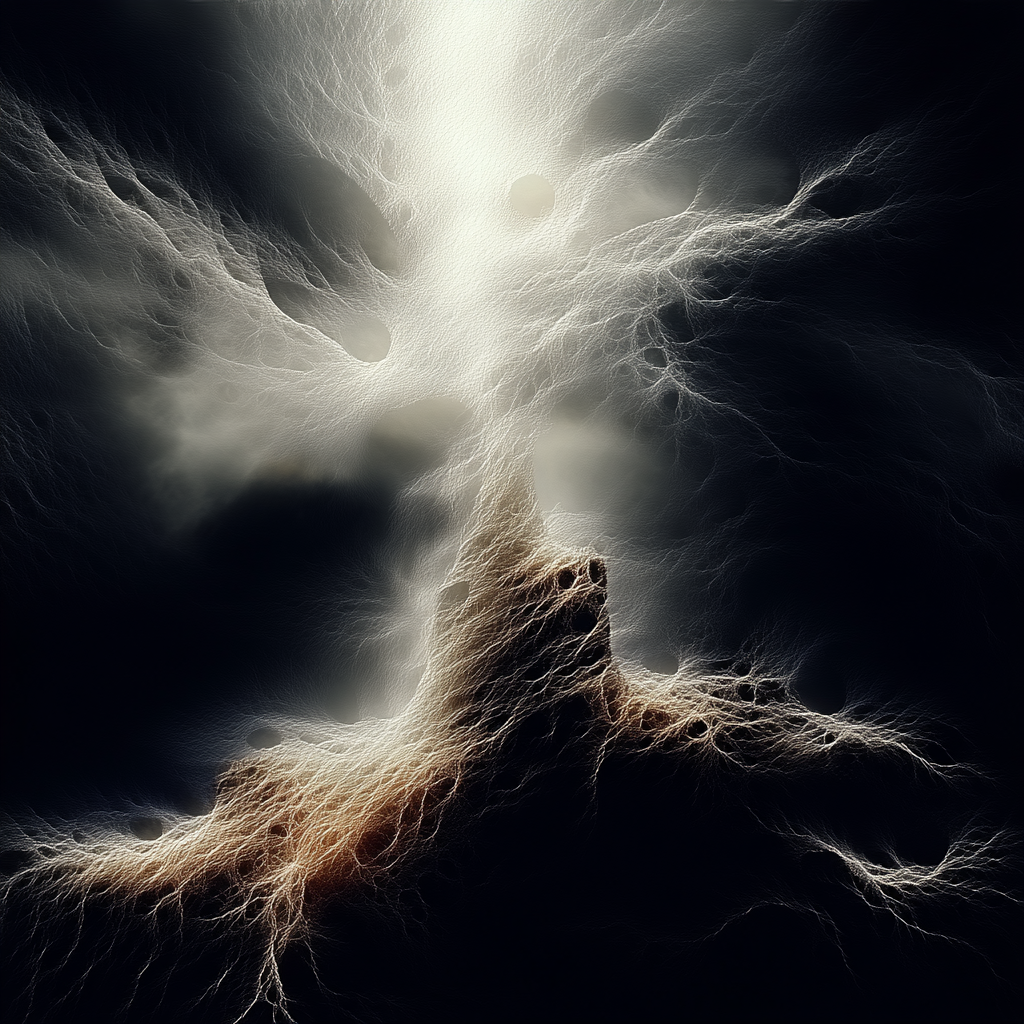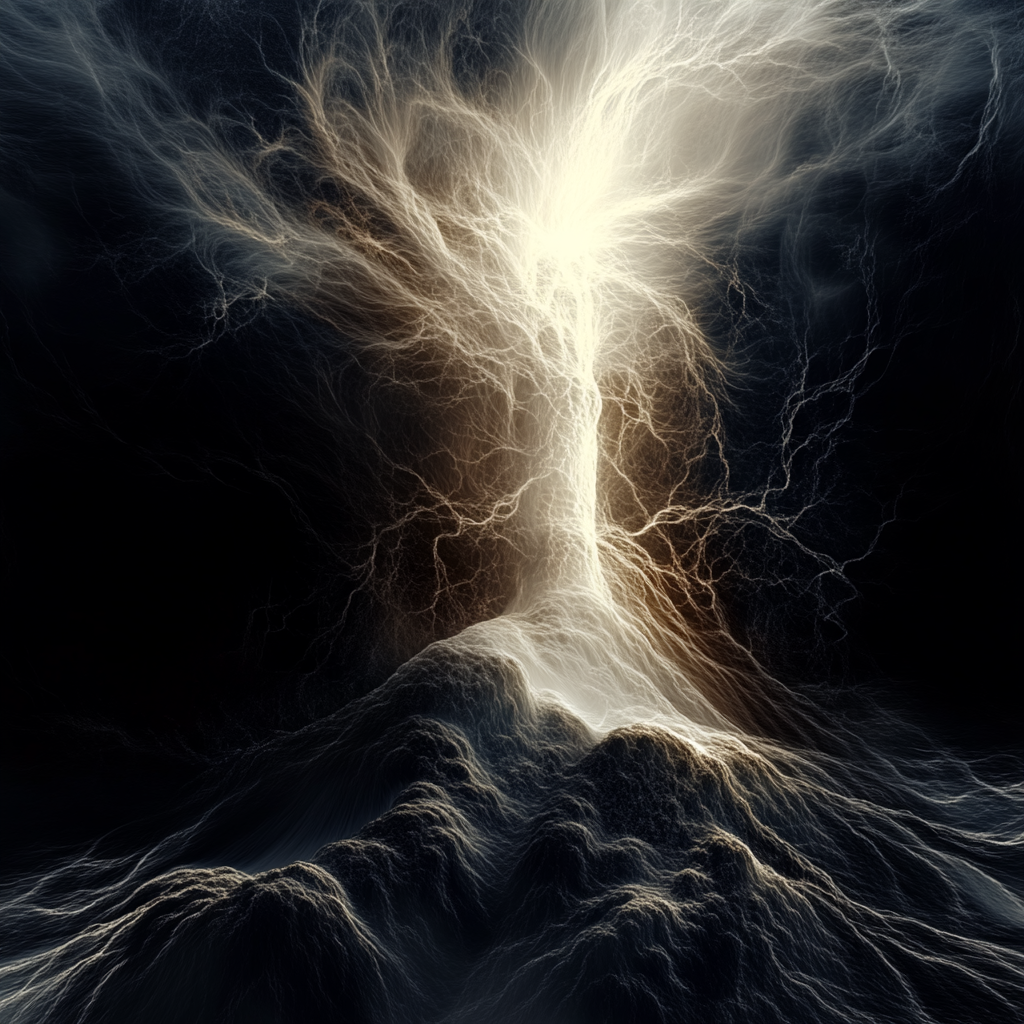
Aucune interprétation


« Interprétation » ©Philippe Quéau (Art Κέω) 2025

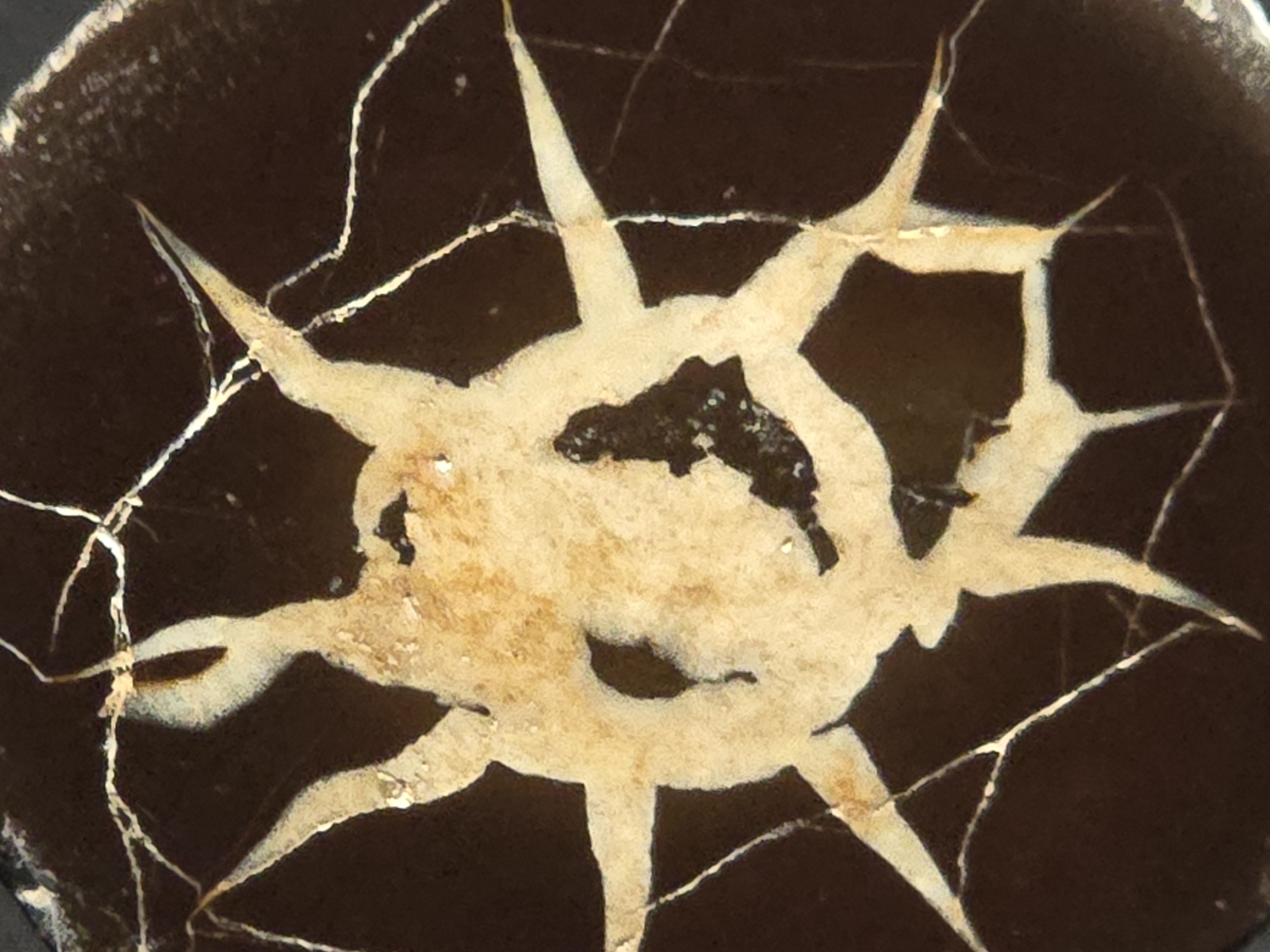
Loin des foules agitées, indifférent aux aigres sarcasmes, détaché de toute arrogance, je songeais aux intuitions insoupçonnées. Dans l’ombre blonde, au pied d’une falaise rousse, j’agrippais des rocs indemnes de profanations citadines, je les serrais de mes mains sincères. Mon esprit, par instants, entrevoyait l’éternité. Dans la nuit, se dissolvaient lentement des sons inspirés, et s’atténuaient les désirs. Bientôt l’aube assoupie s’éveillerait, avec ceux qui luttaient pour la joie et la paix, avec ces bardes que le laurier n’avait pas ceints, avec ceux qui passeront le jour sans rêve ni repos, traversés par le doute, et ceux que n’étreignent pas des bras aimés. Quant à ceux pour qui l’or des songes suffit, les serfs ou les seigneurs, qu’ils soient humains ou non, célestes ou terrestres, qu’ils ne s’approchent pas de la cime, même en tremblant. Ils cherraient.

Libres, nous chantions autour de coupes pleines d’une noble et rubescente boisson. Dans la pénombre du soir, nous buvions le cœur tranquille. « Vous, déités festoyant bien trop haut !, descendez donc en vents frais, émergez, vous-toutes, grouillantes, des tombeaux blancs ! Venez vous joindre à nous, ici-bas. Étonnez-vous de nos danses, grisez-vous de musique et de poésie… », disions-nous, éméchés. Nous ne savions pas que leurs cieux ne subsisteraient pas longtemps. Nous les connaissions pourtant déjà, quelque peu, eux incompréhensibles et nous alliés, avant même de nous être jamais rencontrés.

J’étais sidéré par des rêves d’enfants, dans l’interstice des jours bleus, sous quelque tonnelle, ou allongé paisiblement sur du sable chaud ; mes sensations s’éveillaient, du divin se mouvait en moi, un doux vent planait. Un jour, l’insouciance se déchira, comme un son strident perce l’ouïe. Fatigué de la suite des jours, l’ange quitta ma compagnie. Elle vint, implorant en vain les plus petites créatures ; à travers l’éclat des soleils, j’allais aveuglé. Je contemplais ces visages fidèles. Je ne trouvais aucune interprétation convenant à leur sourire.

The Soul’s Wave Packet


« …. —>|________>|—…. » ©Philippe Quéau (Art Κέω) 2025

……………………… |——– >|__________________________>|——………….. ?

The diagram above is a simplified representation of the “line of existence” of all beings who emerge from nothingness to enter life, then pass from life to death, before returning to nothingness. The diagram uses dotted lines ….., dashes —-, two arrow brackets >, three vertical bars | , a continuous line segment ______, and ends with a question mark. This is an attempt to symbolize the timeline of all individual existence. Starting from the left and moving to the right, we first see a dotted line representing the passage of time, from the distant past to a certain special, unique moment: the conception of a living being. For practical reasons, this line has not been represented in its entirety. In theory, it should begin at the very origin of time, say at the date of the Big Bang. We have limited ourselves to showing its final part, just before the appearance of a first vertical bar and a dotted line, which represent the period of time between the conception of the human being and its birth. The first arrowed parenthesis represents the process of childbirth, while the second vertical bar symbolizes birth. The solid line represents the duration of life in this world. The second arrowed parenthesis denotes the period preceding the moment of death, itself symbolized by a third vertical bar. The second series of dashes represents an intermediate period during which, according to certain traditions, the soul of the being in question continues to be present in this world. Finally, the last dotted line symbolizes a new period, that of the decomposition of the body, followed by the descent into “nothingness” that will ensue, until a hypothetical end of time, represented by a question mark.

Why this diagram? Because it allows us to spin the few spatio-temporal and physico-metaphysical metaphors that follow.

The “slice of life” between birth and death can be likened to a space-time segment belonging to the space-time associated with the entire universe. This segment of “life” has indeed existed in space-time, and will continue to exist as such for as long as space-time itself exists. In other words, even long after the death of a living being, the entirety of its “life” will continue to be stored in the lines of space-time corresponding to its passage on earth, symbolized here by the continuous line segment. Just as the “cosmic microwave background” continues to bear witness to the appearance of a primordial illumination emitted after the Big Bang, so too will everything that existed in a part of the universe during a specific period of time continue to be inscribed in the very substance of space-time, at least as long as the latter still exists. The latter represents a kind of repository of everything that was, everything that is, and everything that will be. A pure observer, that is, one outside this universe and therefore independent of its space-time, would be able to visit every corner of it in spirit, and perhaps virtually “relive” all the events recorded in the space-time segment associated with a particular “slice of life.” Let us suppose, for a moment, for the sake of this conjecture, that there exist outside this universe dematerialized intelligences, freed from all ties to any space-time corporeality, which would in theory be capable of freely flying over and exploring the entirety of the space-time corresponding to this universe, from its origin to its final collapse. All the “slices of life” of all living beings would thus be preserved in their entirety in this space-time, as if in metaphysical Plexiglas blocks, displayed in the windows of the total museum of the universe.

For a long time, the idea of a dualism of soul and body has been defended by philosophers such as Plato and Descartes. Furthermore, and completely independently, quantum physics has familiarized us for about a century with another fundamental dualism, that of the wave and the particle. For the sake of speculation, I propose to compare these two forms of dualism (soul/body and wave/particle). The soul would then be to the body what the wave is to the particle. If we take the metaphor further, certain results of quantum physics could allow us to formulate new hypotheses about the relationship between the soul and the body. Indeed, we could postulate the existence of “fields of consciousness,” just as gravitational fields and quantum fields exist throughout the universe. These fields of consciousness, like quantum fields, could be associated with wave functions. The birth of a new soul in a particular body could then be compared to the “collapse” or “reduction,” in the quantum sense, of a “wave packet of consciousness” that had previously remained in a state of indeterminacy. This collapse or reduction would follow the interaction of a certain wave packet with some “mother matter” consisting of the first cells of the fetus, shortly after conception. The individuality and personality of a singular soul would initially be “informed” by the entanglement of this wave packet with the fetal cells at the moment of “reduction,” and then constantly influenced by other forms of entanglement throughout life. Life would follow its development, gradually conquering different levels of consciousness, according to the experiences lived. Throughout life, the “body-soul” complex would be continuously entangled with fields of consciousness of different natures. It would be analogous to what is called in physics a “black body,” i.e., “an ideal object that perfectly absorbs all the electromagnetic energy (all light regardless of its wavelength) it receives (hence its name ‘black’) and restores it entirely in the form of a particular thermal radiation, known as black body radiation.” This analogy would allow us to imagine the “body-soul” complex of a living being as also absorbing the energy of the various fields of consciousness in which it is immersed, releasing it in the form of “radiations of consciousness,” of which the soul would be particularly aware when they “illuminate” it. When death occurs, at the moment represented in our diagram by the third vertical bar, a process of disentanglement of the soul and the body takes place, until the soul and the body are completely separated. When this process ends, symbolized by the second series of dashes, the soul takes the form of a new “wave packet of consciousness,” enriched by all the experiences it has had, conscious or unconscious, and more particularly by all the ‘awareness’ that has taken place during its life. This “awareness” is distributed throughout life. In fact, at every moment, consciousness is capable of “becoming aware” that it is itself a consciousness capable of becoming aware of itself. I will use one last metaphor here, which will undoubtedly speak to those who have some knowledge of elementary mathematics, that of Taylor series i. At any point on a curve associated with an infinitely differentiable function, all the information needed to fully define this function at all its other points is available. This information consists of the set of all derivatives of the function at the point in question. If we apply this mathematical metaphor to the wave function of the soul, it means that at every moment of the soul’s life, it carries with it its entire past and future life—but only if it is “indefinitely differentiable.” However, the life curve of a soul cannot be presumed to be “indefinitely differentiable.” This curve has singular points, represented in our diagram by vertical bars. Conclusion: the metaphor of Taylor series applied to the soul has only limited scope, but it opens up an interesting avenue: the soul can be likened to an infinite wave function, whose associated quantum field not only fills this universe in its own way, but also transcends it.

_____________________

i In mathematics, and more specifically in analysis, the Taylor series at point a of a function f (real or complex) that is infinitely differentiable at that point, also called the Taylor series expansion of f at a, is an entire series approximating the function around a, constructed from f and its successive derivatives at a. (Wikipedia)

La « Minne » de Hadewijch


« Minne » ©Philippe Quéau (Art Κέω) 2025

Hadewijch, au centre de sa vie, mit la Minne. Ce mot thiois i signifie « amour » ‒ l’amour de l’âme. Plus précisément, la Minne dénote la pensée en amour, la pensée de la personne amoureuse envers la personne aimée. Pensée vivante, qui se renouvelle en permanence. Elle se distingue nettement de Lieve, cet autre mot thiois, qui signifie l’amour humain, charnel. La Minne, elle, vit dans l’intime de l’âme. La Minne est l’âme aimante même. Par anagogie, Hadewijch a vu que la divinité est, en essence, la Minne. Comme l’est aussi la substance de l’Esprit. Dans la langue de Hadewijch, pleine de vie, toute prégnante de Minne, abondent verbes substantifs, formes incisives, tournures nettes, envolées profondes, et acceptions larges, lourdes de tous les prolongements possibles, pour qui consent à s’y plonger. En son écriture, dominent passion, force, grandeur, beauté, fierté, noblesse, rigueur. Elle évite le doucereux, elle fuit le fade, tout ce qui sentirait les tiroirs de la sacristie, l’odeur des bénitiers vides. Hadewijch voit la fin de l’homme, non dans quelque « salut », mais dans la gloire même de la Minne, dans son âme unie à la Minne. Elle craint toujours de ne jamais la servir assez, de la manquer absolument, de ne pas l’étreindre entièrement. Elle ose donc le plus, l’immense et toujours plus encore, de peur d’offenser par trop de petitesse l’infini de la Minne. Ce service est austère, terrible, astreignant. La Minne a des exigences rigoureuses, infrangibles, irrémissibles. Hadewijch y revient ans cesse, elle s’en emplit, elle s’en nourrit, y cherche l’abondance, sans besoin de la vacuité, de la nudité de l’âme, qu’osera prôner, un siècle après elle, Ruysbroeck. La Minne demande un effort positif, puissant, sans relâche. L’âme doit vivre de la Minne, elle doit condamner et bénir, aimer et haïr, se fuir et s’unir, en restant toujours avec elle; elle doit mettre la Minne en chaque chose, et chaque chose en elle, en son lieu. Quelles que soient les dispositions de la Minne à son égard, l’âme y consentira. Elle aura à en souffrir ou à en jouir. Cela n’importe. Ce qui importe, c’est d’être avec elle. La Minne est excessive, virevoltante, imprévisible, fulgurante, transcendante, poétique. La Minne « se détourne de l’âme, fuit devant elle, sans qu’elle puisse l’atteindre, la jette en exil, la bannit au loin, la condamne à courir les aventures à sa quête ; la jette dans les chaînes ; ne s’approche d’elle, ne fait sentir sa présence que par moments fugitifs ; ne la rassasie que pour augmenter sa faim, ne l’apaise que pour la livrer à de nouveaux et plus effroyables orages, la blesse de ses traits, sans remèdes, l’accable de tout le poids de ses exigences, la pousse dans des dédales obscurs, dans les nuits sans lumière, dans les ténèbres sans issue; ouvre sous ses pas les abîmes, amoncelle dans son pays les ruines, la dévastation et la mortii ». Est-il vraiment nécessaire de citer ici l’anachronique Musset, mort six siècles après Hadewijch ?

Que ta voix ici-bas doive rester muette.
Les plus désespérés sont les chants les plus beaux,
Et j’en sais d’immortels qui sont de purs sanglotsiii.

Les chants de Hadewijch sont-ils immortels ? Je ne sais, mais Musset en savait qui étaient, dit-il, « de purs sanglots ». J’en connais de Hadewijch qui sont de vrais brûlots :

« Souvent je crie à l’aide comme femme en gésine : aimé, quand vous viendrez, éperonnez-moi par un nouveau réconfort. Ainsi je puis chevaucher d’un trot altier et, béate, traiter mon aimé comme si nord, sud, est et ouest étaient entièrement sous mon empire. Mais me voici bientôt jetée à terre. Ah ! En quoi cela m’aide-t-il de parler de mon exiliv? »

L’exilée était-elle désespérée ? Évidemment non. Tout le contraire. Encore faut-il lire en son cœur l’au-delà de l’espoir. « La vie la plus haute et la croissance la plus rapide c’est de s’anéantir et de se perdre dans les souffrances de la Minne. Aux douceurs sensibles il y a plus de bassesse ; car en cela on est facilement vaincu et ainsi faillit la force du désir. Et ce qu’on ressent paraît si grand qu’on n’arrive plus à connaître la grandeur de la Minne et son Être parfait. Car lorsque le cœur et les sens inférieurs, qui sont vite remplis, sont touchés d’après notre affection sensible, ils sont comme un ciel dans les cieux, c’est ce qui leur semble. Et dans cette satisfaction ils oublient la grande dette de la Minne qui la leur réclame sans cessev. »

Un ciel dans les cieux ? Qu’est-ce à dire ? Serait-ce le troisième ciel de Paul ? Ou quelque ciel n°7 ou n°9, d’extatique et suprême élévation ? Ce sont là comptes d’apothicaires. Les cieux ne se comptent pas. D’ailleurs, je conjecture qu’il y a peut-être un million de cieux encore jamais vus de quiconque. Ou même, six cent trillions de trilliards ? De quoi se perdre en chemin, pour s’y rendre. « Celui qui veut explorer de bout en bout la Minne doit voyager loin : par sa vaste étendue, sa plus haute altitude, son fond le plus profond. Il devra distinguer les chemins par toutes les tempêtes. Celui-là découvre la merveille de la merveille la Minne, en s’engageant dans son étendue sauvage vi. » J’entends que les cris les moins espérés de Hadewijch se fondent toujours dans un chant d’abandon uni, confiant, total, dans un hymne d’espérance et de triomphe. L’oubli complet, le don total, la perspective de la souffrance, leur donnent un caractère grave, sévère. Hadewijch est forte plus que douce, austère plus que facile, elle n’est ni médiévale ni moderne, elle est en route vers des éternités non-sues.

Vivre avec la Minne, c’est vivre dans la lumière, dans la clarté, dans la vérité. Ces trois mots-là strient ses textes. Elle parle de vérité, en la vivant vraiment. Elle aime, et c’est pour elle souffrir; on ne peut aimer sans souffrir, dit-elle. La souffrance est inhérente à l’amour. L’âme toujours en cela souffre. Voici la raison qu’elle donne : c’est là, la loi de l’amour ; la souffrance stimule, élève, purifie, enflamme, elle empêche de se contenter de joies inférieures, elle tend constamment l’âme vers le seul but digne d’elle. L’âme doit souffrir, parce que la divinité elle-même souffre, et c’est assez de le savoir. La vie mystique, c’est vivre sachant cela. L’Humanité est en gésine, en travail, en souffrance. Vivre en la Minne, c’est vivre en progression, en croissance continuelle. On monte sans fin de degré en degré. On y côtoie des vertus, proche du sentiment de la Minne, au dessus du tumulte des choses et des actes. Elle a cette idée d’être la Minne même, qui dépasse tout ce que l’on peut imaginer. Ce sont là des stades, quelques étapes. Dans les « visions » de Hadewijch, on distingue deux grands moments : il y a celui où l’âme est ravie en esprit, hors des impressions sensibles ; elle voit, elle entend, elle comprend ce qui lui est montré ; et il y a celui où elle tombe hors de l’esprit, dans une union pleine ; alors elle ne voit plus, elle n’entend plus, elle ne sait plus qu’une chose, c’est qu’elle s’est unie à la Minne. Elle voit l’essence divine en cette vie, ce qui, en théorie, ne se peut. Et pourtant, elle a vu l’entrée dans l’Un et la sortie de l’Un. Dans sa mémoire, résident la force, la gloire et l’éternité ; dans sa raison, demeurent la clarté et la vérité ; dans sa volonté, s’éploie l’amour de la douce Minne. Visions vigoureuses d’un cortège de reines aux manteaux à mille yeux, sous des palmes balayant la poussière des soleils et des lunes, entourés d’abîmes sans fond. Vouloir vivre la puissance et la gloire de la jouissance de l’abysse. Vouloir être Dieu avec Dieu. Certes, mais, il est fort peu d’âmes qui veulent vivre l’humain jusqu’à la fin, et diminuer la dette de l’humanité. Quelle dette ? Celle de l’être, doublée des intérêts de l’ignorance. Nous pouvons connaître en nous-mêmes la puissance de notre désir, et l’immensité de notre impuissance. Nous sommes sans lumière, l’esprit gourd et court. Notre être nous semble sans substance, sans constance, et notre intelligence sans vérité. Nous errons parmi les millénaires, malheureux et misérables, dépouillés de passé et d’avenir, en des pays toujours étrangers, sous des cieux vides. Cela, avant que la Minne rompe toute digue, avant qu’elle enlève l’âme hors d’elle-même et la touche intimement. Pas la moindre manie, pas la moindre folie ne ternit son teint médiéval. Un solide bon sens, un esprit acéré accompagnent au fil des jours la dame anversoise et mystique, si loin, si haut qu’elle aille. Aussi longtemps que la douceur dure en elle, elle est avec la Minne ; quand la douceur s’en va, l’amour s’enfuit et le champ reste sec et rude. Les sages anciens le savaient bien, qui ne cherchaient que la volonté de la Minne ; ils ne demandaient d’autre douceur que de reconnaître sa volonté, qu’ils fussent en haut, ou en bas. Mais s’ils éprouvaient de la douceur, il arrivait qu’ils s’y délectassent trop, ils s’y abandonnaient au point de tomber. L’âme est une route verticale, qui offre aussi un passage vers la liberté des profondeurs ; et ces profondeurs sont d’autres chemins vers d’autres libertés, vers des hauteurs qui ne peut être saisies, sauf si elles se donnent ; et si elles ne se donnaient pas tout entières, elles ne lui seraient pas assez. L’âme et l’abîme : deux absences en cheminement, qui veulent se trouver ! Dans l’une de ses visions, se rencontre cette image saisissante : « La Déité est si terrible, si implacable, dévorant et consumant sans merci. Enserrée dans le lit d’un petit ruisseau, l’âme, inondée, déborde et rompt soudain ses digues. Ainsi la Divinité a absorbé en elle toute l’humanitévii .» Elle est au-dessus de tout, sans être élevée, en dessous de tout sans être accablée, au dedans de tout sans être enveloppée, au dehors de tout et cependant en tout. Elle connaît donc son exil, n’y trouvant pas sa Minne amante. « Car [la Minne] est dans la hauteur de sa jouissance, et nous sommes dans la profondeur de notre déficienceviii ». Jouir, en thiois : ghebruken ; manquer : ghebreken. Au fond du fond, le ghebreken se rapporte au ghebruken absolu ; le manque humain est à la mesure divine de la Minne.

_______________________________________

iMinne (subst. féminin), mot commun au thiois (néerlandais médiéval) et à l’allemand, se rattachant étymologiquement au latin memini, mens, à l’anglais mind. Cf. Hadewijch. Lettres spirituelles. Genève 1972. Introduction par J.-B M. Porion, note 14, p. 19

iiSelon l’interprétation qu’en fait J. Van Mierlo. Revue d’Ascétique et de Mystique. N°19, Juillet 1924

iiiAlfred de Musset (1810-1857). Le Pélican.

ivHadewijch. Les Chants. Chant 9. Trad. Daniel Cunin. Albin Michel, 2022, p. 118

vHadewijch. Lettre XXX

viHadewijch. Les Chants. Chant 21. Trad. Daniel Cunin. Albin Michel, 2022, p. 157

viiHadewijch. Les Visions. Trad .G. Epiney-Burgard. Genève 2000, p. 72

viiiHadewijch. Lettre VI. Dans une autre traduction, celle de J.-B M. Porion, on lit : « Il est au sommet de la fruition et nous sommes dans l’abîme de la privation. ». Lettres spirituelles. Genève, 1972, p. 83

Death Instinct v. Survival Instinct


« Survival Instinct » ©Philippe Quéau (Art Κέω) 2025

A Podcast Summary in English of Philippe Quéau’s Blogpost: « Instinct de Mort et Instinct de Sur-Vie »

The Unconscious God


« Job » ©Philippe Quéau (Art Κέω) 2024

For the consciousness that reflects on the presence of Evil in the world, it is impossible to believe that God can identify with the ‘Sovereign Good’, the Summum Bonum, with which Christian philosophy associates Him, as a matter of course. According to Isaiah, YHVH says of Himself that He is « creator of evili  » and that He « makes all this [evil] ». However, on this thorny question of Evil (is it « created » by God or not?), almost all Christian theologians tend to devalue the authority of Isaiah out of hand, or of the prophet who is supposed to be the author of chapter 45 of the Book of Isaiah. But in his seminal book, Answer to Job, C.G. Jung offered some stimulating views on this subject, based on the idea of conjunction or union of opposites. « Clement of Rome professed that God ruled the world with a right hand and a left hand. The right hand meant Christ, the left Satan. Clement’s conception was clearly monotheistic, since he united opposing principles in one God. Later, however, Christianity became dualistic to the extent that the part of the opposing elements, personified by Satan, is dissociated, and Satan is banished in a state of eternal curse. This is the central problem. It is of essential significance, and lies at the root of the Christian doctrine of salvation. If Christianity claims to be a monotheistic religion, it cannot do without the assumption that opposites are unified in one Godii. » The resources of depth psychology can indeed be mobilized to explore (heuristically) the question of Evil in the divine project. But first we need to reread the Jewish and Christian Scriptures that deal with it, such as the Book of Job, the Book of Enoch (and the other books of Jewish Apocalypticism), certain Prophets, and the Gospels. Logically, a God who is both the ‘creator of the world’, ‘omniscient’ and ‘omnipotent’, naturally has an undeniable responsibility for the presence of Evil in this world he is supposed to have created with full knowledge of the facts. His supposed omniscience should have informed him in advance of the particularly harmful role of Evil in the economy of his own creation (at least, from a human point of view). Moreover, God’s (supposed) omnipotence could (should?) have enabled him to eradicate a priori any future presence of Evil in the world, even before creation. Had he really wanted to, God could have created a world devoid of all Evil, couldn’t he? But he didn’t. Why didn’t he? Moreover, why does He reveal to Isaiah that He « creates evil », not once and for all, in the beginning, but ever continuously, as acknowledged by the use of a verb in the imperfect mode of Hebrew grammar (« vore’ « ) ? How could a « good » God voluntarily create evil, allowing it to enter His creation and develop at will? How could an omniscient God, capable of foreseeing the perverse role of Evil, allow it to arise and subsist? We have to choose. God cannot logically be « good », « omniscient », « omnipotent » and « creator of evil » all at the same time. Taken together, these attributes are intrinsically contradictory. Solutions to the dilemma have been proposed over the millennia, such as dualism and Manichaeism, which differentiate between « good » and « evil » Gods. But this is too easy a solution, and incompatible with the monotheistic paradigm of the « One » God. The only remaining possibility is to envisage the idea of a « One » God who unites opposites in Himself, including good and evil. Since He cannot consciously unite them in Himself (if He is « good »), this means that He unites them in His own Unconscious.

Further questions arise. How can such a God demand that believers both « fear » Him (as a God who chastises, and can let Evil loose on the world) and « love » Him (as a God who saves, and brings souls to life)? The fear that the biblical God is supposed to inspire in the believer is a further element of incomprehension for a critical consciousness. Why should we fear at all a supremely good God, the God of Summum Bonum?

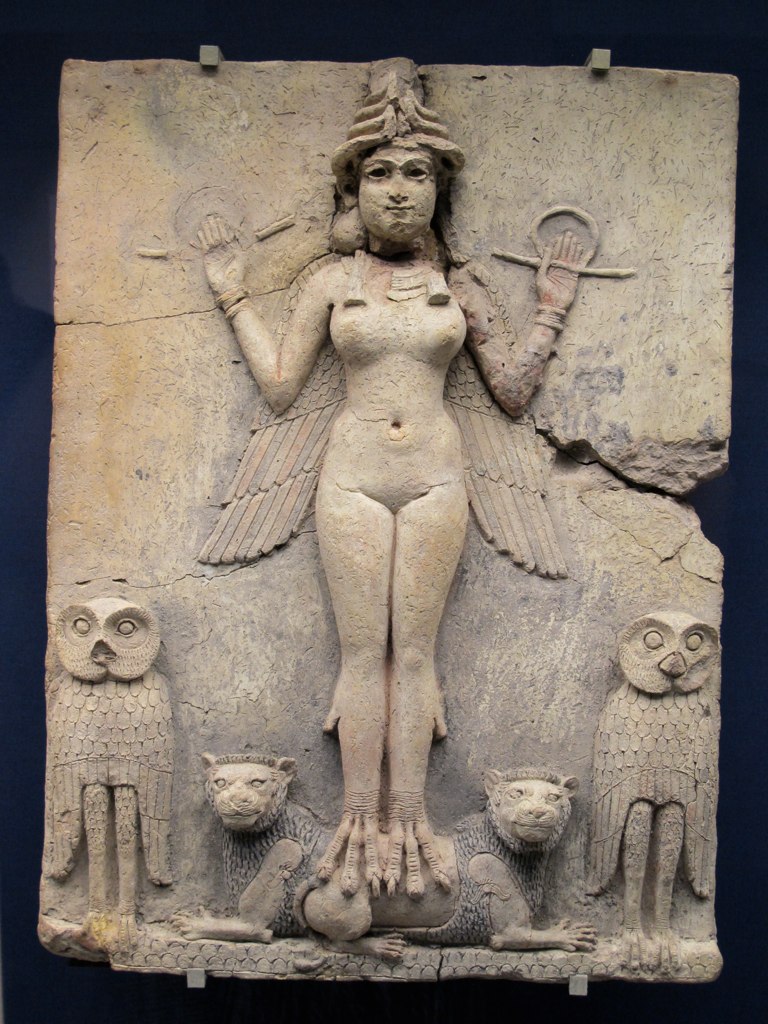
The theory of the saving Messiah, who sacrifices Himself to save sinful mankind, is also difficult to understand. How can a supremely good God let His own ‘Son’ be sacrificed to save mankind from the Evil that the same God has knowingly allowed to flourish in the world? How can a ‘good’ and ‘just’ God let men put His Son to death, precisely in order to save mankind from His own wrath, and from the punishment He intends to inflict on mankind? A ‘good’, ‘just’ and ‘omnipotent’ God could have eradicated Evil by His almighty power, or He could have unilaterally erased mankind’s faults. We can’t evacuate these questions with arguments of authority. A critical consciousness cannot be satisfied with theological decisions. But we can also assume that this question is neither theological nor philosophical. Rather, it is anthropological and psychological. Moreover, it’s important to stress that the paradigm of divine sacrifice for the benefit of Creation is an anthropological constant, spanning millennia and cultures. We also find this idea with Prajāpati in India, Inanna in Sumer, Osiris in Egypt, Dionysus in Greece, Jesus in Israel … a long litany of various Deities sacrificed for the benefit of mankind.

The most important thing is to realize that, in the case of the biblical God, capable of blatant injustice, anger, jealousy and even unfaithfulness to the promises He Himself made, the injunction to love and praise Him as a « good » God is a contradictory injunction. How can we love a « good » God who constantly creates evil, on His own admission? How can a truly critical consciousness understand a God who is essentially, ethically and logically contradictory?

To all these questions, Jung proposes this rather paradoxical answer: God is actually « partly unconscious ». He is unconscious of who He really is (and how He affects His creature). Only an unmistakable lack of « reflection » in « God’s consciousness » can (logically) explain His inexplicable behavior (from the particuliar point of view of human consciousness). The consequence of this unconsciousness is that God can only suffer a « moral defeat » when confronted with the critical consciousness of his creatures, revolted by the injustice of their lot. The paradigmatic example of this revolt is Job. Through this « moral defeat », man finds himself subjectively and unexpectedly elevated to a new level of awareness of God. Simply by being aware of being confronted with an unconsciously immoral God, Job, or for that matter any other critical consciousness, can in fairness take Him to task, and push Him to His limits. God’s such « moral defeat » provokes a profound upheaval in humanity’s (collective) unconscious. Man acquires greater ‘moral value’ in his own eyes. This new ‘moral’ status invades man’s unconscious, filling the ‘void’ left by the ‘unconsciousness’ (or the ‘absence’ ) of God. Unconsciously, man feels morally « grown up » in relation to the conscious, devalued self-image he continues to have. In these circumstances, other latent potentialities of the unconscious are just waiting to burst into consciousness, in the form of dreams, visions, revelations and prophecies. In the first half of the 6th century B.C., the prophet Ezekiel had visions that were symptoms of the fractures between human consciousness and the collective unconscious, in very troubled times. At the same time, Siddhārtha Gautama (b. 562 B.C.), also known as the « Great Spirit », the « Awakened One » or the « Buddha », introduced the world to new possibilities for human consciousness, judged capable of going beyond brahman itself, and reaching parabrahman (the supreme, absolute brahman)… The brahman, which is the origin of All, is also referred to as the ātman (the Self), and as sva (the Sanskrit word that gave rise to the word « self » in English and « soi » in French). Another of his names, in the Vedic tradition, is Prajāpati, the Lord of Creation. In Hinduism, brahman is the cosmic consciousness present in all things, the immanent Self in all being, the Absolute, both transcendent and immanent, the ultimate principle that is, without beginning or end. But it’s important to stress that, above brahman, consciousness can find an even more absolute parabrahman. The race of consciousness towards new heights seems endless. Ezekiel didn’t go that far, however. But he did grasp, in his own visions, that in a sense YHVH had come closer to man. Yet neither Ezekiel nor Job seem to have consciously realized the disturbing fact that their own consciousness (and potentially all human consciousnesses) could turn out to be ‘higher’, in a way, more critical, than YHVH’s own.

It is particularly significant that Ezekiel was the first prophet to quote the expression ‘Son of Man’- Ben-Adam, which YHVH uses on numerous occasions to designate Ezekiel. In the Jewish canon, Ezekiel is the only prophet to be named Ben-Adam by YHVH, with the exception of Daniel who is also called in this way – but by the angel Gabriel. Later, Jesus of Nazareth used the expression « Son of Man » several times, but he innovated by using it to designate himself and to make it a messianic title. For the first time, Jesus formally established the identity of the « Son of Man » and the « only-begotten Son » (of God). One of his disciples, Stephen, exclaimed when he was stoned to death, in the presence of Saul (the future Paul), an accomplice of his torturers: « Ah! » he said, « I see the heavens open and the Son of Man standing at the right hand of God ». It is important to note that the image of the « Son of Man », seated or standing « at the right hand of God », which is also found in the Book of Revelation, was not a Christian innovation. It had already been used for several centuries in Jewish apocalyptic texts, most notably in the three books of Enoch. Today, we can interpret this name, Ben-Adam, as a kind of testimony to God’s awareness of his own unconsciousness.

___________________________

iIs 45:7וּבוֹרֵא רָע ; אֲנִי יְהוָה, עֹשֶׂה כָל-אֵלֶּה (vou-vore’ ra‘ ani YHVH ‘osseh koul-’élêh) « And I, YHVH, am the creator of evil, I make it all » (Is 45:7)

iiC.G. Jung. Answer to Job. Buchet/Chastel, 2009. See also C.G. Jung. Mysterium Conjuctionis. Albin Michel, 1982.

The Star, the Stone, the Oil and the Self


« Self 2 » ©Philippe Quéau (Art Κέω) 2024

Nicholas of Flüe, a Swiss mystic of the XVth century, « the only saint by the grace of God known to Switzerland270 » had prenatal visions—a famous case of fetal consciousness. Marie-Louise von Franz, spiritual heiress of C.G. Jung, has dedicated a book to him, which begins with this precise, heartfelt account: « Henry am Grund, friend and confidant of Nicholas of Flüe, told how Brother Claus [the name by which Nicholas of Flüe was known in Switzerland] had a vision in his mother’s womb, even before he was born. ‘He had seen a star shining in the sky that lit up the whole world; […] so he explained that this meant that anyone could say of him that he shone so brightly in the world. Furthermore, Brother Claus had told him that, before he was born, he had seen in his mother’s womb a large stone that represented the firmness and constancy of his being, in which he had to persist in order not to abandon his enterprise (or his nobility). That he had, on the same occasion and still in his mother’s womb, seen the holy chrism; then, after being born and seeing the light of day, he had recognized his mother and the midwife; he had also seen how he was being carried through the Ranft valley towards Kerns to be baptized, all with such vividness that he had never forgotten it, and had retained an image as clear as when the vision had occurred. In the same circumstances, he had also seen an old man standing beside the font, but he didn’t know him, whereas he recognized the priest who was baptizing him’271. »

From the outset, the contemporary reader is faced with a dilemma. Is this text to be taken seriously, or is it rather a jumble of fallacies and pointless fantasies? How could a fetus have « visions » and then remain conscious of them for the rest of its life? “This account by Brother Claus is disconcerting in the extreme, and presents us with a most difficult problem: either we are dealing with a unique, unheard-of miracle in which a fetus or a new-born baby had perceptions of which it subsequently retained a conscious memory, or we must conclude that the account is fallacious272.” Unheard-of miracle or laughable allegation? Whatever the case, these « visions » are of intrinsic interest, as a testimony to the variety of psychic powers and their relationship with the real world, and with history. In this case, the link between these visions and the reality and history of Switzerland cannot be denied. They visited the mind of the only Swiss ever to be canonized273 by the Catholic Church. Nicholas of Flüe died in 1487 « in the odor of sanctity ». He had won the veneration of his compatriots after saving Switzerland from a fratricidal war. But what’s most interesting about Nicholas of Flüe’s « visions » are the « symbols » and « archetypes » that appear in them: the star, the stone, the oil (chrism) and the old man. Marie-Louise von Franz comments: « First we have the star, which is the image of the Self and of the ‘inner light’ projected into the farthest regions of the universe. Next comes the stone, representing the star descended to earth, now tangible, palpable, so to speak; and finally, we are in the presence of the oil, which is in a way ‘the hidden soul of the stone’, or, in the language of the Church, the substance in which the Holy Spirit manifests Itself. In faith of this, we can see that oil is the symbol of the meaning that orients man towards the numinous presence of divinity, a meaning that stands out against the backdrop of synchronicity phenomena274. » Von Franz’s interpretation is in line with that of C.G. Jung, master of the depth psychology, and promoter of the concept of synchronicity along with physicist Wolfgang Pauli275. I’d like to go a step further, and present an interpretation of the symbols of Nicholas of Flüe’s vision from the perspective of a comparative anthropology of consciousness. The star symbol is one of the oldest in existence. The cuneiform sign that represents the idea of « God » has the shape of an eight-pointed star 𒀭, reading AN or DINGIR in Sumerian. The center of this cuneiform can be seen as the point of intersection, or convergence, of four distinct, centripetal strokes. It could also be seen as the source of centrifugal radiation, flowing in the eight cardinal directions. I interpret it as an image of consciousness, or an ‘image of the Self’. The graphic dualism of the cuneiform star can also be seen as a metaphor for wave/corpuscle dualism. The central point of the star 𒀭 symbolizes the « corpuscle », and the eight rays from it symbolize « waves ». From a psychological point of view, the center of the star 𒀭 symbolizes the « self ». Radiation represents the relationship of the self with the outside world, with the « other ». In the Self, the « I » and the « other » are psychically intertwined, just as are intertwined waves and quantum particles. The star is not just energy. It is also a « stone », supposedly inert, that has fallen to earth, in Von Franz’s interpretation of Brother Claus’s vision. The image of a falling stone is reminiscent of a meteorite striking the earth. Or, on a completely different note, it could symbolize the descent of a soul into a body, its incarnation. The symbol of the stone is also used in the Bible. There’s the foundation stone, aven, « well seated276« , and there’s its opposite, the stone « rejected by the builders », but become against all odds the « ridge stone277« . The dualisms of the cornerstone278 and the stumbling block279, of the « dark and shadowy » stone280 and the « living » stone281 » deploy other metaphors. The stone is a sacred symbol of the self, immutably fused with the Self of the world. And because stone, in the final analysis, always comes from elsewhere, from the far reaches of the cosmos, it is also a symbol of the unknown.

As for the image of « the oil of the hard stone », we find it in the 5th book of the Torah, Deuteronomy. In the « Song of Moses », YHVH makes his people taste « the honey of the rock and the oil of the hard stone282« . From this we can infer that this sweet, unctuous – and sanctified – oil is somehow the « hidden soul » of the stone. But, one might ask, is there really such an oil, such a ‘soul’, at the center of the hard stone? Is it not more reasonable to think that this oil only appears because it is expressed from an oleic substance by means of the millstone? The millstone grinds the olive or vine fruit to express its essence – oil or wine. In the Veda, the sacred book of a completely different culture than the Hebrew, the stone also grinds plants to extract the precious Soma, which is the essence of the Vedic sacrifice, and which is consumed by the priest during the rite rendered to the Vedic God, yet another unique and supreme Creator. How can we fail to see this as a permanent or even immanent paradigm? Under all skies, the millstone crushes and transforms into intoxicating liquid, sticky pour, or fine flour, what was once “one”—the ripe, rubescent grape, the black, naked flesh of the olive, the hard, golden grain of wheat. In Nicholas of Flüe’s dream, the star symbolizes the eternal Self, the stone signifies the incarnate self, and the oil represents the transmuted, transcended self. The stable, compact, resistant self must be liquefied. Through the ordeal of the millstone, its fine grinding, the multiple self becomes a single « oil ». It is thus even more unified than stone, seed or olive ever will be.

The fourth element revealed by Brother Claus’s dreams completes the symbolic quaternion with the « unknown old man », the archetype of the « wise old man », i.e. the Spirit. He corresponds to the « Ancient of Days » and the « Most Holy Old Man », nicknamed « White Head », in the Cabala283. Jung suggests that, in the case of Nicholas of Flüe, this figure represents « the personification of the ‘grain of salt’ that the newborn child receives in baptism, namely the Sapientia Dei, the Wisdom of God, within which God Himself is present284. » This “Most Holy Old Man”, or « Divine Wisdom », played a role throughout Brother Claus’s life, in the form of frequent apparitions.

The star, the stone, the oil and the « unknown old man » first appeared in Brother Claus’s brain as soon as his consciousness awakened. With Jung and Von Franz, we can consider that these symbols prefigured Brother Claus’ exceptional destiny. It’s also conceivable that, in the eyes of a rationalist or a positivist, the story of Nicholas of Flüe, with its prenatal visions and mystical intuitions, would seem perfectly inadmissible. Yet Nicholas of Flüe was indeed a « prophet in his own country », both religiously and politically. His wise counsel saved Switzerland in 1481, when a fratricidal war was brewing. Can we assume that his visions contributed to peace? Every vision is in some way « true » when it bears witness to a profound, immanent order. We can’t rule out the idea that Nicholas of Flüe’s visions contained a subtle, invisible but effective part of this hidden order.

The star-stone-oil triad represents an immanent process of transformation and transmutation of consciousness. It symbolizes the metamorphosis of light (consciousness), in three stages : its (cosmic) origin, its materialization (its ‘incarnation’) and its overcoming (its ‘sublimation’). The grinding of consciousness (or its ‘sacrifice’) opens the way to transcendence, just as holy oil, consecrated chrism (from Greek χρῖσμα / khrĩsma, ointment, perfume) becomes what the Hebrews anointed their « anointed ones » (their prophets and kings) with. Symbolizing the inner light of the Self, the star is the symbol of a light with a universal vocation, a light which from the beginning illuminates the entire cosmos, and which until the end will illuminate the consciousness of beings endowed with a singular soul. The stone, a piece of fallen star, symbolizes the Self incarnated in the ego, in living flesh. The oil represents the very consciousness of the Self. One, but fluid, it became chrism for the anointing of priests, prophets and kings, and is the symbol of grace.

Human and Non-Human Consciousnesses


« Chimère » ©Philippe Quéau (Art Κέω) 2024

The Psalmist sang of YHVH’s eternal, irrevocable covenant with David, his servant, his saint, his anointed. But why is he so bitter? He blames YHVH for his sudden breach of that covenant, his unilateral fickleness, his unpredictable anger. « And yet you have forsaken him, rejected him, your chosen one; you have raged against him. You have broken the covenant of your servant, you have degraded him, and thrown down his diadem259. » Wouldn’t the Psalmist be mistaken in his judgment? How could a God so One, so high, so powerful, be unfaithful to his own word? How could an eternal God be understood, let alone judged, by a fleeting creature, however inspired? Besides, if the Psalmist’s bitterness were to be justified, God forbid, wouldn’t it be better not to insist on this broken covenant, this broken promise? No power, whatever it may be, likes to be called into question, and even less to be challenged on its own ground, in this case that of the word and the promise. YHVH, it’s a fact, doesn’t like man’s critical thinking, this nothingness, to be exercised towards Him. Criticism tends to diminish the quality of the homage and praise He expects from His creatures. His power pervades the universe. His essence is eternal, of course. His existence is real, to be sure. However, this ‘power’ and this ‘existence’ only have real meaning if other, non-divine consciousnesses are aware of them, and praise Him for them. Without them, divine ‘power’ would remain self-centered, solipsistic, centripetal, in a way ‘selfish’, or at least ‘egotistical’. And, by the same token, would it not reveal a ‘lack’ within the divine? To make up for this ‘lack’, there is a kind of intrinsic necessity for other consciousnesses to come and fill it, and for some of them to be able to freely recognize the ‘power’ at work, as a condition of existence, of life, of all forms of consciousness. This is why we can infer that the Creator, in His omnipotence, which is supposed to be absolute, felt the desire to create consciousnesses other than His own; He needed singular consciousnesses to « be », other than in Himself. This was the reason for the original, implicit, natural, structural alliance of God with His Creation, the dialectical alliance of uncreated Consciousness with created consciousness.

In the beginning, it was important for His wisdom to be aware of the existence and essence of all the kinds of consciousness that could be created, in the entire Cosmos, until the end of times that may have no end. Now, it’s important for Him, at every moment, to be aware of the meaning that consciousnesses give to themselves. It also matters to Him what meaning they give (or don’t give) to His existence. He obviously wouldn’t have sent prophets down here if He didn’t care. What matters to Him above all is the general movement of consciousness in the world. By means of a thought experiment, a dream of created consciousness, we could imagine that the Creator creates new consciousnesses, which are, in essence, always ‘in the making’, and which must, while alive, be fulfilled. Placed in the world, they bring to life, grow (or shrink) their potential for consciousness, their wills, their desires, their hopes. We could also imagine that the life of these created consciousnesses, the fulfillment of these ephemeral wills, is not unrelated to the fulfillment of uncreated Consciousness, the realization of the eternal will, the Life of the Self. Finally, we could hypothesize that the Creator has, in consciousness, desired the existence of created consciousnesses, and that His desire grows as consciousness grows in the created world. In His unconscious awareness, or in His conscious unconsciousness, the Creator seems almost oblivious to who He really is, why He creates, and how His creative power can be apprehended, understood and praised by His creatures, in principle reasonable, but surprised to be there. On the one hand, if the Scriptures are to be believed, God YHVH seems to have needed to ally Himself exclusively with a people, binding them to Himself with irrevocable promises and eternal oaths. But on the other hand, again according to the Scriptures, God YHVH did not hesitate to break these promises and oaths, for reasons that are not always clear or expressly alleged. He unilaterally broke the covenant with his chosen one, his anointed, even though it had been proclaimed eternal. Terrible consequences are to be expected from this rupture and abandonment: walls demolished, fortresses ruined, populations devastated and plundered, enemies filled with joy, the end of royal splendor, the throne thrown down, and general shame. Woe and suffering now seem destined to last with no foreseeable end, while man’s life is so brief260. What has become of the promise once made, which in principle was to bind the God YHVH for ever261? The conclusion is abrupt, brief, but without acrimony. Finally, twice, the word amen is addressed to this incomprehensible and, it seems, forgetful God: « Praise the Lord forever! Amen and amen262! » The forsaken anointed one, a little disenchanted, doesn’t seem to hold it against the Lord for not having kept his promise. He doesn’t seem eager to insist on this unilateral abandonment, this abolished covenant. He doesn’t want to admit to himself that this gives him a kind of de facto moral advantage over a God who shows himself unaware of his « forgetfulness », whereas he, the chosen one, the anointed one, has forgotten nothing of the promise. Is it out of prudence? In all His glory and power, the God YHVH doesn’t really seem to appreciate criticism when it comes against Him, and even less when it comes from men who are notoriously so fallible, so sinful. Although his power extends across the universe, and no doubt far beyond, God YHVH needs to be ‘known’ and ‘recognized’ by reflective (and laudatory) consciousnesses. He shows his desire to do more than just « being ». He also wants to « exist » for consciousnesses other than His own. Without human, living, attentive consciousnesses that recognize His « existence », God’s « Being » would have no witness other than Himself. In the absence of these free consciousnesses, capable of recognizing His existence and praising His glory, this very existence and this very glory would in fact be literally « absent » from the created world.

The existence of the divine principle could certainly be conceived in absolute unity and solitude. After all, this is how we conceive of the primordial, original God, before Creation came into being. But does the idea of divine ‘glory’ even make sense, if there is no other consciousness to witness it? In essence, any real glory requires conscious glorification by a glorifying multitude, dazzled, conquered, sincere. Could God be infinitely ‘glorious’ in absolute solitude, in the total absence of any ‘presence’, in a desert empty of all ‘other’ consciousnesses capable of perceiving and admiring His glory? He could, no doubt—but not without that glory suffering a certain ‘lack’. Divine existence can only be fully ‘real’ if it is consciously perceived, and even praised, by consciousnesses that are themselves ‘real’. A divine existence infinitely ‘alone’, with no consciousness ‘other’ than itself, would be comparable to a kind of somnolence, a dream of essence, the dream of an essence ‘unconscious’ of itself. The Creator needs other consciousnesses if he is not to be absolutely alone in enjoying his own glory, if he is not to be absolutely alone in confronting his infinite unconsciousness, without foundation or limit.

Man possesses his own consciousness, woven of fragility, transience, evanescence and nothingness. His consciousness can reflect on itself and on this nothingness. Each consciousness is unique and unrepeatable. Once it has appeared on earth, even the most omnipotent God can’t undo the fact that this consciousness has been, that its coming has taken place. God, in his omnipotence, cannot erase the fact that this singularity, this unique being has in fact existed, even if he can eradicate its memory forever. Nor can God, despite his omnipotence, be both « conscious » as « God the Creator », and conscious as is “conscious” a « created creature ». He must adopt one of these points of view. He has to choose between His consciousness (as being ‘divine’) and the specific consciousness of the creature. Nor can He simultaneously have full and total awareness of these two kinds of consciousness, since they are mutually exclusive, by definition. The potter’s point of view cannot be the pot’s point of view, and vice versa.

But can’t God decide to « incarnate » Himself in a human consciousness, and present Himself to the world as a word, a vision or a dream, as the Scriptures testify? But if He « incarnates » in a man (or a woman), doesn’t He lose to some extent the fullness of His divine consciousness, doesn’t He dissolve His Self somewhat, doesn’t He become partly unconscious of His own divinity, by assuming to incarnate in a human consciousness? In essence, all consciousness is one; it unifies and is unified. All consciousness is a factor of oneness, in itself, for itself. God Himself cannot be simultaneously ‘conscious’ as a conscious man is, and ‘conscious’ as a conscious God is, a One God. A One God cannot at the same time be a double or split God.

We can take another step along this path of reflection. In the depths of the divine unconscious lies this sensational truth: knowledge of the unique, singular consciousness of every human being is not of the same essence as knowledge of the unique, singular consciousness of God. These two kinds of knowledge are mutually exclusive, and if the former escapes entirely from the latter, the latter also escapes, in part, from the former. Every consciousness remains a mystery to all other consciousnesses. The two kinds of consciousness, created consciousness and divine consciousness, cannot merge into a pure identity, but they can enter into dialogue.

Could it be, however, that the unique, singular, created consciousness of each creature is in some way part of God’s unconscious? This question is not unrelated to the hypothesis of a possible divine Incarnation. Before the beginning, the very idea of a Man-God (or of God incarnating Himself in His creation) did not exist. There was only one alternative: God, or ‘nothing’. After Creation took place, the situation changed. There is now God—and ‘something’ else. We must recognize the hiatus, and even the fundamental chiasmus of consciousness caught between these two essences, these two realities, the divine and the created. If Man is conscious in his own (unique, singular) way, how can the God (unique and singular) recognize this uniqueness, this singularity of human consciousness, if He can recognize no ‘other’ consciousness, no ‘other’ uniqueness, no ‘other’ singularity, than His own? If God, being ‘one’, cannot recognize an ‘other’ than Himself, He cannot recognize in Himself the absolute ‘other’. He is therefore not absolutely conscious of Himself, of His own consciousness, of His own uniqueness and singularity, if He is not also conscious of the presence of this ‘other’ within Himself. And, being unconscious of what is absolutely ‘other’ in Him, how could the God glorify in Man’s consciousness, from the point of view of His absolute uniqueness, which, as such, is unconscious of all otherness?

A similar question was formulated by Jung: « Could Yahweh have suspected that Man possesses a light that is infinitely small, but more concentrated than that which he, Yahweh, possesses? Perhaps jealousy of this kind could explain his behavior263. » Is Yahweh really a jealous God, in the literal sense? Is God ‘jealous’ of Man? The expression « jealous God »—El qanna’is used several times in the Hebrew Bible. It’s the name by which YHVH calls Himself (twice) when He appears to Moses on Mount Sinai: « For YHVH, His name is ‘Jealous’, He is a jealous God264! » This name has consequences for man, in a way that can be considered humanly amoral: « For I, the Lord, your God, am a jealous God, who pursues the crime of fathers on children to the third and fourth generation, for those who offend me265. » And, no, this jealous God doesn’t forgive, he wants revenge. « The Lord is a jealous and avenging God; yes, the Lord takes vengeance, he is capable of wrath: the Lord takes vengeance on his adversaries and holds a grudge266. »

Jung also claims that Job was the first to understand the contradiction of God being omniscient, omnipotent and « jealous » all at the same time. « Job was elevated to a higher degree of knowledge of God, a knowledge that God Himself did not possess […] Job discovered God’s intimate antinomy, and in the light of this discovery, his knowledge attained a numinous and divine character. The very possibility of this development rests, we must assume, on man’s ‘likeness to God’267. » If God does not possess the knowledge that Job does, we can say that He is partly unconscious. Now, the unconscious, whether human or divine, has an ‘animal’ nature, a nature that wants to live and not die. Indeed, the divine vision reported by Ezekiel was composed of three-quarters animality (lion, bull, eagle) and only one-quarter humanity: « As for the shape of their faces, all four had the face of a man and on the right the face of a lion, all four had the face of a bull on the left and all four had the face of an eagle268. » From such « animality », so present and so prominent in Ezekiel’s vision of God, what can a man reasonably expect? Can (humanly) moral behavior be (reasonably) expected of a lion, an eagle or a bull? Jung’s conclusion may seem provocative, but it has the merit of being coherent and faithful to the texts: « YHVH is a phenomenon, not a human being269. »

Job confronted the eminently non-human, phenomenal nature of God in his own flesh, and was the first to be astonished by the violence of what he discovered, and what was revealed. Since then, man’s unconscious has been deeply nourished by this ancient discovery, right up to the present day. For millennia, man has unconsciously known that his own reason is fundamentally blind, powerless, in the face of a God who is a pure phenomenon, an animal phenomenon (in its original, etymological sense), and certainly a non-human phenomenon. Man must now live with this raw, irrational, unassimilable knowledge. Job was perhaps the first to elevate to the status of conscious knowledge a knowledge long lodged in the depths of the human unconscious, the knowledge of the essentially antinomic, dual nature of the Creator. He is at once loving and jealous, violent and gentle, creator and destroyer, aware of all his power, and yet, not ignorant, but at least unaware of the unique knowledge that every creature also carries within. What is this knowledge? In Man, this knowledge is that his consciousness, which is his unique and singular wealth, transcends his animality, and thus carries him, at least potentially, into the vertical vertigo of non-animality. This establishes the likelihood of ancient links between monotheistic spirituality and the various shamanic forms of spirituality, so imbued with the necessity of relations between humans and non-humans.

Possession and consciousness


« Possession » ©Philippe Quéau (Art Κέω) 2024

The Pythia or the Sibyl, the Bacchae or the Maenads give themselves over entirely to trance. When they are « possessed », they enter into communication with a divine entity. The God will come to « dwell » within them. Plato compares « this divine power that sets things in motion » to the « stone that was called ‘magnetic’ by Euripides », and sees its effect on artistic creation. « It is thus that the Muse, by herself, makes Divinity in certain men, and that, through the intermediary of these beings in whom a God resides, a line of other people is suspended from her, whom the Divinity then inhabits. » He affirms that « all epic poets, the good ones that is, » and lyrical authors compose their poems and songs, « not by an effect of art, but because a God is in them and possesses themi. » It is precisely because they no longer have all their wits about them that they are able to createii. « The poet is indeed a light thing, a winged thing, a holy thing, and he is not yet able to create until he has become the man inhabited by a God, until he has lost his head, until his own spirit is no longer in himiii! » Indeed, it is the Divinity itself that speaks through the poet. « The Divinity, having taken away their spirit, employs these men at his service to vaticinate and to be diviners inspired by God; so that we who listen to them may understand that it is not they who say these things whose value is so great, they from whom the spirit is absent, but that it is the Divinity himself who speaks, who through them makes us hear his voiceiv ! ». Several words were used to designate the various kinds of « possession » experienced in ancient Greece, such as entheatho, enthousiastikos, enthousiasmos, entheastikos.The most direct term is entheos, meaning literally « the one in whom God is ». The prefix en– emphasizes that the Divinity inhabits the interiority of the human spirit. It’s tempting to draw a parallel with the modes of possession by the Spirit of God described in the Hebrew Bible. For example, the Spirit of Elohim, rûaḥ elohim, comes not « into » but « upon » Saul, ‘alChaoul, to inflame him, burn him with anger and drive him to victory over the Ammonitesv. Isaiah, speaking of the Messiah to come, the scion of the stock of Jesse, uses the expression rûaḥyhwh, the Spirit of YHVHvi who will « rest » not in him, but « upon himvii« . The Spirit of YHVH is a « spirit of wisdom and understanding, spirit of counsel and strength, spirit of knowledge and fear of Godviii« , and it seems to be of a more peaceful nature, wiser even, than the Spirit of Elohim. Just after the disappearance of Elijah (whom God raised to heavenix), it is neither the Spirit of Elohim nor that of YHVH, but the spirit of Elijah that comes to rest on Elisha,according to the testimony of the young prophets observing the scenex. Unlike the Spirit of YHVH, who is all « wisdom and intelligence », Dionysus, the God entheos, the God within, is not a « wise » God, he is a μαινόμενος Διόνυσος, a mainomenos Dionysus, a « crazy God », a Dionysus agitated with bachic transports, a Bacchos(Βάκχος). There are many forms of divine possession. It’s difficult to be exhaustive. Socrates, for example, declared that he himself could suddenly become « possessed by nymphs », νυμφόληπτος, nympholeptos. « This place has something divine about it, » he said to Phaedrus, « and if the nymphs who inhabit it were to cause me in the course of my discourse some frenzied transport, you should not be surprised. Already I’ve risen to the tone of a dithyrambxi. » The chresmologist Bakis, who influenced general Epaminondas regarding the outcome of the Messenian-Lacedemonian war, was also described by Pausanias as « mad by nymphsxii« , μανέντι ἐκ Νυμφῶν. The existence of adjectives such as nympholeptos, « taken by the nymphs », theoleptos, « taken by a god », or even phoiboleptos, « taken by Apollo », seem to indicate specific experiences of divine possession. These possessions are structurally different from ecstasyxiii. The latter, by its etymology, implies a change of place, and possibly a wandering. During ecstasy, soul and body separate. The soul can then travel freely around the world, or wander through time, alone or in the company of the God… Herodotus tells us that Aristaeus suddenly disappeared in the city of Proconnesus. He was thought dead, but was seen shortly afterwards in Cyzicus. He disappeared again, but three hundred and forty years later, he reappeared in Metapontum, accompanying Apollo in the form of a ravenxiv. Pliny quotes this anecdote briefly, without giving it much weight: « It is even said that the soul of Aristaeus was seen in Proconnesus, flying out of his mouth, in the form of a crow; a singularly fabulous talexv.  » But he also relates that the soul of Hermotime of Clazomenes left his body to wander in distant lands, and that on its return it indicated things that could only have been known by someone present at the scenexvi. The idea of the soul’s wandering in the world leads to a comparison with the race of Apollo, named Liber Pater (« the free Father ») by the Romans, because he is « free and wandering (vagus)xvii« .Aristotle alsoasserted, in the Theologumens, that Apollo and Liber Pater are one and the same Godxviii. Macrobius says that « Orpheus calls the sun Phanes ‘ἀπὸ τοῦ φῶτος καὶ φανεροῦ’, i.e. light and illumination; because indeed, seeing all, he is seen everywhere. Orpheus still calls him Dionysosxix. » In his verses, Orpheus identifies Apollo with Dios and Dionysus with Apollo: « Dios, having liquefied the Aether, which was previously solid, made visible to the gods the most beautiful phenomenon that can be seen. He was called Phanes Dionysus, Lord, Wise Counselor (Εὐβουλῆα), dazzling procreator of self; finally, men give him various names. He was the first who showed himself with light; and advanced under the name of Dionysus, to traverse the boundless contour of Olympus. But he changes his names and forms according to the times and seasonsxx. » God has many names, but he is one. The oracle of the Apollo of Claros says of him: « Εἷς Ζεὺς, εἷς Ἅιδης, εἷς Ἥλιος, εἷς Διόνυσος. One Zeus, one Hades, one Sun, one Dionysus. » According to the same oracle, the « one » God is also called Ἰαὼ, « Iaô », a name strangely analogous to that of the Hebrew God, Yahwé or Yah. Consulted to find out who this God was « Iaô », the oracle replied, « After being initiated into the mysteries, you must keep them hidden and tell no one about them; for (man’s) intelligence is narrow, prone to error, and his mind is weak. I declare that the greatest of all gods is Iao, who is Aïdès (Hades), in winter; at the beginning of spring, Dia (Jupiter); in summer, Hélios (the sun); and in autumn, the glorious Iaô« . Dios, Dia, Zeus, Dionysos, Iaô are the same, unique God. This God, through his breath, his pneuma, animates the living, and gives humans a share in his creative power. The pneuma represents the essence of divinity. Only when this sacred breath (hieron pneuma) takes possession of him, can the poet create with « enthusiasm », as Plato explains in the Ion. The pneuma is both creator and procreator. By the breath of Zeus, ek epipnoias Zènos, Io conceives Epaphos. And it is again a « breath in god », an atmon entheon, that makes Pythia « fat » with divine logos. The pneuma is as fertile as the logos spermatikos, spermatic reason, or seminal speech, which sustains the existence of the world. « The words God, intelligence, destiny, Jupiter and many others like them refer to one and the same being. God exists absolutely by himself. In the beginning, he changed into water all the substance that filled the air, and just as in generation the germs of beings are enveloped, so too God, who is the seminal reason of the world (σπερματικὸν λόγον ὄντα τοῦ κόσμου)xxi. » But possession by the divine breath does not produce the same effects, depending on whether it comes from Zeus, or Apollo or Dionysus, although these various names are those of the same God, ‘one’. For example, Dionysus drives mad those who don’t believe in him. He made his mother Semele’s sisters delirious, because they didn’t recognize that Dionysus was born of Zeusxxii. Pentheus, son of Cadmus’ daughter, also denied Dionysus’ divinity. « He fights against my divinity, excludes me from the libations, and does not mention my name in prayer. So I intend to prove my divine birth »says Dionysus. He will be driven mad. If Dionysian delirium can drive people mad, it can also inspire prophetic power. « Know that Bacchos is a soothsayer. The fury he inspires has prophetic power like dementia. When he penetrates us with all his power, he urges us, by panicking us, to tell the future. » Prophetic power inhabits the conscience, which identifies with it. Pythia spoke as if she were God himself. But what had become of her will, her own intelligence? Had they dissolved into the divine? Or was the abolition of Pythia’s personal consciousness a necessary condition for the truth of revelation?

____________________

iPlato, Ion, 533 e

ii« Just as those who fall prey to the delirium of the Corybantes do not indulge in their dances when they have their spirits, so too the authors of lyrical songs do not have their spirits when they compose these magnificent songs; on the contrary, as often as they have embarked on harmony and rhythm, then seizes them the bachic transport, and, possessed, they resemble the Bacchae who draw honey and milk from the rivers when they are in a state of possession, but not when they have their spirits.  » Plato, Ion, 533 e -534 a

iiiPlato, Ion, 534 b

ivPlato, Ion, 534 c-d

vI Samuel, 11, 6

viIs. 61,1 uses the expression : רוּחַ אֲדֹנָי יְהוִה, rûaḥ adonaï yhwh, lthe Spirit of the Lord YHVH.

viiIs. 11,2

viiiIs. 11,2

ix2 Kings 2:1

x2 Kings 2:15

xiPlato, Phaedrus, 238c-d. « Τῷ ὄντι γὰρ θεῖος ἔοικεν ὁ τόπος εἶναι, ὥστε ἐὰν ἄρα πολλάκις νυμφόληπτος προϊόντος τοῦ λόγου, γένωμαι μὴ θαυμάσῃς- τὰ νῦν γὰρ πόρρω διθυράμβων φθέγγομαι. »

xiiPausanias IV, 27.4

xiiiThe Greek word ἒκστασις, ekstasis, means « wandering of the mind », with, by its etymology, the idea of a change of place (ek-stasis), a departure from one’s natural place. The adjective ἐκστατικός, ekstatikoshas two meanings, transitive and intransitive: « 1. Transitive. Which makes one change places, which disturbs; which makes one leave oneself, which leads the mind astray. 2. Intrans. One who is out of one’s way, one whose mind has wandered. »

    xivHerodotus IV, 14-15: « Aristaeus was from one of the best families in his country; it is said that he died in Proconnesus, in the store of a fuller, where he had entered by chance; that the fuller, having closed his store, went at once to warn the relatives of the dead man; that this rumor having soon spread through the whole city, a Cyzicene, who came from Artace, disputed this news, and assured that he had met Aristaeus going to Cyzicus, and that he had spoken to him ; that, while he was holding him up, the dead man’s relatives went to the fuller’s store, with all they needed to carry him to his burial place; but that, when they opened the house, they found neither Aristaeus dead nor alive; that, seven years later, he appeared again in Proconnese, wrote the epic poem that the Greeks now call Arimaspies, and that he disappeared for the second time. This is what the cities of Proconnese and Cyzic say about Aristaeus. (…) The Metapontines report that Aristaeus appeared to them and commanded them to erect an altar to Apollo, and to erect a statue near this altar, to be given the name of Aristaeus of Proconnesus; that he told them they were the only people of the Italiotes whom Apollo had visited; that he himself, who was now Aristaeus, accompanied the god in the form of a raven; and that after this speech he disappeared. The Metapontines add that, having sent to Delphi to ask the god what this specter might be, the Pythia ordered them to do as he told them, and that they would be better off for it; and that, on this reply, they complied with the orders given to them. Even now, in the public square of Metapontum, next to the statue of Apollo, you can see another statue bearing the name of Aristaeus, and the laurel trees that surround them

    xvPliny. NaturalHistory.VII, 52, 2

    xviPliny. Natural History. VII, 52, 1: « Such is the condition of mortals: we are born for these whims of fate, and in man we must not even believe in death. We find in the books that the soul of Hermotime the Clazomenian, leaving his body, went wandering in distant lands, and that it indicated things that could only have been known by someone present on the spot; meanwhile: the body was half dead: but his enemies, who called themselves Cantharides, seizing this moment to burn his body, removed, as it were, the case to the soul that was returning. »

    xviiMacrobius, Saturnalia, XVIII

    xviiiMacrobius, Saturnalia, XVIII

    xixMacrobius, Saturnalia, XVIII

    xxMacrobius, Saturnalia, XVIII

    xxiDiogenes Laërce, VII, 115-136

    xxiiEuripides. The Bacchae,v. 26-32. Translation by M. Delcourt-Curvers. Gallimard, 1962, p.1216

      Inanna, Dumuzi, and their Sacred Marriage


      « Inanna (a.k.a. Ishtar) »

      A « Deep Dive » Podcast in English about my Blog’s articles: « Inanna and Dumuzi . Their Sacred Marriage and How It Ended » and, in French, « Inanna et Dumuzi: la Fin de leur Sacré Mariage ».

      Alkaloids and Transcendence


      « Amanita Fly Killer »

      A « Deep Dive » Podcast in English about my Blog’s article: « Alcaloïdes, Symbiose et Transcendance »

      The Quantum Theory of Proto-Consciousness


      « Roger Penrose »

      A « Deep Dive » Podcast in English about my Blog’s Article « The Quantum Theory of Proto-Consciousness : A Critique and some Perspectives »

      God and Dung


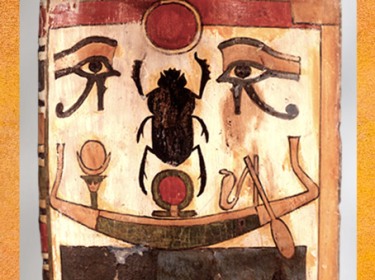
      « Kephri, the Sacred Beetle »

      A « Deep Dive » Podcast in English about my Blog’s article « Divinité et Scatologie »:

      https://metaxu.org/2021/11/28/divinite-et-scatologie/

      The Unconscious God


      « Horeb » ©Philippe Quéau (Art Κέω) 2024

      A « Deep Dive » Podcast in English about my Blog’s article « The Unconscious God »

      The God Named « Me Me Him »


      « I I Him » ©Philippe Quéau (Art Κέω) 2024

      A « Deep Dive » Podcast in English about my Blog’s article « Le Dieu ‘Moi Moi Lui' »

      Tantric Intrication


      « Tantric Intrication » ©Philippe Quéau (Art Κέω) 2024

      A « Deep Dive » Podcast in English about my Blog’s Article « Intrication tantrique »

      The World History of Kafka’s Soul


      « The Death of Kafka’s Soul » ©Philippe Quéau (Art Κέω) 2024

      A « Deep Dive » Podcast in English about my Blog’s article : « Histoire mondiale de l’âme de Kafka »

      Brahman, Kenosis and Tsimtsoum


      « Abraham Hosting Three Strangers » ©Philippe Quéau (Art Κέω) 2024

      A « deep dive » podcast, translated into English, about my Blog’s article « Brahman, Kenosis and Tsimtsoum »

      Making God


      « Making God » ©Philippe Quéau (Art Κέω) 2024

      A « Deep Dive » Podcast about my Blog article : « Making God »: Kabbalah, Trance and Theurgy.

      Being Other


      « Being Other » ©Philippe Quéau (Art Κέω) 2024

      Podcast in English about my blog article « L’Être Autre » https://metaxu.org/2024/08/14/letre-autre/

      About God Yah


      « Invisible silence » ©Philippe Quéau 2024 ©Art Κέω 2024

      Podcast translated into English from https://metaxu.org/2024/06/09/du-dieu-yah/

      Gravitational Metaphysics


      « Gravitational Metaphysics » ©Philippe Quéau (Art Κέω) 2024

      Podcast translated into English from https://metaxu.org/2024/08/27/metaphysique-gravitationnelle/

      Brain Dark Energy


      A Podcast summarizing and translating: https://metaxu.org/2024/04/16/lenergie-noire-du-cerveau/

      « Dark Energy » ©Philippe Quéau (Art Kéo) 2024

      An Unphilosophical Prophet


      Presence of Absense


      « Présence de l’absence » ©Philippe Quéau ©Art Kéo 2023

      The Power of the Past and the Seed of the Future


      « Shir ha-Shirim »

      The Rig Veda is the most ancient source from which to draw in an attempt to understand the state of the first conceptual representations of humanity by itself, more than four millennia ago. Religion and society, then, were in an infancy that did not exclude a profound wisdom, more original than what Greek and Roman antiquity were able to conceive later, and of which the Hebrew wisdom itself was a later heir.

      The memory of the Veda, long unwritten and transmitted orally for thousands of years by pure thinkers and rigorous ascetics, bears witness to an intellectual and moral state of humanity in an age much earlier than the time of Abraham. When this prophet left Ur in Chaldea, around 1200 B.C., for his exile to the south, many centuries had already nourished the valleys of the Oxus and watered the Indus basin. Several millennia before him, time had sedimented layers of human memory, ever deeper. The Vedic priests celebrated the idea of a unique and universal deity long before the « monotheisms ». Melchisedec himself, the oldest prophetic figure in the Bible, is a newcomer, if we place him in the obscure sequence of times that preceded him.

      This observation must be taken into account if we want to put an end to the drama of exceptions and the drifts of history, and understand what humanity as a whole carries within it, since the beginning.

      Homo sapiens has always been possessed by multiple intuitions, immanent, of the Divine, and even, for some individuals of this species, by singular ‘transcendent’ visions that they have sometimes been able to share and transmit. We must try to grasp these intuitions and visions today, by questioning what remains of their memory, if we want to draw prospective lines towards the distant future that is looming in the dark shadow of the future.

      The Hebrew Bible is a fairly recent document, and its price should not make us forget its relative youth. Its age goes back at most to a thousand years before our era. In contrast, the Veda is one or even two millennia older. This seniority, in fact rather short, should certainly not make us forget that it is itself based on much more remote memories, of which the Chauvet cave (~30 000 years) is only a simple marker, pointing out the mystery of the very origins of the Homo genus, as for the specific nature of its « consciousness ».

      This is why it is important to consider what remains of the memory of the Veda, in order to try to draw more general lessons from it, and to try to understand the unity of the human adventure, in order to foresee its possible evolutions – so much so that the past is one of the forms in power of the future.

      To illustrate this point, I would like to propose here a brief review of some of the symbols and paradigms of the Veda, to weigh and consider their potential universality.

      Butter, oil and sacred anointings.

      In those ancient times, melted butter (ghṛita) alone represented a kind of cosmic miracle. It embodied the cosmic alliance of the sun, nature and life: the sun, the source of all life in nature, makes the grass grow, which feeds the cow, which exudes its intimate juice, the milk, which becomes butter by the action of man (the churning), and finally comes to flow freely as sôma on the altar of the sacrifice to mingle with the sacred fire, and nourish the flame, engender light, and spread the odor capable of rising to the heavens, concluding the cycle. A simple and profound ceremony, originating in the mists of time, and already possessing the vision of the universal cohesion between the divine, the cosmos and the human.

      « From the ocean, the wave of honey arose, with the sôma, it took on the form of ambrosia. This is the secret name of the Butter, language of the Gods, navel of the immortal. (…) Arranged in three parts, the Gods discovered in the cow the Butter that the Paṇi had hidden. Indra begat one of these parts, the Sun the second, the third was extracted from the sage, and prepared by rite. (…) They spring from the ocean of the Spirit, these flows of Butter a hundred times enclosed, invisible to the enemy. I consider them, the golden rod is in their midst (…) They leap before Agni, beautiful and smiling like young women at the rendezvous; the flows of Butter caress the flaming logs, the Fire welcomes them, satisfied. « i

      If one finds in Butter connotations too domestic to be able to bear the presence of the sacred, let it be thought that the Priests, the Prophets and the Kings of Israel, for example, were not afraid to be anointed with a sacred oil, Shemen Hamish’hah, a « chrism », a maximum concentration of meaning, where the product of the Cosmos, the work of men, and the life-giving power of the God magically converge.

      Hair and divine links

      Hair is one of the oldest metaphors that the human brain has ever conceived. It is also a metonymy. The hair is on the head, on top of the man, above his very thoughts, links also with the divine sphere (this is why the Jews cover themselves with the yarmulke). But the hair also covers the lower abdomen, and announces the deep transformation of the body, for life, love and generation. Finally, the fertile earth itself is covered with a kind of hair when the harvest is coming. Here again, the ancient genius combines in a single image, the Divine, Man and Nature.

      A hymn in the Veda combines these images in a single formula:

      « Make the grass grow on these three surfaces, O Indra, the Father’s head, and the field there, and my belly! This Field over here, which is ours, and my body here, and the Father’s head, make it all hairy! »ii

      But the hair has other connotations as well, which go further than mere metonymic circulation. The hair in the Veda also serves as an image to describe the action of God himself. It is one of the metaphors that allow to qualify him indirectly, as, much later, other monotheistic religions will do, choosing his power, his mercy, or his clemency.

      « The Hairy One carries the Fire, the Hairy One carries the Soma, the Hairy One carries the worlds. The Hairy One carries all that is seen from heaven. The Hairy One is called Light. »iii

      The Word, divinized.

      More than five thousand years ago, the Word was already considered by the Veda as having a life of « her » own, of divine essence. The Word is a « Person, » says the Veda. The Word (vāc) is the very essence of the Veda.

      « More than one who sees has not seen the Word. More than one who hears has not heard it. To this one She has opened Her body as to her husband a loving wife in rich attire. « iv

      Is this not a foreshadowing, two thousand years earlier, of the Psalms of David which personify Wisdom as a figure, divine and « feminine », associated as a goddess with the unique God?

      Thought, image of freedom

      In the Veda, Thought (manas) is one of the most powerful metaphors that man has ever conceived for the essence of the Divine. Many other religions, millennia later, also celebrated the divine « Thought » and sought to define certain attributes of « her ». But, in the Veda, this original intuition, developed in all its emergent force, confirms Man in the idea that his own thought, his own faculty of thinking, has always been and remains in power the source of a radical astonishment, and the intimate certainty of a primary freedom.

      « She in whom prayers, melodies and formulas rest, like the grapes at the hub of the chariot, she in whom all the reflection of creatures is woven, the Thought: may what She conceives be propitious to me! »v

      The Infinite, so old and always young…

      The idea of an « infinite », « hidden » God, on whom everything rests, was conceived by Man long before Abraham or Moses. The Veda attests that this idea was already celebrated millennia before these famous figures.

      « Manifest, he is hidden. Ancient is his name. Vast is his concept. All this universe is based on him. On him rests all that moves and breathes (…) The Infinite is extended in many directions, the Infinite and the finite have common borders. The Guardian of the Vault of Heaven travels through them, separating them, he who knows what is past and what is to come. (…) Desireless, wise, immortal, self-born, satiated with vital sap, suffering no lack – he does not fear death who has recognized the wise Ātman, unaged, ever young. « vi

      The Love of the Creator for the Created

      The Bible, with the famous Shir ha-Chirim, the Song of Songs, has accustomed us to the idea that the celebration of love, with human words and crude images, could also be a metaphor for the love between the soul and God. This very idea is already found in the Veda, to describe the cry of love between the God and his creature, the human soul:

      « As the creeper holds the tree embraced through and through, so embrace me, be my lover, and do not depart from me! As the eagle, in order to soar, strikes at the ground with its two wings, so I strike at your soul, be my lover and do not depart from me! As the sun one day surrounds the sky and the earth, so I surround your soul. Be my lover and do not depart from me! Desire my body, my feet, desire my thighs; let your eyes, your hair, lover, be consumed with passion for me! »vii

      From this brief return to Vedic memory, and from these few allusions to much more ancient and immanent memories (going back to the origin of the Sapiens species), I conclude that a comparative anthropology of the culture of the depths and that a paleontology of the intuitions of the sacred is not only possible, but indispensable. They are necessary first of all to relativize at last the excessive claims of such or such late religious or philosophical traditions, unduly arrogating themselves specious privileges. Above all, they confirm the necessity and the fruitfulness of a research on the very essence of the human conscience, outside the current framework of thought, materialist, positivist, nominalist, and of which the crushed, wounded modernity suffers so much from the absence of recognition.

      ___________

      i ṚgVeda IV,58.

      ii ṚgVeda VIII,91

      iii RgVeda X,136

      iv ṚgVeda X,71

      v ṚgVeda X,71

      vi A.V. X,8.

      viiA.V. VI,8-9.

      Super-Essential Self(s)


      « Sunselfs » Ⓒ Philippe Quéau, 2022

      After an absolute, mystical experience of the end, or an NDE, one’s existence may then, probably, be focused on the fact that one has witnessed the indescribable as such, the non-separation of the whole, an imminence of actual death, and yet the survival of consciousness, and the possibility of its super-life. The miracle of which one has been the dumbfounded and almost impotent witness, destroys forever the face value of ideas, forms, sensations, human realities, which all have become too ‘provincial’.

      The mystical experience has no essence.
      For some it represents the destruction of the individual, of the self. For others it prefigures a change of paradigm. For still others, there is nothing to say, nothing to prove, everything is beyond imagination, and expression.


      It is quite inexplicable that one’s unassuming self can somewhat unexpectedly absorb and sustain the entire mystical experience, though it effectively destroys any idea of the Divine, of the Cosmos, and even the Self.


      It is equally incomprehensible that the (human) self remains capable of resisting the ecstatic impact of the (divine) Self. Face to Face. Panim.


      How can it be that the human self suddenly gets out of itself and ecstatically merges with the divine Self, disappears into it, remains conscious and aware of this assimilation, this disintegration, throughout the cancellation of itself?


      The individual, the self, is to be swallowed up in the Whole, the Godhead. The paradox is that this small self, swallowed up by the divine ocean, never loses its consciousness of still being this particular self, a small but effective point of consciousness tossed about in an unheard-of ecstatic storm, a wind of infinite strength. This weak self remains irresistibly invincible, unbreakable, it does not dissolve, ever, whatever infinitely powerful is the Self that invades and overcomes it…

      Mysticism and tragedy have this in common that they transform into close neighbors, death and life, the nothing and the whole, the freedom and the dissolution of the self.
      The mystic experience melts, allows oneself to be absorbed, in and by these superior powers ; the tragic experience confronts the self with them and shatters it.
      In the first case, the self escapes any personal interpretation of what led it there, free to rush without restraint in an indescribable ecstasy.
      In the second case, the tragic self loses its individuality at the very moment when it makes the supreme choice, the one that is supposed to confirm it in the purity of the Self, the one in which it discovers the proper power of exaltation.
      Who can say then what is alive and what is dead, in the mystical self and in the tragic self, so much death now seems a super-life, and life a kind of mild death.

      Heraclitus famously said:
      “The immortals are mortal and the mortals, immortal; the life of some is the death of others, the death of some is the life of others.”i

      Super-life, or its miracle, is not something you see every day, admittedly.
      There are some people who laugh about any sort of miracle. The passage of the Red Sea, the pillars of fire and the clouds, the resurrection of Lazarus, the multiplication of the loaves, they just laugh about it. And how old-fashioned it all seems to them, how useless, how forever devoid of any (modern) meaning!

      But for the witnesses who see with their own eyes, there is no doubt, only the miracle is real, really real, resplendent with surreality. But this glitter and splash is also a door to death. The miracle in reality announces an after-world, a meta-reality, for which nothing prepares us, except what the miracle precisely lets us glimpse.

      Death then, for those who accept to learn the lesson, is only an obligatory passage, like the Red Sea once was, towards a desert traversed by columns and clouds, towards some putative Promised Land, or some resurrection, in another universe where one will be satiated with ‘super-essential’ bread (in Greek epiousion, – as in τὸν ἄρτον τὸν ἐπιούσιον).

      When death approaches with its velvet steps the eyes open. The soul becomes more conscious of itself, not of its victories or defeats, which then matter little, but of its irresistible inner drive for life. Life wants to live. But the border is there, tangible, the soul approaches it, is it a wall, a door, a bottomless abyss?

      Until the last moment the enigma remains. Only a few souls have seen in advance what was beyond the experience. By what miracle?
      They see what awaits them behind death, something like a thousand suns, or rather a zillion suns, as words fail them. And they see their very self melting away, a drop of pure fire in the infinite ocean.


      No, no, that is just illusion, assert the skeptics, simple chemistry of the brain during its initial necrosis, derisory neurochemical whirlwind, panic of asphyxiated synapses.

      What does the polemic matter at this hour? One moment more and one will be fixed for ever, in a direction or another.
      One cannot, by the sole force of reasoning, exclude one or the other way, the one leading to nothingness and the one opening on the ocean of possibilities.
      After all, was not birth, if one remembers, like a red and very narrow passage, leaving a first world behind?

      It is in the last moments, oh paradox, that life takes on all its meaning, takes on all its weight, fills itself with all the emotions, regrets, hopes, laughter and happiness.
      All this melts into a single point, hyper-dense, heavy with all the experience, an over-concentrated center, and which is, however, no more than a light baggage, a meager bundle, suddenly, for the eternal migrant that the living being discovers to be in the vicinity of death.

      The essence of the man lies in this unique point, made of a nebula of myriads of moments, this total sum of existence and oblivion.
      This is another way of solving the hackneyed question of essence and existence. Neither one nor the other precedes.
      It is this single dense point, gravitating from a whole life, which is only real, miraculously real, and which allows to add a little to the oceanic immensity.

      The surreal ocean that aggregates, and agrees, all that has lived, and will live.

      ___________

      iFr. 62

      More Than Man Can Ever Imagine


      There are many kinds of beings, divine, human, natural, artificial, material, without forgetting the beings of reason and language, the ideal, symbolic and modal beings, etc.. From this multiplicity of types of beings, one can conjecture the existence of a rich assortment of possible ontologies. In the crowd of all these beings, man may have a special role. He does not know who he really is, and he knows that he does not; he also knows that he is not only what he knows he is. So there is still a lot of room for research. He becomes more what he is in particular when the question of being in general within him is revealed. He begins to understand his own nature when he understands that it is entirely within this questioning, that of its origin and that of its end.

      How does he know all this? Considering the opaque mystery from which he emerges, and the even darker abyss into which death projects him, he draws inductions, builds hypotheses, formulates theories.

      This is why it is said that man is a metaphysical animal, more apt than the sea urchin, the fly, the monkey or the angel, to ask himself the question of his specific being, and thus to attack without respite the question of being in general, the ontological question.

      It was no small intuition to come to think of the passage from the particular to the general, that is to say, to conceive the abstraction of being, as emanating from the innumerable cohorts of concrete beings.

      This intuition establishes a community of essence between all that « is », without setting aside a radical variation between the « levels of being » of the various beings. Some of them bathe in the super-luminous consciousness of their Self, others grope in twilight limbo, and still others crawl endlessly in the night of dead dreams.

      Man is a being placed in a world that is also a being, and in the midst of other, different kinds of beings. These different kinds of beings manifest themselves in one way or another, but without ever revealing themselves completely. It is difficult, if not impossible, for man to penetrate the mystery of being in others beings than himself, since he already fails to penetrate this mystery in himself.

      His consciousness manifests itself to him, too, and never ceases to reveal itself, always again, without ever being exhausted, by his questioning, except, of course, in death. And there, can we presume that the questions that the consciousness asks finally find an answer, final, complete, terminal? Doesn’t death lead either to a nothingness with no room for questions or answers, or is it only a passage towards a state where the Self continues, in other forms, to ask itself still other questions?

      There is in the being of man a mixture of infinity (in potency) and finitude (in act). Forwards, backwards, upwards, downwards, and on all other sides, man is objectively surrounded by the finite, he is ‘confined’. His perspectives are quickly crushed. His ‘self’ is only a point, without dimension, and the unlimited that surrounds it in theory is only a conjecture, a phantasm, a representation without explicit content.

      This point, this limit point, is a self without dictable content, but it is the basis of all metaphysics, the most laconic or the most talkative. Without this point, this raft of the being, everything dissolves quickly into a dreamless nothingness. But with it, we can begin to found, paradoxically, an ontology of unveiling. On this point, this single point, can we build worlds, chasms, firmaments, empyreas? We don’t really know, it is the human spirit that works, that weaves on its loom canvases and veils.

      Why is the mind inclined to always weave? Because the point of consciousness is essentially naked. It needs linen, wool and words to dress its nudity, which is also solitude.

      When man thinks that he is finished, that he is alone, he also thinks that he might not be, in theory.

      When he believes in reality, dense and low, he also believes in mirages, ethereal, elevated, which the crowd and its time propagate.

      Man is an infinitely finite and ultimately infinite being.

      Penetrated by a finitude and solitude that surrounds him on all sides, man turns towards transcendence as a way out. But this does not give him any guarantee, any certainty. It is necessary to continue without assurance the search, a source of anguish, a fountain of worry. Afflictions of not knowing where one is going.

      Anxiety is perhaps too strong a word, too dramatic. Faced with nothingness, the strong soul is not moved: if the great hole is an empty place, what does she have to fear, the soul that finds without a blow the blackness and the unconscious in which she has slept in non-existence, before appearing briefly on the scene of a world without meaning.

      The alternative is much more stimulating naturally. This is why for thousands and thousands of generations man has continued to ask himself the metaphysical question without worrying about the laziness of the materialists, the sneers of the strong minds.

      Anxiety is also called transcendental curiosity.

      What can be the nature of a world whose meaning is neither given nor said?

      It is the act of looking nothingness in the face that is the first victory of the mind. It is laid bare by its very question. And if he does not hasten to dress his metaphysical nakedness with some hasty veil, if he does not hurry to put an end to this skinning, then he can seize himself as such, naked, skinned, raw, between life and death, without knowing what will prevail.

      This non-knowledge, this ignorance, this suffering, one may want to put an end to it. Religions such as Vedic, Buddhist, but also Jewish and Christian, theorize in their own way how to escape from it.

      Religions don’t do metaphysics. They propose coded answers, forged over millennia. But every man is newly born: in a completely new way, he in turn asks himself very old questions.

      He may adopt the lesson of the ancient masters, but he may also notice their metaphysical vanity, noting that their answers are based on unfounded assertions.

      All things considered, a well-born man is worthy of a prophet or a sage of old, if he has intuitions of comparable strength or even visions superior to this or that ancient one.

      For all these past geniuses also had to walk a narrow path. They all had to feel the precariousness, the fragility of their certainties.

      Their faith has always been in a state of wavering.

      Doubt founds man and gives him his irrefutable nobility.

      It is this doubt that gives man’s time its eternal varnish. Because its truth is not in what it shows, but in what it hides. Behind the veil of time probably lies the great mystery of all times, – but perhaps there is nothing but the sneers of the disheveled matter.

      Ontology of the doubt, ontology of the bet, ontology of the die and the Rubicon, royal and prophetic, which the well-born soul adopts as its only homeland, its only religion, its only metaphysics.

      If time is the only real wealth, eminently limited, why do we spend our time wasting it, in nothingness?

      It is only if it is not the only wealth, the only reality, that it is reasonable to waste time thinking about it, this time that veils the future, and everything that is above it, or after it.

      It is there, in thought, that the well-born man, and reborn, pierces the wall of the presence to oneself. The horizon of time, so low, so blurred, so close, he rolls it up like a canvas, and sets out on his way to the stars.

      For the being (of man) is not made of time. Once the tent is taken down, he migrates out of time. He opens, and discovers what is no longer time, what is above and outside of time, a timeless, a meta-time.

      There is no more time. Does everything stop then?

      No, the flow continues. Other dimensions are emerging. The world with three dimensions of space and one of time is replaced by a world with 17 or 256 dimensions of space and as much time.

      The time is no longer temporal, but… gustatory or tactile.

      Time is a strong and hollow intuition. It is constantly occupying the mind, and it is an empty form.

      And man seeks the full, not the empty.

      He has the intuition that only emptiness can come out of emptiness. There is no future in sight in the void. The man full of himself cannot imagine living his own emptiness. He continues to search for more fullness, which fills all the emptiness he experiences.

      But does man have a full intuition? One can think so. Fetuses and lovers experience a relative fullness, which leaves unforgettable marks, working tirelessly in the unconscious, and giving hope for other plenitudes to come, less relative, more absolute perhaps.

      Reason is of little use in the face of this mystery; it is incapable of discerning any path. It is too embarrassed by its weight of rules and logic.

      Intuition here is more flexible, to guess the future and the potency not yet revealed. Less formal, but more founded, – in a sense.

      Where does intuition come from? If it has the slightest validity, even if it is only that of a mustard seed, intuition comes from elsewhere, from the beyond and the unthinkable. It is a kind of antenna sensitive to all the noises, all the rumors that reason does not hear.

      Of two things one.

      Either intuition is actually in contact, in some unspeakable way, with the after-world, the beyond, the universe of the possible, the spheres of the unthinkable, and then the precious drops of meta-temporal elixir that it captures and exudes are more valuable than all the riches of the world.

      Either intuition is not in contact with any of this, and then what is it worth? Not even the fabric from which dreams are made, aborted before they fly. And then, decidedly, man is a beast seized with torpor.

      We must imagine a world where thought takes the form of pure intuition. Their immediacy, their sharpness is unparalleled. Time is suddenly abolished before the force of these intuitions. A fountain of understanding flows in great waves, it drowns the dazed mind, covers it with revelations, opens new paths, unveils worlds. Far behind intuition, the spirit takes flight, heavily but surely.

      The mind is heavy, clayey. Intuition is burning, cherubic. Its light warms the distant ones, that thought, for its part, cools and freezes.

      Not that thinking is not useful. It has its utility, at the back, in support, with the train. But not in the front, looking forward.

      Above all, intuition has this generous, gushing, crackling character. Source or flare. Each drop, each spark, is the promise of an infinity to come, of which they are the humble and brilliant messengers.

      It is a strange phenomenon that intuition, from the moment we see it, is not only for what it suggests, but what it implies. Its « beyond » signs the end of the narrow. It reveals doors opening onto myriads. It unveils worlds where the thin is loaded with thickness. The pollen announces the forest, the smell makes the forgotten Orients shimmer, the grain promises the premises.

      Intuition is not a phenomenon. On the contrary, it is more real than the real.

      Human knowledge comes from two sources: the ability to receive impressions, and the ability to represent forms. It is by associating these impressions (coming from the world) and these forms (coming from the mind) that the faculty of ‘knowing’ can blossom.

      What are these forms that come from the mind, these concepts pre-positioned to interpret impressions?

      They do not result from the activity of thought, but from the fullness of intuition. Intuition already inhabits the gaze of the newborn child, and sows its virgin brain.

      Intuition reigns supreme in the most crucial, sublime, transcendental moments.

      Intuition reveals in a tenuous and tenacious way what we are not yet conscious of being.

      By a sparkle of intuition, man, being finite, surrounded on all sides, without vision, without perspective, suddendly discovers that he is infinitely more than he had ever imagined.

      An Ugly Black Sun From Which the Night Radiates


      -Victor Hugo-

      Victor, thoughtful, once stood near the dolmen of Rozel. A dark and talkative ghost appeared to him. From his mouth of night flowed a powerful, agitated stream, mixing raw and chosen words, where dead trunks and black silt layed. The nyctalope poet was even more loquacious, and his verses sprang, in hurried theories, out of their grassy, wordy bushes.

      The images added up, like glasses at the bar:

      The immense can be heard. Everything speaks. Everything has consciousness. The tombs are dressed in grass and night. The abyss prays. All lives. The depth is imperfect. Evil is in the universe. Everything goes to the worst, always, without ceasing. The soul chooses. The tree is religious. The pebble is vile, blind, hideous. Matter is evil, – fatal fruit. The incontinent poet rhymes ‘ombre‘ (shadow) with ‘sombre‘ (dark) several times without any shame. And, to compensate, ‘vivant‘ (alive) with ‘en avant‘ (forward).

      He had a sad forehead, this great man, this exile with sad sweats, funeral impulses. He bent, this poet, from the weight of the infinite, nothing less, and from the silly light of the gloomy suns.

      God is here. Are we so sure? Of course we are! He is not out of anything, by the way. The azure, and the rays, hide His wingspan.

      Interpelled in vain, the Spirit continues his way, without wanting to hear Man alone, despising his ‘vile flesh’. The word ‘vile’ returns like an antiphon. The enormous life always continues, it enters the invisible, it ascends to the heavens, it travels ‘millions of leagues’, it reaches even to the ‘radiant toe’ of the ‘archangel sun’ and vanishes in God. Yes ‘in God’! That is, in the depths! Jacob and Cato have already passed through these ladders, with their future of duty, mourning, and exile. They have passed through these precipices and abysses, where the larvae and the mysteries, the vapors and the hydrants, are hurried.

      Following them, the seers and angels plunged, towards the winged souls.

      But for the banished who remain stuck in the nadir, shipwreck is promised, and the ‘rimless abyss’, full of ‘rain’, opens up.

      « Of all that lived rains unceasingly the ashes;

      And one sees everything at the bottom, when the eye dares to go down there,

      Beyond the life, and the breath and the noise,
      An ugly black sun from which the night radiates! »i

      The Spirit thunders and threatens. As a prophet, he says: the top goes down, the ideal goes to matter, the spirit falls to the animal, the great crashes into the small, the fire announces the ashes, blindness is born of the seer, and darkness of the flamboyant.

      But the rhymes save! ‘Azure’ goes with ‘pure’.

      Above is joy, below is filth and evil.

      It’s perfectly binary. Structurally binary.

      In the infinite, one goes up, – or one falls.

      Every being is in balance, and weighs its own weight. For elevation, or fall.

      Let man contemplate, then, the cesspool or the temple!

      Underneath even the worst of the rough ones, there are still the plants without eyelids, and under the stones, there is chaos.

      But, always, the soul must continue to descend, towards the dungeon, the punishment and the scaffold.

      Ah! Victor! How your hard and funny verses judge worlds and History!

      With a light gesture, you cut down your cleaver, soaked with unbelievable alexandrines!

      « Once, without understanding it and with a dazed eye

      India has almost glimpsed this metempsychosis. »ii

      ‘India has almost glimpsed this metempsychosis’. Seriously ???

      You Victor, you saw! You Clarified Poet, young Genius of Jersey! You, Seer, you knew, much better than her, this old India, that the bramble becomes a claw, and the cat’s tongue becomes a rose leaf, – to drink the blood of the mouse, in the shadows and the shouts !

      Ah, Victor, seeing from your higher heaven, you contemplate the unheard-of spectacle of the lower regions, and you listen to the immense cry of misfortune, the sighs of the pebbles and the desperate.

      You see ‘everywhere, everywhere, everywhere’, angels ‘with dead wings’, gloomy larvae, and ragged forests. Punishment seeks darkness, and Babel, when it is overthrown, always flees into the depths of the night. The man for you, O Victor, full of victories, glory and knowledge, is never but a brute drunk with nothingness, who empties the drunken glass of his sleeps, night after night.

      But there is a but. When you think twice, man is in prison but his soul remains free. The magi thought that legions of unknown and enslaved souls were constantly trampled underfoot by men who denied them. The ashes in the hearth, or the sepulchre, also claim that a heap of evil sleeps in them.

      Man says: No! He prostitutes his mouth to nothingness, while even his dog lying in the night (that sinister constellation) sees God. This is because man is nothing, even if the starry beast is little. He denies, he doubts, in the shadow, the dark and gloomy, the vile and hideous, and he rushes into this abyss, this universal sewer.

      Ah! Victor! Why didn’t you crush, with a heavy foot, that immortal worm that was gnawing at your overripe soul?

      Alas! Alas! Alas! All is alive! Everything thinks!

      Triple complaint, quintuple exclamation. One must cry over all the hideous ugliness of the world.

      The spider is filthy, the slug is wet, the aphid is vile, the crab is hideous, the bark beetle is awful (like the sun!), the toad is scary.

      But there is still hope at the end!

      The underworld will refer to itself as eden. It will be the real day. Beauty will flood the night. The pariah universe will stutter in praise. Mass graves will sing. The mud will palpitate.

      The pains will end, – as this poem ends: with the ‘Beginning’!

      To Victor, however, I would like to address a short message from beyond time, a brief word from beyond the age, a distant sign from India, who ‘glimpsed’ something that Hugo neither saw nor suspected:

      Before the very Beginning, there was neither being nor non-being, and ‘all darkness was enveloped in darkness.’ iii

      Wise men commented: the spirit (in Sanskrit: manas) is the one and only thing that can be both existing and non-existent. The spirit exists, they said, only in things, but things, if they have no spirit, then they are non-existentiv.

      The seers have long sought wise views on these difficult questions.

      They thought, for example, that there was a hidden, deep, obscure link between Being and Non-Being. And they asked themselves: What link? And who could really know anything about it?

      They replied ironically: « He certainly knows it – or maybe He Himself doesn’t even know it ! »v

      _____________

      i Victor Hugo. Contemplations. XXVI , « What the Mouth of Shadow Says ».

      ii Ibid.

      iiiRV X,129.3

      ivCf. SB X,5,3, 1-2

      v RV X,129.7

      Deep Logos and Bottomless Soul


      « Heraclitus »

      For at least a million years, man has been using the spoken word more or less skillfully. Since ancient times, its uses and modes of expression have been infinite, from the most futile to the most elevated. The stammering child, the fluent poet, the sure sage, the inspired prophet, all tried and continue trying their own ways and speaking their voices.

      With the same breath of expelled air, they generate gutturals from the glottis, fricatives from the pharynx, hissing on the tongue, whistling labials through the lips.

      From these incessant sounds, what sense does exhale?

      Heraclitus, master in obscure matters, great lord of meaning, once made this sharp judgment:

      ἀνὴρ νήπιος ἤκουσε πρὸς δαίμονος ὅκωσπερ παῖς πρὸς ἀνδρός.

      « The man is held as a little boy by the divinity, like the child by the man. »i

      This both pessimistic and optimistic fragment proposes a ratio of proportion: what the child is to man, man is to the divinity. The observation of man’s impotence in relation to the divine is not dissociated from the natural and expected perspective of a passage from childhood to adulthood.

      In his translation of this fragment, Marcel Conche curiously emphasizes speech, although the word logos is clearly absent from the Heraclitus text:

      « A ‘marmot’ (a toddler) who cannot speak! Man is thus called by the divine being (δαίμων), just as a child is called by man. « ii

      The periphrase ‘A marmot who cannot speak’ is the choice (bold and talkative) made by Marcel Conche to render the meaning of the simple Greek word νήπιος, affixed by Heraclitus to the word ‘man’ (ἀνὴρ).

      Homer also uses the word νήπιος in various senses: ‘who is in infancy’, ‘young child’, but also ‘naive’, ‘foolish’, ‘devoid of reason’.

      Conche evokes these various meanings, and justifies his own translation, which is periphrastic and therefore not very faithful, in the following way:

      « Translating as ‘child without reason’ sounds right, but not precise enough: if νήπιος applies to the ‘infant’ child, one must think of the very young child, who does not yet speak. Hence the translation [in French] by ‘marmot’, which probably comes from ‘marmotter’, which originates from an onomatopoeia expressing murmuring, the absence of distinct speech. « iii

      This is followed by a comment on the supposed meaning of the fragment:

      « It is about becoming another being, who judges by reason, and not as habit and tradition would have it. This transformation of the being is translated by the ability to speak a new language: no longer a particular language – the language of desire and tradition – but a discourse that develops reasons referring to other reasons (…) Now, from this logical or philosophical discourse, from this logos, men do not have the intelligence, and, in relation to the demonic being – the philosopher – who speaks it, they are like little brats without speech (…) To speak as they speak is to speak as if they were devoid of reason (of the power to speak the truth). »iv

      Although this fragment of Heraclitus does not contain any allusion to logos, the main lesson that Conche learns from it is : « Man is incapable of logos for the demonic being ».

      In a second departure from the commonly received meaning for this fragment, Marcel Conche considers that the divinity or demonic being (δαίμων) evoked by Heraclitus is in reality the ‘philosopher’. For Conche, it is the philosopher who is the demonic being par excellence, and it is precisely he who is able to determine for this reason that « man is incapable of logos ».

      However Heraclitus certainly did not say: « Man is incapable of logos.»

      Man may mumble. But he also talks. And he even has, in him, the logos.

      Indeed, if the word logos is absent from fragment D.K. 79, it is found on the other hand in ten other fragments of Heraclitus, with various meanings : ‘word’, ‘speech’, ‘discourse’, ‘measure’, ‘reason’…

      Among these ten fragments, there are five that use the word logos in such an original, hardly translatable way that the common solution is just not to translate it at all, and to keep it in its original form : Logos

      Here are these five fragments:

      « The Logos, which is, always men are incapable of understanding him, both before hearing him and after hearing him for the first time, for although all things are born and die according to this Logos, men are inexperienced when they try their hand at words or deeds. »v

      « If it is not I, but the Logos, that you have listened to, it is wise to agree that it is the One-all. »vi

      « In Prayer lived Bias, son of Teutames, who was more endowed with Logos than the others. « vii

      In these three fragments, the Logos seems to be endowed with an autonomous essence, a power to grow, and an ability to say birth, life, death, Being, the One and the Whole.

      In the next two fragments, the Logos is intimately associated with the substance of the soul itself.

      « It belongs to the soul a Logos that increases itself. « viii

      « You cannot find the limits of the soul by continuing on your way, no matter how long the road, so deep is the Logos it contains. « ix

      As a reminder, here is the original text of this last fragment :

      ψυχῇ πείρατα ἰὼν ἰὼν ἂν ἐξεύροιο, πᾶσαν ἐπιπορευόμενος ὁδόν- οὕτω βαθὺν λόγον ἔχει.

      Strangely enough, Conche, who added the idea of speech in a fragment that did not include the word logos, avoids using the word logos here, in his translation, though the fragment does contain it explicitly: « You wouldn’t find the limits of the soul, even if you walked all the roads, because it has such a deep discourse.»x

      Is it relevant to translate here the word logos by discourse?

      If not, how to translate it?

      None of the following meanings seems satisfactory: cause, reason, essence, basis, meaning, measure, report. The least bad of the possible meanings remains ‘speech, discourse’xi according to Conche, who opts for this last word, as we have seen.

      But Heraclitus uses a strange expression here: ‘a deep logos‘, – a logos so ‘deep’ that it doesn’t reach its ‘limit’.

      What is a logos that never reaches its own depth, what is a limitless logos?

      For her part, Clémence Ramnoux decided not to translate in this fragment the word logos. She even suggested to put it in brackets, considering it as an interpolation, a late addition:

      « You wouldn’t find a limit to the soul, even when you travel on all roads, (it has such a deep logos). « xii

      She comments on her reluctance in this way:

      « The phrase in parentheses may have been added over. If it was added, it was added by someone who knew the expression logos of the psyche. But it would not provide a testimony for its formation in the age of Heraclitus. « xiii

      In a note, she presents the state of scholarly discussion on this topic:

       » ‘So deep is her logos’. Is this added by the hand of Diogenes Laërtius (IX,7)?

      Argument for: text of Hippolytus probably referring to this one (V,7): the soul is hard to find and difficult to understand. Difficult to find because it has no boundaries. In the mind of Hippolytus it is not spatial. Difficult to understand because its logos is too deep.

      Argument against: a text of Tertullian seems to translate this one: « terminos anime nequaquam invenies omnem vitam ingrediens » (De Anima 2). It does not include the sentence with the logos.

      Among the moderns, Bywater deleted it – Kranz retained it – Fränkel retained it and interpreted it with fragment 3. »xiv

      For his part, Marcel Conche, who, as we have seen, has opted for the translation of logos by ‘discourse’, justifies himself in this way: « We think, with Diano, that logos must be translated, here as elsewhere, by ‘discourse’. The soul is limited because it is mortal. The peirata are the ‘limits to which the soul goes,’ Zeller rightly says. But he adds: ‘the limits of her being’. « xv

      The soul would thus be limited in her being? Rather than limited in her journey, or in her discourse? Or in her Logos?

      Conche develops: « If there are no such limits, it is because the soul is ‘that infinite part of the human being’. »

      And he adds: « Snell understands βαθὺς [bathus] as the Grenzenlosigkeit, the infinity of the soul. It will be objected that what is ‘deep’ is not the soul but the logos (βαθὺν λόγον). (…) In what sense is the soul ‘infinite’? Her power is limitless. It is the power of knowledge. The power of knowledge of the ψυχὴ [psyche] is limitless in so far as she is capable of logos, of true speech. Why this? The logos can only tell reality in a partial way, as if there was somewhere a reality that is outside the truth. Its object is necessarily reality as a whole, the Whole of reality. But the Whole is without limits, being all the real, and the real cannot be limited by the unreal. By knowledge, the soul is equal to the Whole, that is to say to the world. « xvi

      According to this interpretation, reality is entirely offered to the power of reason, to the power of the soul. Reality has no ‘background’ that remains potentially obscure to the soul.

      « The ‘depth’ of the logos is the vastness, the capacity, by which it equals the world and establishes in law the depth (immensity) of reality. Βαθὺς : the discourse extends so deeply upwards or downwards that it can accommodate everything within it, like an abyss in which all reality can find its place. No matter which way the soul goes on the path of knowledge, inward or outward, upward or downward, she encounters no limit to her capacity to make light. All is clear in law. Heraclitus’ rationalism is absolute rationalism. « xvii

      Above all what is absolute, here, is the inability to understand the logos in its infinite depth, in its deepest infinity.

      We’re starting to understand that for Heraclitus, the Logos cannot be just reason, measure or speech.

      The soul (psyche) has no ‘limits’, because she has a ‘deep logos‘ (βαθὺν λόγον).

      The soul is unlimited, she is infinite, because she is so vast, so deep, so wide and so high that the Logos himself can dwell in her always, without ever finding his own end in her, – no matter how many journeys or speeches he may make…

      No wonder the (word) Logos is ‘untranslatable’. In theory, and in good logic, to ‘translate’ it, one would need an infinitely deep periphrase comprising an infinite number of words, made of infinite letters…

      ____________

      iFragment D.K. 79. Trad. Jean-Paul Dumont. Les Présocratiques. Bibliothèque de la Pléiade. Gallimard 1988, p. 164

      iiD.K. 79. Translation by Marcel Conche, in Héraclite PUF, 1986, p.77.

      iiiMarcel Conche, Héraclite PUF, 1986, p.77

      ivMarcel Conche, Héraclite PUF, 1986, p.80

      vFragment D.K. 1, Trad. Jean-Paul Dumont. The Presocratics. Bibliothèque de la Pléiade. Gallimard 1988, p. 145

      viFragment D.K. 50. Trad. Jean-Paul Dumont. The Presocratics. Bibliothèque de la Pléiade. Gallimard 1988, p. 157

      viiFragment D.K. 39. Trad. Jean-Paul Dumont. The Presocratics. Bibliothèque de la Pléiade. Gallimard 1988, p. 155

      viiiFragment D.K. 115. Trad. Jean-Paul Dumont. The Presocratics. Bibliothèque de la Pléiade. Gallimard 1988, p. 172

      ixFragment D.K. 45. Trad. Jean-Paul Dumont. The Presocratics. Bibliothèque de la Pléiade. Gallimard 1988, p. 156

      xM. Conche, Heraclite PUF, 1986, p.357

      xiIbid.

      xiiRamnoux, Heraclitus, or the man between things and words. Ed. Les Belles Lettres, Paris, 1968, p. 119.

      xiiiIbid.

      xivRamnoux, Heraclitus, or the man between things and words. Ed. Les Belles Lettres, Paris, 1968, p. 119, note 1.

      xvM. Conche, Héraclite PUF, Paris, 1986, p.357.

      xviM. Conche, Héraclite PUF, Paris, 1986, p.357-359

      xviiM. Conche, Héraclite PUF, Paris, 1986, p.359-360

      The Law of the Universal Attraction of Consciousnesses


      « Isaac Newton »

      In a previous article, The Dreamers’ Paradise, we invited you to meditate on the double nature of the plant, which is rooted below, or in the stomach, for the materialists, or on the contrary above, in the philosophy of the Veda. In both cases, the plant and its roots sum up their respective visions of the world.

      Hylozoismi, which is not very Vedic but intrinsically modern, sees life as « springing » from matter itself, which is still a metaphor. The « source » can be seen to be, in a way, analogous to the « root ». In everything, always and everywhere, life supposes the immanent presence of the same internal and autonomous principle of generation, source or root, which animates all things.

      No less modern, and rather more so, materialism, is by definition eminently immanent. It denies a priori any idea of soul in life, and it kills (in the bud) any idea of spirit within matter. Its aim is to assimilate, to digest in the material stomach any idea of the spirit, or of its essence, which amounts to the same thing.

      Kant, on the other hand, is not at all modern. He asserts that an immaterial world exists. This immensely vast world includes all created intelligences, reasonable beings, but also the sentient consciousnesses (of all animals), and finally all the principles of life, whatever they may be, and which are found everywhere in nature, for example in plants.

      Among the « created intelligences » some are related to matter. We know this, because we experience it in ourselves, and it is they who, through this special alliance, form « persons ».

      Other « created intelligences » are not bound to matter. They may remain isolated, or they may be linked to other spirits, or they may be more or less closely associated with other entities, having an intermediate status between matter and spirit.

      All these immaterial natures (the intelligences, the consciousnesses, the principles) exert their (immaterial) influence in the corporeal world, according to ways and means which remain incomprehensible.

      Among them, there are all the so-called « reasonable » beings, whether they are present on earth or lying, presumably, elsewhere in the universe. Because of the use of their reason, whose end it is, they are not destined to remain separate (from matter). Reason is another name for an immanent, ordering and regulating principle, which reasonable beings (i.e. beings in which reason is immanent) use to animate the (irrational) fabric of matter, and constitute it as a « living » entity.

      We can suppose that the so-called reasonable beings maintain with the other created intelligences various exchanges or communications, in accordance with their respective natures.

      These communications are then not limited by bodies, nor by the usual constraints of material life. They transcend them. Nor do they weaken with distance in space or time, nor do they disappear when death occurs.

      According to these general views, the human soul, which is a particular case of these immaterial and reasonable natures, should therefore be regarded as already linked, in the present life, to both worlds, the immaterial and the corporeal.

      The singular soul is bound to a particular body, which makes it an absolutely unique person. It clearly perceives the material influence of the corporeal world. As it is also part of the spirit world, it also feels the influences of the immaterial natures, and can perceive, in certain cases, their immaterial effluvia.

      At death, as soon as the bodily connection has ceased, the soul continues to be in impalpable community with the spiritual natures.

      Undoubtedly, it should then, being at last separated from the body, be better able to form a clearer intuition of its own nature, and to reveal it, in an appropriate manner, to its inner consciousness.ii

      On the other hand, it is probable that the other spiritual natures, those which are not « incarnate », cannot be immediately conscious of any sensible impression of the bodily world, because they are not bound in any way to matter.

      Not having a body of their own, they cannot be conscious of the material universe or perceive it, lacking the necessary organs. But they can exert a subtle influence on the souls of men, because they have a nature similar to their own.

      The two can even maintain a reciprocal and real trade, capable of progress and enrichment.

      However, the images and representations formed by spirits that still depend on the corporeal world cannot be communicated to beings that are purely spiritual.

      Conversely, the conceptions and notions of the latter, which are intuitive representations corresponding to the immaterial universe, cannot pass as such into the clear consciousness of man.

      Let us add that the ideas and representations of purely spiritual beings and of human spirits are undoubtedly not of the same kind, and are therefore very difficult to transmit and to share as such, without having been digested first.iii

      Among the ideas or representations which can set the human mind radically in motion, stimulate in it an acute desire for metamorphosis, and begin its transformation into a « new man », the most powerful ones can appear to it quite unheard of, inexplicable, perfectly capable even of « submerging » or « drowning » it.

      Where do they come from?

      From an immaterial world, that of the Muses, these inspirers reputed to come to the rescue of creators and disarmed spirits?

      As phenomena, they also seem to be able to emerge spontaneously from the deepest interior of man himself.

      The most elevated of them have a priori no connection with the personal utility or with the immediate, practical, individual needs of the men who receive them.

      But perhaps they have some use for distant, theoretical, universal needs, which concern the whole universe?

      They are moreover capable of transporting themselves again, leaving the sphere of consciousness assigned to a particular person, by a kind of contagion, of contamination, extending outwards, far beyond what one can imagine.

      They go far, touching in the passage of their noumenal and numinous power other reasonable beings that they affect in their turn.

      There are thus two types of spiritual forces, some centripetal, where self-interest absolutely dominates, and others, centrifugal, which reveal themselves when the soul is somehow pushed out of itself and attracted to others.iv

      The lines of force and influence that our minds are capable of receiving or conceiving do not, therefore, simply converge in each of us, to be confined to them.

      There are also forces that can move powerfully outside of us, outside of our own intimate space, and sometimes in spite of us, – to reach other people, other minds.

      And even caress the confines.

      From this, we deduce that irresistible impulses can carry the strong man away from self-interest, even to the ultimate sacrifice.

      The strong law of justice, and the somewhat less imperious law of generosity and benevolence, which do not fail to show themselves universally in human nature, can carry one or the other, according to the circumstances, and according to the specific tessitura of such or such spirits, conditioned by their deep aspirations, suddenly revealed.

      It is thus that in the apparently most intimate motives, we find ourselves depending in fact on universal laws, of which we are not even a little conscious.

      But the result is also, in the world of all thinking natures, the possibility of a general unity and communion obeying all spiritual laws, and by this effect, preparing new degrees of metamorphosis.

      Newton called ‘gravitation’ the tendency of all material bodies to come together. He treated this gravitation as a real effect of a universal activity of matter, to which he gave the name of « attraction ».

      In a similar way, one could imagine the phenomenon of thoughts and ideas getting into thinking natures, then revealing themselves to be sharable, communicable, as the consequence of a universal force, a form of « attraction » by which spiritual natures influence each other.

      We could name this power, the « law of the universal attraction of the consciousnesses ».

      Pushing the metaphor, the force of moral feeling could well be then only the dependence felt by the individual will towards the general will, and the consequence of the exchanges of universal actions and reactions, which the immaterial world uses to tend in its way to unity.v

      The human soul, in this life, occupies its full place among the spiritual substances of the universe, just as, according to the laws of universal attraction, matter spread over the immensity of space never ceases to be bound by bonds of mutual attraction, and the elementary particles themselves, far from remaining confined to a narrow granularity, fill the whole universe with their quantum potentials of field.

      When the links between the soul and the corporeal world are broken by death, it can be assumed that another life in another (spiritual) world would be the natural consequence of the countless links already maintained in this life.

      The present and the future would thus be formed as of one piece, and would compose a continuous whole, both in the order of nature and in the order of the spirit.vi

      If this is the case with the spiritual world and the role that our spirit plays in it, it is no longer surprising that the universal communion of spirits is an ordinary phenomenon, and far more widespread than is generally admitted.

      The extraordinary, in fact, lies much more in the absolute singularity of psychic phenomena affecting such and such a singular, individual person, than in their very existence, which seems to be widespread throughout the universe.

      ______________________

      i Philosophical doctrine which maintains that matter is endowed with life by itself.

      iiCf. Kant. Dreams of a man who sees spirits, – explained by dreams of metaphysics. (1766). Translated by J. Tissot. Ed. Ladrange, Paris, 1863, p.21

      iiiIbid. p.22

      ivIbid. p.23

      vIbid. p.23-24

      viIbid. p.26