In the Fayan (« Master Words ») of Yang Xiong, written two thousand years ago, the chapter entitled « Questions about the divine » begins laconically:
« The question is about the divine.
– The heart.
– What do you mean by this?
– Immersing itself in the sky, it becomes heaven. Immersed in the earth, it becomes earth. Heaven and earth are divine clarity, unfathomable, and yet the heart plunges into them as if it were going to fathom them.”i
The divine is indefinable, unintelligible. However, the heart does not care. It tries to form an idea of it, by its impetuous and passionate way of searching for it. It knows that it has no chance of grasping it in its essence or in its existence, in heaven or on earth. Yet he does not hesitate, he throws himself into the bottomless abyss, as if he could reach the bottom.
The heart knows that it cannot reach a bottom that is bottomless. But it rushes into the abyss. It drowns in the immensity, and by guessing the immensity, it becomes immense. It immerses itself in the sky and grasps the sky in itself, it enters the earth and everything in it becomes earth, it jumps into mystery, and mysteriously metamorphoses into mystery.
Only by plunging into the abyss does it discover that it becomes an abyss, and that it has always been an abyss, that it is still an abyss, and will be even more so.
All knowledge of the divine begins with the as if it were possible to know this knowledge. The as if carries the faith of the heart forward or backward. The as if carries the heart beyond what it is and beyond what it knows.
Why does the heart bet on the as if?
Yang Xiong explains it in a commentary on the Tài Xuán Jīng (« The canon of the supreme mystery »):
« The heart hidden in the depths, beauty of the sacred root. Divination: the heart hidden in the depths, the divine is not elsewhere.”ii
Compact, unmistakable style.
In Chinese, « divine » is shen, 神. This ambiguous word also means soul, spirit, mystery, alive, and even God.
« Heart » is xīn 心. Three tears around a blade. Three moons on the mountain. Three gods near a tree.
Shen is xīn. Xīn is shen. The heart drowns in the divine. The divine drowns in the heart.
This idea is classical in Confucianism. It is found in the Mengzi, which quotes Confucius, and Yang Xiong takes it up again in this form:
« The divine in the heart of man! Summon it, it exists. Abandon it, it disappears.”iii
It is the idea, therefore, that the holy man makes the divine exist in the world through his action. He stands on the border between heaven and man. Participating in both worlds, he fills the gap between them.
Yet another image:
« The dragon is writhing in the mud. The lizard basks there. Lizard, lizard, how could you understand the dragon’s aspiration?
– Must the dragon have this desire to rise into the sky?
– When it’s time to rise, it rises. When it is time to dive, it dives. There is both rising and diving at the same time.”iv
When it comes to research, no time form basking in the sun. Or in the mud.
It is important to know whether the world is one or not. On this difficult matter Henri Michaux is quite assertive: « There are four worlds (apart from the natural world and the alienated world). Only one appears at a time. These worlds categorically exclude the normal world, and exclude each other. Each of them has a clear, unique correspondence with a place in your body, which is taken to another level of energy, and receives instantaneous nourishment, rejuvenation and warmth.”i
Why only four worlds then, and not many more ?
The human body possesses, in several precise points within the spinal cord, energy nodes, moose nests, areas of illumination, seats of pleasure, sacred vertebrae, unfolded plexuses, where perhaps some special and subtle gateways, wirelessly connected to other worlds, are initiated. In India, these points are known as chakras.
The spinal column is not alone, moreover, in concealing mysteries (in this case medullary ones). The human brain welcomes other secrets, lodged between the medulla oblongata and the thalamus. But there is not enough room to describe them here, and the words are too worn and connoted.
Misunderstood, Michaux the poet is too much elsewhere, dilated, honest. He is really elsewhere than in an Orient or an Occident of paper. He pays with his person, takes risks, puts himself in danger.
Michaux has taken drugs like a taxi. How can one go higher than the stars when the meter is running, when time is running out, when the arteries are congested?
How to describe what has never been put into words, the unstoppable?
There are undoubtedly other ways than spinal or synaptic, freer, less congested.
Michaux knew this, in a sense. He kept a cool head when the force rose. He went very far, very high, and came back. He wandered for a long time in the tangled infinity, slipped into the sealed space. Others would have perished, got lost. He drew some maps of it. He thickened his blood, he marked his trace, accumulated reminiscence, then came back to lay down his nights on paper.
« There are still two other ‘beyond’, equally exclusive, closed, where one only enters thanks to a kind of cyclone, and to arrive at a world that is itself a cyclone, but the center of a cyclone, where it is liveable and where even it is Life par excellence. You get there by transport, by trance.”ii
One transport for two ‘beyond’. What a masterstroke.
The « cyclone » is a meteorological phenomenon whose characteristic feature is the whirlwind.
« Life » is a biological phenomenon whose image is the spiral, such as that of DNA, or the kundalini.
« Trance » is a psychological phenomenon whose trajectory can take the form of a parable, hyperbola or ellipse, among others. These mathematical figures are also figures of speech. This leads to a more difficult question: what is the trance itself the figure of?
Trance is a ‘transport’, Michaux asserts.
Every expanse requires a means of transport. Trance meets this need. It is a means of transport, a figure of tension towards transcendence. « If the expanse is one of the characters of the divine, much more so is the tension.”iii
It’s a desire to see the truth, to see the whole of nothingness. « The insignificance of the constructions of the mind appears. Contemplation without mixing. We no longer think about affiliations, designations, determinations, we can do without them; the wind has passed over them, a psychic wind that undoes them before determinations, categories are born. “iv
A finding of sarcastic impotence. The spirit means nothing by itself. It is free like a whip antenna.
A « wind » passes far above the human brain, undoing everything that is not born, everything that is content with the static. In exchange, without mixing, what Michaux calls « contemplation ». Undoing rather than doing, the lot of the poet on the hunt.
« Every man is a « yes » with « no ». After the unheard of and somehow unnatural acceptances, one must expect returns of « no », while something continues to act, which cannot be erased, nor can it go back, living in the shadows of the Unforgettable. Ongoing evolution… »v
Man is a « yes », with « no », and perhaps with « maybe », and no doubt with doubts. But surely there is something else again, that neither « yes » nor « no » can say, and « perhaps » even less so, and doubt, not at all.
Man is also, without knowing it, that « something » living in secret.
This living « something » separated from the unforgettable.
That unforgettable, which we have never seen, and which we have forgotten, and which is alive.
In close order, on the white sheet of paper, many small pieces of black diamonds. Badly cut, they vibrate in obtrusive variations, they play with accents and margins. This is all that remains of « mescaline speed »:
« Drugs, let us remember, are more revealing than creative.”vi
The poet dreams alone, but we can think, being many.
Let’s go back for a moment: « I would like to unveil the ‘normal’, the unknown, the unsuspected, the incredible, the enormous normal. The abnormal has made it known to me (…) I would like to unveil the complex mechanisms that make man above all an operator.”vii
« Normal »… « Operator »… « Mechanisms »…
How do these standard, normal words fit in with the mescaline experience?
« It was always about going beyond, superhumanizing, transmuting, transubstantiating everything, sometimes opening up to the sacred, the sacred is a mode, the one according to which we receive.”viii
The poet is a mystery to himself and to others. He opens doors and worlds, takes away their veils from the heavens, strips the spirit from his herds, fills the books with black and ochre battalions, and sets up his fame as an ascetic. And yet nothing, really nothing of what really matters, shows through the tidy fog of the pages.
Man, poet or not, still has a long way to go, before reaching parallel universes, which are far beyond « icy skies »ix, and which no language has ever touched.
—–
iHenri Michaux Les Grandes Épreuves de l’Esprit. Œuvres complètes, tome III .Gallimard, 2004. p.418
ii« Il existe encore deux autres « au-delà », tout aussi exclusifs, fermés, où l’on n’entre que grâce à une sorte de cyclone, et pour arriver à un monde qui est lui-même un cyclone, mais centre de cyclone, là où c’est vivable et où même c’est par excellence la Vie. On y accède par transport, par transe. » Henri Michaux Les Grandes Épreuves de l’Esprit, et les innombrables petites. Œuvres complètes, III .Gallimard, 2004. p.422
Not only prophets have visions. Poets also are « seers ». Thus, Henri Michaux. He has gone up to the « silent theater of the heights (…) towards the beyond that appears, disappears and reappears.”i
But what did Michaux really « see »?
The afterlife is not within everyone’s reach. One needs calm eyes, gentle nerves. Rare are the direct witnesses, those who have seen the beyond of the world, the infinite, acute, nascent, initial abyss, rising straight up beyond the heavens, effortlessly eluding all known peaks.
The effort is above all in coming back. The memory is overwhelmed. Intelligence wavers in its doubt. Faith is blind. Returning, whoever has seen it recognizes it here and there, in obscure verses, heard silences, allusive sentences.
In the middle of a page, a word, an echo perhaps, an infinitesimal resonance.
« Perhaps the heavens are opening up.”ii This is not a hypothesis, it is an observation. « An Auguste Presence came to the destitute.” The following question is not formal:
Michaux, who knows the weight of words, finally gives up and multiplies the « suspension points », as many points as it takes to equal the last line.
Perhaps they are more suitable than ‘unzipping’?
The poet takes the risk of words. He tries to say what he may not have seen, what he may have sensed. He embarks on a narrow path, in the Paris of the avenues, the city of lights. He calls for his help, the skilful writer, words in capital letters:
Capital letters, again, this is a serious matter. Michaux found his mistress in vision, without mescaline, — and he asks questions:
« To whom does the supernatural appear?
Commonly to children, not at all brilliant, far from the cities, from the walls. Not very enviable, one would not distinguish them, neither too studious, nor very pious, without any special quality, from a modest environment, knowing especially the discomfort, in a small lost village. They are not liars.”viii
But the appearance does not stop there. The vision is only a step. There is the rest. The healing, which strikes the crowds, and even the devious clergymen:
« And who heals? In whom does the supernatural healing take place? »
We are no longer in the realm of convention. Already in their afterlife.
« In a multi-religious country, while many pious people pray in vain near the tomb of a Catholic monk, as they themselves are, a Shiite woman who knows nothing about the Christian religion is healed in the moment (but does not convert). She had confidence and a faith as one should have it, overwhelming, a rare, exceptional treasure.”ix
Michaux wonders: « In whom exactly did she have faith? Secret.”x
Can « modern » people help to see things clearly?
« What about scientists?
One day perhaps, taking the embarrassing problem from another angle, science will find in the brain, thanks to a more precise location of a point in the organism that controls a self-healing function (under the effect of intense emotion), and will in turn approach the miracle with its own means and will even want to produce it coldly, in some cases replacing in its own way the exaltation of faith. Spoiling here, improving there in the unexpected, opening the door to new mysteries.”xi
Miracle, exaltation, unexpected, mystery: all the words point to still other questions. There is never an end to it. It’s better this way. The victories (in this case putative) of science would be, in this matter, pyrrhic. Or a miracle point nested at the bottom of the pineal gland. What if it is? Why does this point activate? Under the effect of an « intense emotion »? But where does this emotion come from? What creates it, what gives it its energy? The body is not an island. The soul is linked to the body, a little, and to the beyond, even more so, if we believe the « daughter of the mountain ».
Not that she said anything later. She discouraged questions. She avoided declarations of faith. Her silence still speaks.
An improbable line linking worlds, times. This great poet, lost in the century, wanders for a long time in « abysses », and recognizes the strength of what is born of the mountain.
_____
iHenri Michaux. Fille de la montagne. (1984) [Text dedicated to Lokenath Bhattacharya]. (in Œuvres complètes, t.3, Gallimard, 2004, p.1290)
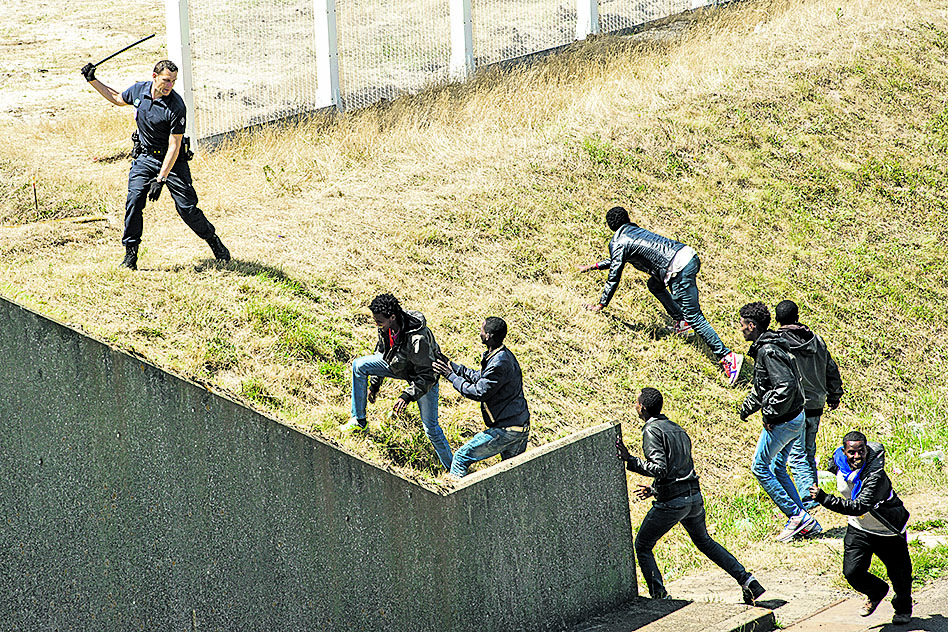
A French antiriot police officer tries to prevent illegal migrants from hiding in trucks heading for England in the French northern harbour of Calais, on June 17, 2015. AFP PHOTO / Philippe Huguen
A little over two thousand years ago, Philo of Alexandria advocated radical emigration. He did not care about land borders, historical nations, geographical territories. « You must emigrate, in search of your father’s land, the land of the sacred word, the land of the father of those who practice virtue. This land is wisdom. « i
He was looking for access to another world, whose foreboding had come to him in a strange way, and whose presence seemed irrefutable to him. « Sometimes I would come to work as if I were empty, and suddenly I was full, ideas fell invisible from the sky, spread out inside me like a shower. Under this divine inspiration I was so excited that I no longer recognized anything, neither the place where I was, nor those who were there, nor what I was saying or writing.”ii
Philo had been seized several times by divine inspiration, he had « seen » it. « To see », at that time, was « to know ». In the old days in Israel, when people went to God for advice, they would say, « Come, let us go to the seer! For the one we call the prophet today was once called the seer.”iii
After his long fight in the dark night, Jacob too had wanted to « see ». He had wanted to hear the name of the one he had fought, to finally « see » him. But the name he asked for was not revealed to him. He only heard his own name, what was to be his new name. A name given by the one who kept his own name silent. Only then did Jacob « see ». But what did he see? A name? An idea? A future?
All we know is that he heard a voice in the night that gave him his name, his new and true name.
This voice is a light in the night. A voice of wisdom, no doubt, which sees itself, a splendour, of which the sun would never be but a faint image.
Jacob heard his « name », and he was no longer Jacob. He heard, – and then he « saw ». The important thing was not the name, but that he « saw ».
Philo explains this: « If the voice of mortals is addressed to the hearing, the oracles reveal to us that the words of God are, like light, things seen. It is said, ‘All the people sawthe voice‘ (Ex. 20:15) instead of ‘heard the voice’. For indeed there was no shaking of the air due to the organs of the mouth and tongue; there was the splendor of virtue, identical with the source of reason. The same revelation is found in this other form: ‘You have seen that I have spoken to you from heaven’ (Ex. 20:18), instead of ‘you have heard‘, always for the same reason. There are occasions when Moses distinguishes between what is heard and what is seen, hearing and sight. ‘You heard the sound of the words, and you saw no form but a voice’ (Deut. 4:12).”iv
Seeing the voice, hearing the word, the « sound of the word ». These words have a double meaning.
In the original Hebrew we read: « kol debarim atem shome’im » ( קוׄל דְּבָרׅים אַתֶּם שֺׁמְעׅים ), which literally translates as : « you have heard the voice of the words ». This is a veiled indication that the « words » in question are like living beings, since they have a « voice ». This voice is not embodied in « air shaking », but is given to be « seen ». This « voice » inhabits the interior of the words, it makes their immanent nature, their « secret » dimension visible, it reveals an enigmatic background, of which they are the living mirror.
Whether they are Kabbalists, Vedic or Sufi, the mystics all know their own path towards this nature, this secret. Rûmî, John of the Cross or Jacob Boehme have followed this path of discovery as far as possible. Great writers of language, they showed how the language of the gods (or of God) could marry with that of men, and give birth to manifest secrets. Everything that is, everything that is said, everything that is presented to reason, has a background. These mystics have shown, as far as men can do it, that part of the essence of the world is in language, or, better said: « is » language.



Vous devez être connecté pour poster un commentaire.