Two « Sons » : Bar and Ben


« Michel d’Anastasio. Calligraphie hébraïque »

There are two words in Hebrew for the idea of filiation : ben בן and bar בר.

These two words mean « son », but with very different shades of nuances, due to their respective roots. Their etymologies open surprising perspectives…

The word ben comes from the verb banah בָּנָה, « to build, to construct, to found, to form », which connotes the idea of a progressive emergence, an edification, a construction, necessarily taking a certain amount of time.

The word bar comes from the verb bara‘ בָּרַא, « to create, to draw from nothing, to give birth » and in a second sense « to choose ». The idea of filiation is here associated with a timeless or instantaneous creation, that may be congruent with a divine origin. Thus the verb bara’ is used in the first verse of Genesis, Berechit bara’ Elohim . « In the beginning created God… ».

In a figurative sense, bar also means « chosen, preferred », connotating choice, election or dilection.

What does the difference between ben and bar teach us?

There is a first level of reading: with bar, the idea of filiation begins with a ‘creation’, appearing from nothingness (bara’), but with ben, it rather implies a long work of ‘construction’, and ‘foundation’ (banah).

On the one hand, bar evokes the atemporality (or timelessness) of a transcendence (coming from nothingness), and by opposition, ben implies the necessary temporality of immanence.

In the biblical text, these words, (banah and bara’, ben and bar) so common, so familiar, are like two opposite doors, opening on very different paths.

Doors, or rather trapdoors, under which profound abysses are revealed.

Let’s start with creation. Berechit bara’.

The word bar has its own depth, its subtle ambiguities. Its primary meaning is ‘son‘, but it may mean son of man, son of Elohim, or son of the Gods.

« What! My son! What! Son of my guts! « (Prov. 31:2)

The Book of Daniel uses the expression בַר-אֱלָהִין , bar-elohim, literally « son of the Gods » (Dan 3:25). In this case, bar-elohim refers to an « angel ».

But bar seems to be able to also mean « Son of God ».The psalmist exclaims, « Worship the Lord with fear » (Ps 2:11), and immediately afterwards David cries out, « Nachku bar », « Kiss the Son » (Ps 2:12).

Who is this ‘Son’ (bar) to be kissed or embraced ? He indeed has a special status, since he is refered to by David, just after the name YHVH, and in the same elan of praise.

According to some, this ‘Son’ is to be understood as ‘the king’, and according to others, it refers to ‘purity’.

Why the ‘king’? Why ‘purity’?

Because bar comes from the verb bara’, one of whose original meanings is « to choose ». Bar also means ‘chosen, elected, preferred’.

In Psalm 2, the word bar may well mean the ‘Chosen One’, the ‘Anointed’ (mashiah, or ‘messiah’) of the Lord.

By derivation, bar also means ‘pure, serene, spotless’, as in bar-levav, ‘pure in heart’ (Ps. 24:4) or ‘the commandments of YHVH are pure (bara)’ (Ps. 19:9).

So, what does ‘nachqou bar’ really mean ? « Kiss the Son », « kiss the king », « kiss the Chosen One », « kiss the Anointed One », « kiss the Messiah », or even « embrace purity »?

Who will tell?

Let us note here that Christians could interpret this particular bar (in Ps 2:12) as a prefiguration of Christ (the name ‘Christ’ comes from the Greek christos which is the Greek translation of the Hebrew word mashiah, ‘anointed’).

As for ben, like I said, this noun derives from the verb banah, that we find used in various ways (to build, to form, to found):

« I built this house for you to live in. « (1 Kings 8:13)

« The Lord God formed a woman from the rib. « (Gen 2:22)

« By building your high places » (Ez 16:31).

« He founded Nineveh » (Gn 10:11).

Solomon played with the word and its ambivalence (to build/ a son), as he made his speech for the inauguration of the Temple. He recalled that it was indeed David’s idea to build (banah) a temple in honor of God, but that the Lord had said to him, « Yet it is not you who will build (tibneh) this temple, it is your son (bin or ben), he who is to be born of you, who will build (ibneh) this temple in my honor. « (1 Kings 8:19)

Solomon was to be the son (ben) who would build (ibneh) the Temple.

Noah also built an altar (Gen 8:20). Here too, one can detect a play on words with even deeper implications than those associated with the construction of the Temple.

« What does ‘Noah built’ mean? In truth Noah is the righteous man. He ‘built an altar’, that’s the Shekhina. His edification (binyam) is a son (ben), who is the Central Column. » i

The interpretation is not obvious, but if one believes a good specialist, one can understand this:

« The Righteous One ‘builds’ the Shekhina because He connects it to the Central Column of the divine pleroma, the Sefira Tiferet, called ‘son’. This masculine sefira is the way by which the Shekhina receives the ontic influx that constitutes her being. »ii

The Shekhina represents the divine « presence ». It is the ‘feminine’ dimension of the divine pleroma. And even, according to some daring interpretations proposed by the Kabbalah, the Shekhina is the « spouse » of God, as we have seen in a previous article.

The Kabbalah uses the image of the union of the masculine (the Central Column) and feminine (the Abode) to signify the role of the Just in the ‘construction’ of the Divine Presence (the Shekhina).

« The Righteous One is the equivalent of the sefira Yessod (the Foundation) represented by the male sexual organ. Acting as the ‘righteous’, the man assumes a function in sympathy with this divine emanation, which connects the male and female dimensions of the Sefirot, allowing him to ‘build’ the Shekhina identified at the altar. » iii

Ben. Son. Construction. Column. Male organ.

And from there, the possible theurgic action of the righteous man, ‘edifying’ the Shekhina.

We see that bar and ben offer two paths linking the divine and the human. One path (bar) is a descending one, that of choice, of election, of the Anointed One, of the Messiah.

The other path (ben) rises like a column in the temple, like a work of righteousness, erected upright, toward the Shekhina.

_____________

iZohar Hadach, Tiqounim Hadachim. Ed. Margaliot, Jerusalem, 1978, fol. 117C cited by Charles Mopsik. The great texts of the cabal. Verdier. Lagrasse 1993, p. 591

iiCharles Mopsik. The great texts of the cabal. Verdier. Lagrasse 1993, p. 591

iiiCharles Mopsik. The great texts of the cabal. Verdier. Lagrasse 1993, p. 593
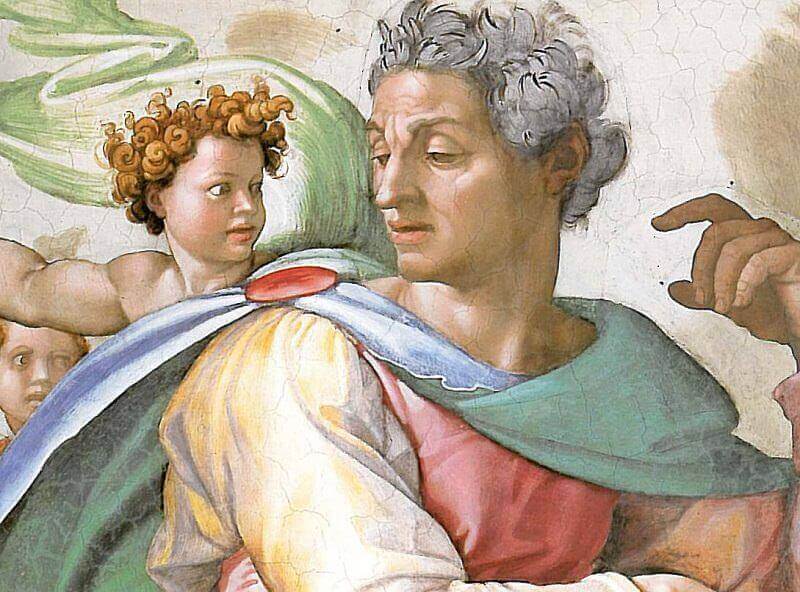
Kinds of Prophets


« Isaiah » – Michelangelo

Prophets can be grouped into three categories, admittedly. There are those who see with their eyes, such as Abraham who saw three men under the oak tree of Mamre. There are those who see by the spirit, like Isaiah. And there are those who see neither with the eyes nor with images or figures, but with pure intuition of the spirit (intuitio). Thus Daniel intuitively contemplated, by the sole force of his intellect, what Baltassar had seen in his dream, and was able to interpret it. ii

Maimonides reduces these three groups to one, and draws a general lesson from it. « Know that the three verbs raâ, hibbît and ‘hazà apply to the sight of the eye; but all three are used metaphorically for the perception of intelligence. (…) It is in this metaphorical sense that the verb raa must be taken whenever it is applied to God, as for example in the following passages: ‘I saw the LORD’ (1 Kings 22:19); ‘and the LORD showed himself to him’ (Gen. (Gen. 18:1); ‘And God saw that it was good’ (Gen. 1, passim); ‘Let me see your glory’ (Ex. 33:18); ‘And they saw the God of Israel’ (Ex. 24:10). This is everywhere an intellectual perception, not the sight of the eye.» iii

According to Maimonides, all « visions » must be understood as operations of intelligence.

But this rationalist approach does not account for all cases of observed « prophecies ».

Other commentators offer a more detailed analysis, such as Isidore of Sevilleiv, who distinguish seven kinds of prophecies.

The first is ecstasy (ekstasis). It is a temporary passage of the mind into an afterlife. Thus the ecstasy of Peter. « He saw the sky open, and an object like a great tablecloth tied at the four corners, descending and lowering itself to the earth, where all the quadrupeds and the reptiles of the earth and the birds of the sky were.» v

This ecstasy consists of three moments: an exit out of the body, the sight of an (extraordinary) phenomenon in the heights, followed by a descent, a lowering and a return to earth.

The second is vision (visio). Isaiah tells: « In the year of the death of King Uzziah I saw the Lord sitting on a great and high throne. His train filled the sanctuary. Seraphim stood above him, each with six wings, two to cover his feet, two to cover his face, and two to fly. They shouted to one another, « Holy, holy, holy is the Lord of hosts, his glory fills the whole earth.» vi

Unlike ecstasy, which is an elevation followed by a descent, the vision stands entirely in the heights. Another difference: ecstasy is precise, detailed. Peter perceives all the animals of the earth and the sky (but not those of the sea). In contrast, Isaiah’s vision is partial, more veiled. He sees the « sanctuary », filled by God’s « train ». The Hebrew text uses the word Hekal, הֵיכָל. The Hekal is the part of the temple that stands before the « Holy of Holies », the Debir, דְּבִיר, – which is the most sacred, most inaccessible place. So Isaiah sees the sanctuary, but not the Holy of Holies, which remains veiled by the « train » (שׁוּלׇ), the bottom of God’s garment. He also sees seraphim, but only partially, since two pairs of their wings cover their faces and feet. Isaiah’s vision is partly incomplete.

Vision is superior to ecstasy in that it « sees » in the heights certain aspects of the divinity, but it also encounters various obstacles, veils that cover other layers of mystery.

The third kind of prophecy mobilizes the dream (somnium). Jacob saw in the dream: « Behold, a ladder was set up on the earth, and the top of it reached to heaven, and angels of God ascended and descended on it! Behold, Yahweh stood before him and said, ‘I am Yahweh, the God of Abraham, your ancestor and the God of Isaac.» vii

Jacob’s dream combines the ascent and descent, as in ecstasy, and adds a divine vision, in which the Lord calls himself and speaks. He makes a solemn promise and a covenant: « I am with you, I will keep you wherever you go. » viii

All this could impress anyone. But Jacob is a cautious man. He saw Yahweh in a dream, and the LORD spoke to him, and made him mirthful promises. But it was only a dream after all. The next day, when Jacob woke up, he made a vow: « If God is with me and keeps me on the road where I am going, if he gives me bread to eat and clothes to wear, if I return safely to my father’s house, then the LORD will be my God. » ix

The dream after all is only a dream. Nothing can replace true reality. Jacob waits to see, in order to believe in his dream, the fulfillment of promises: bread, clothes, a safe journey. The vision of the dream is veiled too, from the veil of doubt, the doubt of the dreamer.

The fourth kind of prophecy is not direct either, it is perceived through still other veils: fire, a cloud or a storm.

One reads: « And the angel of the LORD appeared to him in a flame of fire from the midst of a bush. Moses looked, and the bush was ablaze but not consumed. » x

One also reads: « I will come to you in the thickness of the cloud, so that the people will hear when I speak with you and believe in you forever. » xi

Or: « And the LORD answered Job out of the midst of the storm, and said… » xii

Here again, the vision is somehow mixed, confused. The vision is made against the background of a phenomenon of nature with which it hybridizes.

The fifth kind of prophecy is not a vision but a voice, – coming from heaven. « The angel of Yahweh called it from heaven and said, ‘Abraham! He answered, ‘Here I am. xiii

Abraham hears the voice of God distinctly, at a particularly dramatic moment: « Do not stretch out your hand against the child! Do no harm to him! I know now that you fear God: you did not deny me your son, your only one. » xiv

If the ear undoubtedly hears, the vision remains earthly. At the sound of God’s voice, Abraham raises his eyes and sees a ram whose horns have been caught in a bush.

A similar phenomenon took place on the road to Damascus, with different effects. « Falling to the ground, he heard a voice saying to him, ‘Saul, Saul, why are you persecuting me? xv

There is the voice but not the image. « His companions on the road had stopped, mute in amazement: they heard the voice, but saw no one. » xvi

Deeper, this voice that we do not see, – this (non-)vision, blind. « Saul rose from the ground, but although his eyes were open, he saw nothing. He was led by the hand back to Damascus. For three days he was blind, eating and drinking nothing. » xvii

The sixth kind of prophecy is purely intellectual. It is the one that happened to Solomon composing his Proverbs.

The seventh kind of prophecy sums them all up. It consists in being fulfilled by the Holy Spirit (repletio). It is common to all prophets, for it is the very condition of their prophecy.

These various kinds of prophecies all have another thing in common, which is that they are always in some way, for one reason or another, veiled.

Maimonides made a comment on this subject, which may help to become aware of the inevitability of the veil. « It is frequently found in the Midrashoth and Haggadoth of the Talmud [this assertion] that among the prophets there are some who saw God behind many veils, others through a few, depending on how close they were to the divinity and on the rank of the prophets, so that [the Doctors of the Law] have said that Moses, our Master, saw God behind a single veil that was shining, that is, transparent, according to this word (Yebamot 49b): « He (Moses) contemplated God [as] through a mirror illuminating the eyes », ispaklaria (=speculare) being [in Latin] the name of the mirror, made of a transparent body, like glass and crystal. » xviii

Maimonides adds that the prophet Isaiahxix said that the sins and vices of man are « veils » that come between man and God. This is why, according to the doctors of the law, « prophetic inspiration is given only to a wise, strong and rich man » (Shabbat 92a).

But, Maimonides also tempers, « the prophet need not necessarily possess all the moral qualities, so that no vice can befall him, since Solomon was a prophet in the witness of Scripture. ‘At Gibeon the Lord appeared to Solomon’ (Kings 3:5), but we know of a moral defect, a passion for a certain thing: the great number of women. » xx

He also points to the negative examples of David, « who shed much blood » (Chron. 28:3), and Elijah, who was prone to anger and fanaticism.

What can be said is that the more the prophet is afflicted with nonconforming moral dispositions, the more the number of veils between him and God increases. But there are also structural limits, inherent in man’s intelligence.

Even to Moses, there remained « a single transparent veil that prevented him from attaining the real knowledge of the divine essence: human intelligence ». xxi

Even Moses still had a veil…

But could any man still live, if stripped of all veils, in the cruellest nudity?

A document was read at the Nuremberg trial, the deposition of the German engineer Graede, an eyewitness to the massacre of several thousand Jews near Dubno in October 1942. « Men, women and children of all ages were undressed before the eyes of the SS, who walked among them with a whip or whip in their hands. They would then place their clothes in the place that was indicated to them, pieces of clothing on one side, shoes on the other. Without shouting or crying, all these naked people grouped themselves into families. After kissing each other and saying goodbye, they waited for the sign of the S.S. who was standing at the edge of the pit, also with a whip in his hand. I stayed about fifteen minutes with one of them, and I did not hear anyone complaining or asking for mercy… I saw a whole family: a man and a woman of about fifty years old, with their children of eight and nine years old, and two tall girls in their twenties. A white-haired woman was holding a one-year-old child in her arms, singing a song to him and tickling him…: the child laughed, the father and mother looked at their child with tears in their eyes. The father of a ten year old child held his hand and spoke softly to him; the child tried not to cry; the father pointed to the sky, stroked his hair; he seemed to be explaining something to him. » xxii

The father pointed to the sky, stroking his child’s hair. He really was explaining something to him.

______________

iMc 9.4

iiDan. 2, 26-28

iiiMoses Maimonides. The Guide of the Lost. Ed. Verdier, 1979, p.35.

ivEtymologies, VII, viii, 33-37

vActs 10,11-12

viIs. 6,1-3

viiGen. 28, 12-13

viiiGen. 28.15

ixGen. 28, 20-21

xEx. 3, 2

xie.g. 19.9

xiiJob 38.1

xiiiGen. 22, 11

xivGen. 22.12

xvActs 9, 4

xviActs 9, 7

xviiActs 9, 8-9

xviiiMoses Maimonides. Treatise on the eight chapters. Verdier, 1979, p. 667.

xixIs. 59.2

xxMoses Maimonides. Treatise on the eight chapters. Verdier, 1979, p.668.

xxiIbid. p.670

xxiiLe Monde, issue of January 3, 1946. Cited in Jules Isaac, Jésus et Israël, Ed. Fasquelle, 1959, reprinted 1987, p.527.