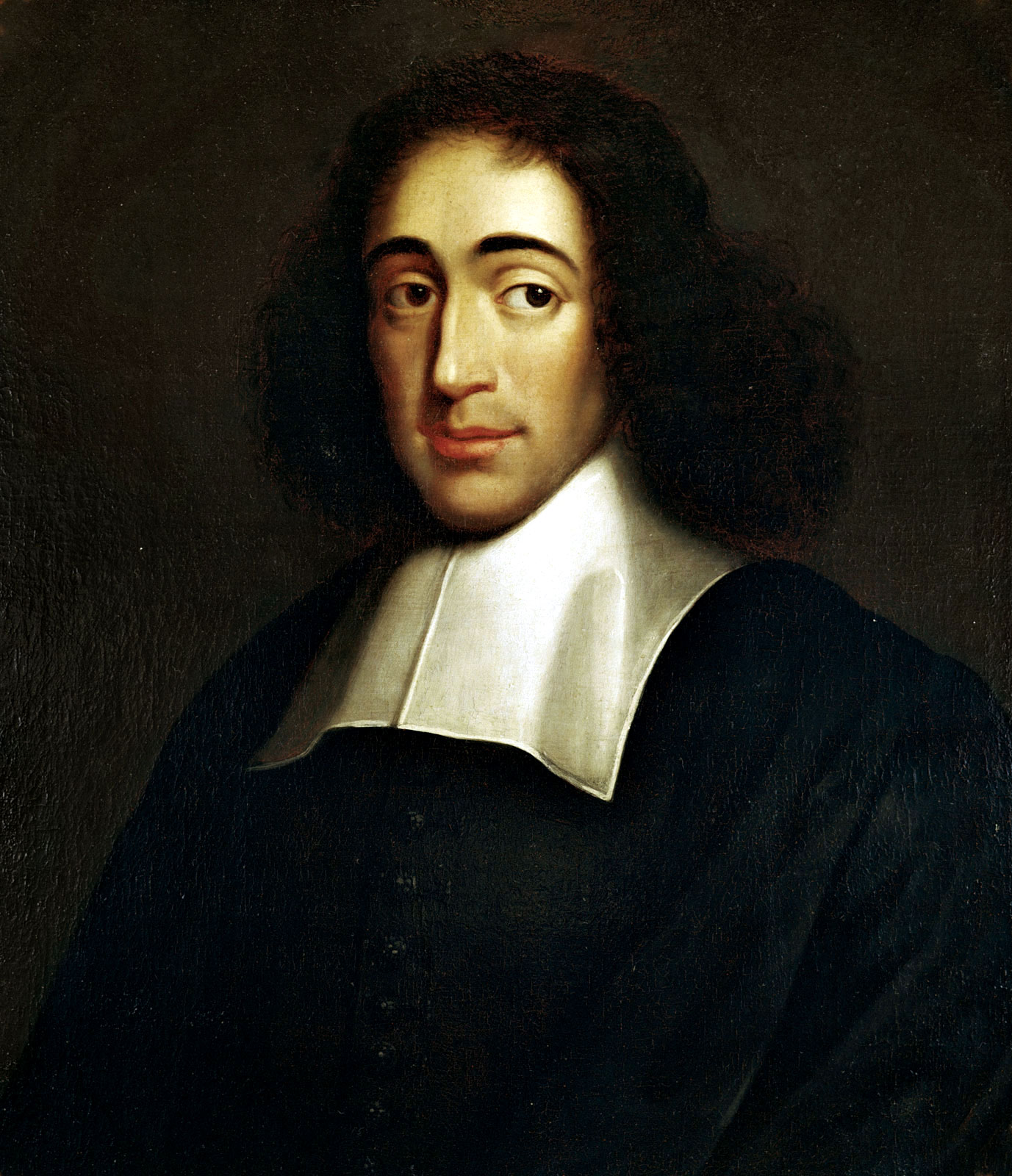
The Four Kinds of Knowledge, and Spinoza.


« Baruch Spinoza »

Spinoza defines several kinds of knowledge by which we form general ideasi . First, there is the knowledge we obtain through the senses, which he calls « knowledge by vague experience », and « truncated and confused ». Then he describes three other kinds of knowledge that enable us to form « ideas »: Imagination, Reason and Intuition, which he calls « knowledge of the first kind », « knowledge of the second kind » and « knowledge of the third kind » respectively.

Knowledge of the first kind is « opinion or Imagination », which derives from the signs or words by which we remember things, and by means of which « we form ideas similar to those by which we imagine them »ii . Knowledge of the second kind is « Reason« , which is derived from the fact that we have « common notions and adequate ideas of the properties of things ». Knowledge of the third kind is « Intuitive Science » which, I quote, « proceeds from the adequate idea of the formal essence of certain attributes of God to the adequate idea of the essence of things ». This convoluted formula is really not easy to understand. That’s why Spinoza says he’s going to explain it with an example – the « Rule of Three ».

As we all know, this Rule allows us, given three numbers, to obtain a fourth, which is to the third as the second is to the first.

There are two ways of applying it, one academic, the other immediate. « Merchants will not hesitate to multiply the second by the third and divide the product by the first »iii says Spinoza, but for the simplest numbers no demonstration is necessary. « Given the numbers 1, 2 and 3, there is no one who does not see that the fourth (proportional) number is 6, » he explains. We see at a glance the relationship between the first and the second (the number 2 is double 1), and we conclude that the fourth is obviously 6 (double 3).

Spinoza thinks that we can apply the Rule of Three to the relationship between the ideas we form about God and the ideas we form about the world… According to him, there is a kind of proportion between: 1° the ‘formal’ essence of God’s attributes, 2° the ‘adequate’ idea we form of them, 3° the true essence of things and 4° the idea we form of their essence.

In other words, the idea we have of the essence of God’s attributes can be compared to the idea we have of the essence of things. This statement may seem self-evident: the idea of one essence is analogous to the idea of another essence – they are both ideas about essence. Any idea conceived by Man about any essence is, on a formal level, analogous to any other idea conceived about any other essence.

However, isn’t it difficult to put ideas about this world and ideas about God in correspondence, without any particular precaution?

Spinoza asserts that, in knowledge of the third kind, a relationship of proportion is possible between human thoughts about the essence of things and human thoughts about the essence of God. He thus explicitly rejects the hypothesis that no proportion is possible between God, Man and the World.

Let us now try to test this relationship of proportion, assumed by Spinoza, on three classic examples of the formulation of divine attributes: « God is », « God is alive », « God is one ».

1 « God is ».

God « is ». By this simple assertion, he is – without attribute or epithet. He is only this « He is« . « Being in God is not something added, but a subsistent truth », says S. Hilaire.iv Thomas Aquinas similarly affirms that God’s being is not ‘added on’ to him. God’s being is not added to him, but « subsists » in him. His being is « without addition ».v Boethius, seven centuries before Thomas Aquinas, had already said: « That which is may well, by a new addition, be something else again: but being, there is no addition to it ».vi Thomas Aquinas gave as an example the difference between the beast and the animal. The ‘beast’ is the animal that is just that – an animal. The ‘animal’, on the other hand, is an animal that can also be reasonable, or unreasonable, or anything else. The divine being ‘is’, as the beast is a beast, quite simply. It is only ‘being’, – a being without addition. On the other hand, the being in general, and the human being in particular, « is » like the animal is an animal with specific possibilities of addition (« feathered animal », « reasonable animal », « political animal », etc.). Hence this possible analogy, if we follow Thomas Aquinas: The being of God is to the being of Man, as the being of the beast is to the being of the animal…

The very being of God only « is ». This does not prevent an infinite number of things from following from the divine being, through an infinite number of modes, says Spinoza: « An infinite number of things must follow in an infinite number of modes from the necessity of the divine nature, that is, everything that can fall under an infinite understanding ».vii But the very being of God can only be this very being. If we believe, as Spinoza does, that this is the opportunity to discover knowledge of the third kind, then, by the Rule of Three, the very being ofman can only be that very being. Or can it be other than this very being?

2. « God is alive ».

Four centuries before Spinoza, Thomas Aquinas devoted the beginning of the Summa Theologica to questions such as: Is the existence of God self-evident? Does God exist? Is there in God a composition of essence and existence? Is God perfect? Do creatures resemble God? Is there in God a composition of essence and subject?

To answer this last question, Thomas Aquinas posits a sort of relationship of proportion between God and deity, on the one hand, and life and the living, on the other. « It is said of God that he is life, and not only that he is alive, as we see in S. John (14,6): ‘I am the way, the truth and the life’. Now deity is in the same relationship with God as life is with the living. So God is deity itself ».viii The distinction between life and the living is a good example of knowledge of the third kind, which allows a formal analogy between the living God and what is life, or living, in man.

3. « God is one ».

What is the essence of divine unity? Is it a numerical unit? The number 1 would then enclose God, and contain him in its arithmetical essence, which seems impossible to admit.

Is it an ontological unity, a unity of being? God’s being would then be limited to being only this being, which is a (grammatical) mode of being, whereas God is supposed to be being itself, beyond all modes of being.

Is it a unity of essence? No. But every essence, whatever it may be, is already ‘one’, in a way by essence. To assert the unity of God’s essence is therefore a pleonasm, because every essence is essentially one.

Is it a ‘transcendental’ unity? Then it would be, to a certain extent, intelligible as an a priori form of reason.

Is it a ‘transcendent’ unity? Possibly, but then as a transcendent unity it is completely unknowable to reason.

As we can see, the possible formulations of the question of divine unity represent various ideas, more or less ‘adequate’, of what its essence might actually be. Let’s imagine that we choose, from among them, one idea (or another) of the formal essence of divine unity. By applying the Rule of Proportion, on the basis of this idea of divine unity, a similar idea of the essence of the unity of things in the world could emerge.

But let us immediately add that the analogy of proportion could also work in the other direction: if we form an adequate idea of the essence of a thing in the world, we should therefore be able to deduce an analogous idea as to the nature of the divine essence.

For example, we can conceive of something in the world as being ‘one’, insofar as it presents itself as a unique, singular entity.

By analogy, then, we can form the idea that God’s essence is also ‘unique’, ‘singular’.

However, there are many singular things in the world, and even an innumerable number. Would there then, by analogy, be many singular things in the world? Many « Gods », and even an uncountable multiplicity? Perhaps, but not necessarily. Applying the Rule of Proportion, we might only wish to deduce that there are indeed many singular attributes in God, and even an infinite number. This is what Spinoza does, and from this he draws this stimulating proposition: « The more we know singular things, the more we know God ».ix

These examples show that it is possible to progress in our knowledge of God, even though he is infinite and has an infinity of attributes. This is how we can best define him: « By God I mean an absolutely infinite being, that is, a substance made up of an infinite number of attributes, each of which expresses an eternal and infinite essence ».x

Spinoza’s God is even infinitely infinite, because each of his ‘attributes’ can have an infinite number of ‘modes’, i.e. affections. « By modes I mean the affections of a substance. »xi Each mode is an affection of an attribute of the substance, and an attribute can have an infinite number of possible affections, and therefore as many ‘modes’. The substance of God, in so far as it ‘affects’ a certain thing, is translated into a particular mode. All things in the world are particular ‘modes’ in God, ‘affections of his substance’. We can also say that these modes are ‘conceived’, or ‘represented’, by means of particular things.xii Thoughts too are ‘modes’ in God, ‘affections of his substance’. They are affections of the divine attribute that is thought.xiii

The fact that there are ideas, the fact that there is ‘thinking’, is a ‘mode’ that expresses in a certain way the nature of God, insofar as he is a ‘thinking thing’.xiv The fact of thinking a ‘singular’ thought (this thought, or that thought) is also a ‘mode’, which expresses the nature of God in a certain and determined way.xv Finally, the bodies themselves are also ‘modes’ expressing God. xvi

All of the above can be called « third-kind » knowledge. What purpose does this knowledge serve, you may ask? This is a very interesting question, and one that goes to the heart of consciousness and unconsciousness. One possible answer can be found on the last page of the Ethics. Spinoza harshly criticises the « ignorant ». He says that the « ignorant » has, in a way, ceased to be: « The ignorant is almost unconscious. As soon as he ceases to suffer, he also ceases to be ».xvii On the other hand, Spinoza values his antonym, the Wise Man. « The Wise Man, on the contrary, considered in this capacity, hardly knows inner turmoil, but having, by a certain necessity, eternal awareness of himself, of God and of things, never ceases to be and possesses true contentment. If the path that leads to it appears to be extremely arduous, it is still possible to enter it. And it must certainly be arduous which is so rarely found. How could it be possible, if salvation were within reach and could be reached without great difficulty, that it should be neglected by almost everyone? But everything beautiful is as difficult as it is rare.xviii

Everything beautiful is difficult and rare…

But not everything that is difficult and rare is necessarily beautiful. Neither difficulty nor rarity are sufficient conditions for beauty.

Beauty comes like grace. But where does it come from?

To answer this question, we might need to know some kind of knowledge of a fourth kind…

__________________

iSpinoza. Ethics. Part II. On the Nature and Origin of the Soul. Scolie 2 de la Proposition XL Trad. Ch. Appuhn. Garnier-Flammarion, 1965, p.115

iiSpinoza. Ethics. Part II. On the Nature and Origin of the Soul. Scolie 2 de la Proposition XL Trad. Ch. Appuhn. Garnier-Flammarion, 1965, p.115

iiiSpinoza. Ethics. Part II. On the Nature and Origin of the Soul. Scolie 2 de la Proposition XL Trad. Ch. Appuhn. Garnier-Flammarion, 1965, p.115

ivS. Hilaire. De Trin. VII. PL 10, 208

v« What is said about being without addition can be understood in two senses: either the being receives no addition because it is part of its notion to exclude all addition: thus the notion of ‘beast’ excludes the addition of ‘reasonable’. Or it does not receive addition because its notion does not include addition, as the animal in general is without reason in the sense that it is not in its notion to have reason; but neither is it in its notion not to have it. In the first case, the being without addition of which we speak is the divine being; in the second case, it is the being in general or common. « Thomas Aquinas. Summa Theologica, I, Question 3, Article 4, Solution 1

viBoethius. De Hebdomadibus. PL 64, 1311.

viiSpinoza. Ethics. Part I. Proposition XVI. Translated by Ch. Appuhn. Garnier-Flammarion, 1965, p.39

viiiThomas Aquinas. Summa Theologica, I, Question 3, Article 3.

ixSpinoza. Ethics. Part V. On the freedom of man. Proposition XXIV. Translated by Ch. Appuhn. Garnier-Flammarion, 1965, p.325

xSpinoza. Ethics. Part I. On God. Definition VI. Ibid, p.21

xiSpinoza. Ethics. Part I. On God. Definition V. Ibid, p.21

xiiModes are conceived as being derived from the divine substance, since they represent particular affections of it.

xiii« Thinking is an attribute of God, in other words God is a thinking thing. God ‘thinks’ when he ‘affects’ his substance in something other (than himself). Spinoza. Ethics. Part II. On the Nature and Origin of the Soul. Proposition I. Ibid, p.71

xivSpinoza. Ethics. Part II. On the Nature and Origin of the Soul. Demonstration of Proposition V. Ibid, p.74

xvSpinoza. Ethics. Part II. On the Nature and Origin of the Soul. Demonstration of Proposition I. Ibid, p.71

xvi« By body I mean a mode which expresses the essence of God, in so far as it is considered as an extended thing, in a certain and determinate manner. » Spinoza. Ethics. Part II. On the nature and origin of the soul. Definition I. Ibid, p.69

xviiSpinoza. Ethics. Part V. On the freedom of man. Scolia of Proposition XLII Ibid, p.341

xviiiIbid.p.341
Tout ce qui est beau est difficile et rare.


« Spinoza ».

Spinoza définit plusieurs genres de connaissances par lesquelles nous nous formons des idées généralesi. Il commence par mentionner la connaissance que l’on obtient par les sens, dont il dit qu’elle est « tronquée et confuse », et qu’il appelle « connaissance par expérience vague ». Puis il en décrit trois autres, qui nous rendent capables de former des « idées » : l’Imagination, la Raison et l’Intuition, — qu’il appelle respectivement « connaissance du premier genre », du « deuxième genre » et du « troisième genre ».

Il appelle « connaissance du premier genre, opinion ou Imagination » celle qui tire son origine des signes ou des mots par lesquels nous nous rappelons des choses, et au moyen desquels « nous nous formons des idées semblables à celles par lesquelles nous nous les imaginons »ii.

Il appelle «connaissance du deuxième genre, ou Raison » celle qui se tire du fait que nous avons « des notions communes et des idées adéquates des propriétés des choses. »

Enfin il appelle « connaissance du troisième genre, ou Science intuitive » le genre de connaissance qui « procède de l’idée adéquate de l’essence formelle de certains attributs de Dieu à l’idée adéquate de l’essence des choses ».

Cette formule n’est pas immédiatement simple à comprendre. C’est pourquoi Spinoza dit qu’il va l’expliquer avec un exemple.

Cet exemple est la Règle de trois.

Comme on sait, cette Règle permet, si l’on donne trois nombres, d’en obtenir un quatrième, qui soit au troisième comme le second au premier.

Mais il y a deux manières de l’appliquer, l’une scolaire, et l’autre immédiate.

« Des marchands n’hésiteront pas à multiplier le second par le troisième et à diviser le produit par le premier »iii dit Spinoza, mais pour les nombres les plus simples aucune démonstration n’est nécessaire. Étant donné les nombres 1,2,3, il n’est personne qui ne voit que le quatrième proportionnel est 6, explique-t-il.

Nous voyons d’un seul regard la relation qu’a le premier avec le second (le nombre 2 est le double de 1), et nous en concluons que le quatrième est évidemment 6 (le double de 3).

Cet exemple est intéressant en ce qu’il semble pouvoir être spécifiquement appliqué aux rapports entre les idées que l’on se forme sur Dieu et celles que l’on se forme sur les choses dans le monde…

Pour Spinoza, le « troisième genre de connaissance » revient en effet à appliquer la Règle de trois, ou Règle de proportion, entre : 1° l’essence ‘formelle’ des attributs de Dieu, 2° l’idée ‘adéquate’ que l’on s’en fait, 3° l’essence véritable des choses et 4° l’idée sur l’on se fait de leur essence.

Plus formellement, la connaissance du « troisième genre » se tire du fait que l’on est en droit de penser comme étant analogues les rapports du 2° au 1°, et du 4° au 3°.

Spinoza affirme ceci: l’idée que l’on se fait de l’essence des attributs de Dieu est comparable à l’idée que l’on se fait de l’essence des choses.

D’un côté, cette affirmation paraît aller de soi : toute idée conçue par l’Homme sur quelque essence que ce soit, est en un sens analogue à toute autre idée conçue à propos d’une autre essence.

D’un autre côté, l’affirmation de Spinoza va moins de soi, si l’on considère que cette règle de proportionnalité met en correspondance, en comparaison, des idées et des essences touchant ce monde-ci et des idées et des essences relatives à Dieu.

La connaissance du troisième genre affirme explicitement qu’un rapport de proportion est possible entre les pensées humaines sur l’essence des choses, et les pensées humaines sur l’essence de Dieu.

Essayons de tester ce rapport de proportion sur trois exemples : « Dieu est », « Dieu est vivant », « Dieu est un ».

1. « Dieu est ».

Dans sa Somme théologique, Thomas d’Aquin affirme que l’être de Dieu ne se surajoute pas à lui.

« L’être n’est pas en Dieu quelque chose de surajouté, mais vérité subsistante »iv

L’être de Dieu ne s’ajoute pas à lui, mais « subsiste » en lui.v

« Ce qu’on dit de l’être sans addition peut se comprendre en deux sens : ou bien l’être ne reçoit pas d’addition parce qu’il est de sa notion d’exclure toute addition : ainsi la notion de « bête » exclut l’addition de « raisonnable ». Ou bien il ne reçoit pas d’addition parce que sa notion ne comporte pas d’addition comme l’animal en général est sans raison en ce sens qu’il n’est pas dans sa notion d’avoir la raison ; mais il n’est pas non plus dans sa notion de ne pas l’avoir. Dans le premier cas, l’être sans addition dont on parle est l’être divin ; dans le second cas, c’est l’être en général ou commun. »vi

Thomas d’Aquin donne une exemple. La « bête » est l’animal qui n’est que cela, animal.

L’ « animal », en revanche, est un animal qui peut être « raisonnable ».

L’être divin « est » comme la « bête » est bête, il n’est qu’ « être », un être sans addition.

L’être en général ou commun « est » comme l’ « animal » est animal, avec des possibilités d’additions (comme « animal raisonnable », « animal politique »,…)

D’où cette analogie de proportion: L’être de Dieu est à l’être de l’Homme, comme l’être de la bête est à l’être de l’animal…

Dieu est un être sans addition, ce qu’avait vu Boèce, sept siècles avant Thomas d’Aquin : « Ce qui est peut bien, par une nouvelle adjonction, être autre chose encore : mais l’être même ne comporte nulle adjonction. »vii

Être autre chose encore ? Être autre chose qu’ être ? Ou être un être ayant en lui autre chose encore ?

L’être peut être encore une infinité de choses : « De la nécessité de la nature divine doivent suivre en une infinité de modes une infinité de choses, c’est-à-dire tout ce qui peut tomber sous un entendement infini. »viii

2. « Dieu est vivant ».

Thomas d’Aquin a consacré le début de sa Somme théologique à des questions comme : L’existence de Dieu est-elle évidente par elle-même ? Dieu existe-t-il ? Y a-t-il en Dieu composition de l’essence et de l’existence ? Dieu est-il parfait ? Peut-on dire que les créatures ressemblent à Dieu ?

Il pose aussi la question de la composition en Dieu d’une essence et d’un sujet. Dans le développement de son argumentation, il propose, quatre siècles avant Spinoza, une sorte de rapport de proportion entre, d’un côté, Dieu et la déité et, de l’autre, la vie et le vivant.

« Il est dit de Dieu qu’il est la vie, et non pas seulement qu’il est vivant, comme on le voit en S. Jean (14,6) : ‘Je suis la voie, la vérité et la vie.’ Or la déité est dans le même rapport avec Dieu que la vie avec le vivant. Donc Dieu est la déité elle-même. »ix

Il me semble que c’est là un bon exemple d’une connaissance du troisième genre.

3. « Dieu est un ».

Quelle est l’essence de cette ‘unité’ divine? Est-elle une unité numérique ? Une unité ontologique ? Une unité d’essence ? Une unité ‘transcendante’ (donc inconnaissable à la raison raisonnante) ? Une unité ‘transcendantale’ (donc intelligible en tant que forme a priori de la raison) ?

Si l’on remarque que toute essence, quelle qu’elle soit, est déjà ‘une’, par essence en quelque sorte, on pourra dire que l’une des hypothèses ci-dessus, l’idée de l’unité d’essence de Dieu, n’apporte pas grand-chose, parce que toute essence est nécessairement une.

Mais on pourra rétorquer que si toute essence est une, c’est justement parce que l’essence divine est une…

Quoi qu’il en soit des hypothèses proposées ci-dessus sur l’essence de l’unité divine, et de la préférence qu’on serait amené à privilégier pour l’une ou l’autre, on pourra toujours dire que les possibles réponses à la question représentent des idées plus ou moins ‘adéquates’ de ce qu’est effectivement l’essence de l’unité (divine).

Imaginons maintenant que l’on choisisse telle idée (ou telle autre, plus ou moins adéquate) de l’essence formelle de l’unité divine.

En appliquant la Règle de proportion suggérée par Spinoza, de cette idée pourrait procéder alors une idée analogue de l’essence de l’unité des choses.

Ou inversement: l’analogie de proportion, en effet, pourra jouer dans les deux sens.

Si l’on se forme une idée adéquate de l’essence d’une chose, on devrait pouvoir en déduire une idée analogue quant à tel ou tel attribut de l’essence divine.

Or on peut concevoir qu’une chose est ‘une’, comme entité unique, singulière.

On peut donc, par analogie, se former l’idée que l’essence de Dieu est aussi ‘une’, unique, singulière.

Cependant, il y a aussi beaucoup de choses dans le monde, et même une infinité (potentielle). Y aurait-il donc beaucoup de Dieux, et même potentiellement une infinité ?

Non, pas nécessairement. D’après l’application de la Règle de proportion, on peut seulement déduire qu’il y a beaucoup d’attributs en Dieu, et même une infinité.

Spinoza en tire d’ailleurs l’une de ses propositions :

« Plus nous connaissons les choses singulières, plus nous connaissons Dieu ».x

Il en ressort qu’il est possible de progresser dans la connaissance de Dieu, bien qu’il soit infini et qu’il ait une infinité d’attributs.

« J’entends par Dieu un être absolument infini, c’est-à-dire une substance constituée par une infinité d’attributs dont chacun exprime une essence éternelle et infinie. »xi

Il est même infiniment infini, car chacun de ses ‘attributs’ peut avoir une infinité de ‘modes’.

« J’entends par mode les affections d’une substance. »xii

Chaque mode est une affection d’un attribut de la substance, et un attribut peut avoir une infinité d’affections possibles, et donc autant de ‘modes’.

Ainsi les choses (dans ce monde-ci) sont toutes des ‘modes’ en Dieu, des ‘affections de sa substance’. La substance de Dieu, en tant qu’elle ‘affecte’ une certaine chose, se traduit en un mode particulier. On peut aussi dire que ce mode est ‘conçu’ (ou ‘représenté’) par le moyen de cette chose particulière. (Ce mode est aussi conçu comme issu de la substance divine, puisqu’il en représente l’une des affections).

Les pensées aussi sont des ‘modes’ en Dieu, des ‘affections de sa substance’. Elles sont des affections de l’attribut divin qu’est la pensée (« La pensée est un attribut de Dieu, autrement dit Dieu est chose pensante »xiii).

Dieu ‘pense’ quand il ‘affecte’ sa substance en une autre chose (que lui-même).

Le fait qu’il y ait des idées, le fait qu’il y ait du ‘penser’, est un ‘mode’ qui exprime d’une certaine manière la nature de Dieu, en tant qu’il est ‘chose pensante’.xiv

Le fait de penser une pensée ‘singulière’ (cette pensée-ci, ou cette pensée-là) est un aussi ‘mode’, qui exprime la nature de Dieu d’une manière certaine et déterminée.xv

Enfin, les corps sont aussi des ‘modes’.

« J’entends par corps un mode qui exprime l’essence de Dieu, en tant qu’on la considère comme chose étendue, d’une manière certaine et déterminée. »xvi

Toutes les considérations qui précèdent peuvent être appelées des connaissances du « troisième genre ».

A quoi servent-elles, pourra-t-on demander ? C’est là une question fort intéressante, et qui touche de près notre sujet principal, celui de l’essence de la conscience, et l’essence de l’inconscience.

Tout à la fin de l’Éthique, Spinoza a des mots assez durs contre l’ignorant.

« L’ignorant est dans une inconscience presque complète de lui-même, de Dieu et des choses et, sitôt qu’il cesse de pâtir, il cesse aussi d’être. »xvii

Mais c’est pour aussitôt valoriser son contraire, le Sage.

« Le Sage, au contraire, considéré en cette qualité, ne connaît guère le trouble intérieur, mais ayant, par une certaine nécessité éternelle conscience de lui-même, de Dieu et des choses, ne cesse jamais d’être et possède le vrai contentement.

Si la voie qui y conduit paraît être extrêmement ardue, encore y peut-on entrer. Et cela certes doit être ardu qui est trouvé si rarement. Comment serait-il possible, si le salut était sous la main et s’y l’on y pouvait parvenir sans grand peine, qu’il fût négligé par presque tous ? Mais tout ce qui est beau est difficile autant que rare. »xviii

Tout ce qui est beau est difficile et rare.

Mais tout ce qui est difficile et rare n’est pas nécessairement beau.

D’où cela vient-il ?

Peut-être d’une connaissance du quatrième genre.

__________________

iSpinoza. Éthique. Partie II . De la nature et de l’origine de l’âme. Scolie 2 de la Proposition XL Trad. Ch. Appuhn. Garnier-Flammarion, 1965, p.115

iiSpinoza. Éthique. Partie II . De la nature et de l’origine de l’âme. Scolie 2 de la Proposition XL Trad. Ch. Appuhn. Garnier-Flammarion, 1965, p.115

iiiSpinoza. Éthique. Partie II . De la nature et de l’origine de l’âme. Scolie 2 de la Proposition XL Trad. Ch. Appuhn. Garnier-Flammarion, 1965, p.115

ivS. Hilaire. De Trin. VII. PL 10, 208

vThomas d’Aquin. Somme Théologique, I, Question 3, Article 4.

viThomas d’Aquin. Somme Théologique, I, Question 3, Article 4, Solution 1

viiBoèce. De Hebdomadibus. PL 64, 1311

viiiSpinoza. Éthique. Partie I. Proposition XVI. Trad. Ch. Appuhn. Garnier-Flammarion, 1965, p.39

ixThomas d’Aquin. Somme Théologique, I, Question 3, Article 3.

xSpinoza. Éthique. Partie V. De la liberté de l’homme. Proposition XXIV. Trad. Ch. Appuhn. Garnier-Flammarion, 1965, p.325

xiSpinoza. Éthique. Partie I. De Dieu. Définition VI. Trad. Ch. Appuhn. Garnier-Flammarion, 1965, p.21

xiiSpinoza. Éthique. Partie I. De Dieu. Définition V. Trad. Ch. Appuhn. Garnier-Flammarion, 1965, p.21

xiiiSpinoza. Éthique. Partie II. De la nature et de l’origine de l’âme. Proposition I. Trad. Ch. Appuhn. Garnier-Flammarion, 1965, p.71

xivSpinoza. Éthique. Partie II. De la nature et de l’origine de l’âme. Démonstration de la Proposition V. Trad. Ch. Appuhn. Garnier-Flammarion, 1965, p.74

xvSpinoza. Éthique. Partie II . De la nature et de l’origine de l’âme. Démonstration de la Proposition I. Trad. Ch. Appuhn. Garnier-Flammarion, 1965, p.71

xviSpinoza. Éthique. Partie II. De la nature et de l’origine de l’âme. Définition I. Trad. Ch. Appuhn. Garnier-Flammarion, 1965, p.69

xviiSpinoza. Éthique. Partie V. De la liberté de l’homme. Scolie de la Proposition XLII Trad. Ch. Appuhn. Garnier-Flammarion, 1965, p.341

xviiiSpinoza. Éthique. Partie V. De la liberté de l’homme. Scolie de la Proposition XLII Trad. Ch. Appuhn. Garnier-Flammarion, 1965, p.341