Ecstasy


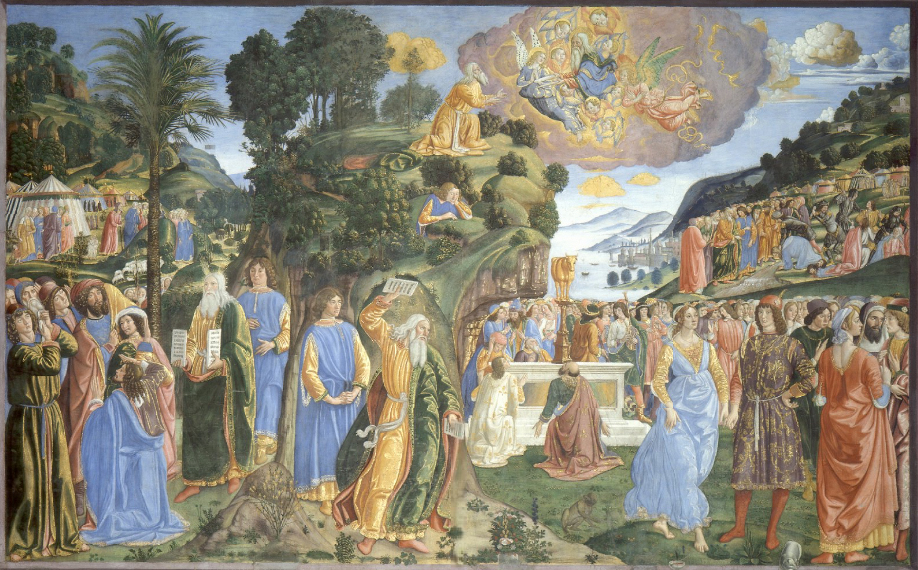
The Descent from Mount Sinai, by Cosimo Rosselli, the Sistine Chapel, Rome

Under Tiberius, in the year 16, soothsayers, astrologers and magi were expelled from Italy. Divination had become a capital crime that one would pay with one’s life. A new millennium had begun, but no one suspected it. Times were changing faster than people’s minds. And the Roman religion had to defend itself foot to foot against barbaric ideas from elsewhere.

Long gone was then the time of Moses, who saw in the light what thought could not embrace. Long gone, the time of the prophets, who received dreams and visions, images and words.

Long gone also, was the time of the Chaldean magi and the Avestic and Vedic priests. Possessed of a divine madness, they could, it is said, predict the future by their power of enthusiasm, their capacity for ecstasy.

The words ‘enthusiasm’ and ‘ecstasy’ translate by means of Greek words and roots experiences of a probably universal nature. But do these words adequately reflect the variety of ‘visions’ and the diversity of ‘seers’ throughout the world and throughout history? How can this be ascertained? How can we organize the timeless archaeology of enthusiasm, launch the worldwide excavations of the ecstatic states?

When the divine penetrates the human, it overturns all that is known, all that is acquired, all that can be expressed, all that can be dictated. Everything is overturned, but it also seems that the mind receives, if we believe the testimonies, a capacity for understanding, comprehension and conviction, without any possible comparison. The prophet ‘hears’ or ‘sees’ in an instant thoughts which he considers ‘divine’ but which he makes his own, and to a certain extent he can communicate them to others and find attentive ears. This is where the true prophet is revealed.

After God breathed thoughts and laws into Moses’ mind, Moses in turn repeated them to Aaron. This double operation (first through divine breath, then through human speech) can be understood as an allegory. Moses is above all God’s interpreter. Firstly, he represents His Intelligence, then His Word. The Intelligence first grasps Moses entirely. What can be said of this? The texts are opaque, difficult to interpret. As for the Word that Moses repeated to Aaron, it represented the prophetic act itself, the decisive leap out of the sanctuary of ecstasy into freedom.

Free, the prophet is also bound, from above and below, – bound to heaven by Intelligence, bound to earth by the Word. Philo sums up: « The soul has an earthly base, but it has its summit in pure Intelligence.”i

For my part, I would add that the most important thing is not in fact to be found in Intelligence, which assails the soul entirely and subjugates it, nor in the Word, whose task is to give meaning to the unspeakable and then bring the worlds together.

What is really important, for the rest of the ages, and for its truly unspeakable implications, is the absolute freedom of the soul (here the soul of Moses) which has been able to free itself from ecstasy, then to transcend the innumerable constraints of the human word, and finally to launch a bridge over unfathomable chasms.

What a lesson!

What an encouragement!

iPhilo, De Somn. 1. 146

Circumcised Ears


Rationalist, materialist minds generally consider the sacred texts of Egypt, China, India, Mesopotamia, Persia, Israel, Chaldea, as esoteric reveries, compiled by counterfeiters to mislead the common public.

For them, treasures such as the Book of the Dead, the texts of the Pyramids, the Vedas, the Upanishads, the Zend Avesta, the Tao Te King, the Torah, the Gospels, the Apocalypse, are only vast mystifications, settling down over the centuries, across the continents.

They are the expression of tribal or clan practices, or a desire for temporal and spiritual power. The social illusion they encourage would be fostered by the staging of artificially composed « secrets » that leave a lasting impression on the minds of peoples, generation after generation.

But broader, more open minds, may see all these ancient testimonies, so diverse, but tainted by the same central intuition, as a whole, – coming from the human soul, and not as a collection of heterogeneous attempts, all of them unsuccessful.

History has recorded the failure of some of them, after a few millennia of local supremacy, and the apparent success of some others, for a time more sustainable, seemingly better placed in the universal march.

With a little hindsight and detachment, the total sum of these testimonies seems to be nestled in a common drive, a dark energy, a specific genius.

This drive, this energy, this genius, are not very easy to distinguish today, in a sceptical environment, where miracles are rare, crowds cold, passions exacerbated.

Not easy but not impossible.

One can always walk between the flowers of human thought, smelling their unique scent, sensitive to the continuous rise of sap in their flexible stems.

The word « esotericism » has become malignant. Whoever is interested is considered a marginal in rational society.

But this word also has several divergent, and even contradictory, meanings that may enlighten us, for that matter.

For example, the Jewish Kabbalah is intended to be a revelation or explanation of the « esoteric » meaning of Moses’ Books. It is even doubly esoteric.

It is esoteric in a first sense in so far as it opposes exotericism. In this sense, esotericism is a search for protection. There are ideas, secrets, that must not be disclosed to the crowd.

It would deeply distort its meaning, or project mud, contempt, lazzis, spit, hatred against them.

It is also esoteric in that it deepens the secret. The text is said to contain profound meanings, which only initiation, prepared under strict conditions, can reveal to hand-picked entrants after long trials. Esotericism is not there prudence or protection, but a conscious, characterized method, elite aspiration.

There is yet another form of esotericism.

R.A. Schwaller de Lubicz defines it as follows: « Esoteric teaching is therefore only an « Evocation » and can only be that. Initiation does not reside in the text, whatever it may be, but in the culture of the Intelligence of the Heart. Then nothing is more « occult » or « secret », because the intention of the « Enlightened », the « Prophets » and the « Envoys from Heaven » is never to hide, on the contrary. »i


In this sense, esotericism has nothing in common with a desire for secrecy. On the contrary, it is a question of revealing and publishing what several minds can, through a common, sincere effort, discover about the nature of the Spirit.

The Spirit is discovered through the Spirit. It seems to be a flat tautology. But no. Matter is incapable of understanding the mind. The mind is probably better equipped, however, to understand matter. And if matter can merge with itself, only the spirit can take the measure of the infinite depth and understand the height of the Spirit without merging with it, undoubtedly relying on analogies with what it knows about itself.

Mind is, at the very least, a metaphor of Spirit, while matter is never a metaphor of Matter. The material, at most, is only an image, invisible to itself, drowned in the shadows, in its own immanence.

Jewish Kabbalah developed in the European Middle Ages, assuming obvious filiation links with the former Egyptian « Kabbalah », which also has links with the Brahmanic « Kabbalah ». I hasten to concede that the nature of the Jewish mission reflects its specificity in the Jewish Kabbalah. Nevertheless, the links of filiation with older “Kabbalahs” appear to be valuable subjects of reflection for the comparativist.


The various « Kabbalahs » of the world, developed in different climates, at times unrelated to each other, are esoteric according to the three meanings proposed above. The most interesting of these meanings is the last. It expresses in action the sincere Intelligence, the Intelligence of the heart, the intuition of the causes, the over-consciousness, the metamorphosis, the ex-stasis, the radial vision of the mythical nucleus, the intelligence of the beginnings and the perception of the ends.

Other metaphors are needed to express what needs to be expressed here.


Pharaonic Egypt is no more. But the Book of the Dead still speaks to a few living people. The end of ancient Egypt was only the end of a cycle, not the end of a world.

Osiris and Isis were taken out of their graves and put into museum display cases.

But Osiris, Isis, their son Horus, still produce strange scents, subtle emanations, for the poet, the traveller and the metaphysician.

There are always dreamers in the world to think of the birth of a Child God, a Child of the Spirit. The Spirit never ceases to be born. The fall of the Word into matter is a transparent metaphor.


Where does the thought that assails and fertilizes us come from? From a neural imbroglio? From a synaptic chaos?

The deep rotation of the worlds is not finished, other Egypts will still give birth, new Jerusalems too. In the future other countries and cities will appear, made not of land and streets, but of spirit.

The Spirit has not said his last word, for the Word is endless.

In the meantime, it is better to open one’s ears, and to have them circumcised, as once was said.


iR. Schwaller de Lubicz. Propos sur ésotérisme et symbole. Ed. Poche. 1990