
According to experimental results from quantum chromodynamics (QCD), the « vacuum » is not empty. The « vacuum » is actually a dynamic and complex medium, sometimes compared to a kind of « quantum molasses ». An infinite number of virtual particles constantly appear in it, including virtual pairs of quarks and anti-quarks, which explain the confinement of quarks in hadrons, as well as the emergence of their mass (hadronic mass). The « quantum vacuum » fills the infinitesimal spaces between atoms, but also between electrons and their nuclei, and even between quarks confined in protons, with virtual particles. In this « vacuum », pairs of virtual quarks and anti-quarks « condense », forming a « chiral condensate » whose symmetry they can occasionally « break ». When a real quark moves through the chiral condensate, it constantly interacts with virtual quark-antiquark pairs (qq̅ ) and thereby acquires an « effective » mass. The « barei » quark has an energy between 5 and 20 MeV, but when it interacts with the chiral condensate, it becomes a « clothed » quark with an effective mass between 300 and 500 MeVii. This mechanism of mass acquisition is general, and it is the role of the quantum vacuum to make it possible. The effective mass of a proton (also represented by its energy: E=mc²) can be analysed as consisting of the kinetic energy of its quarks plus the binding energy (the energy of the gluons that « glue » the quarks together and keep them confined). In summary, the mass of the proton is constituted by the interaction of the three valence quarks (uud) with an immense « sea » of virtual quarks of all colours and flavours (uū + dd̅+ ss̅ + …), gluons and chiral condensate. The interaction of real quarks with this virtual « sea » explains why the actual mass of the proton is 938 MeV, while the mass of the « bare » proton is only 23 MeV.
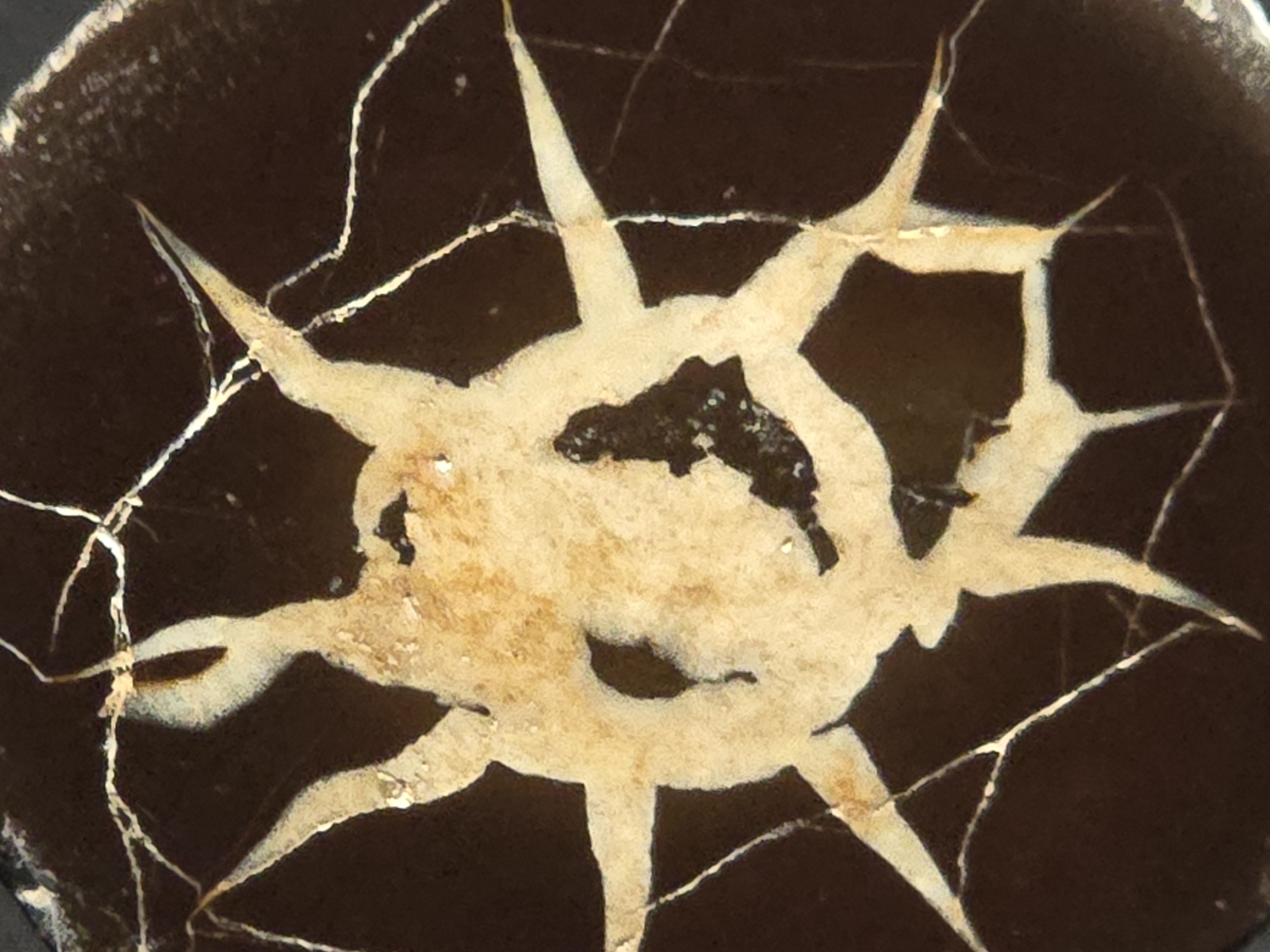
With these elements in place, and to illustrate the point, we could compare the quantum vacuum to a (giant) diamond. The chiral condensate of the vacuum would then correspond to the network of carbon atoms structuring the diamond; the excitations of the hadronsiii would be comparable to the vibrations of phonons in the crystal; the chiral symmetry breaks would be analogous to the translational symmetry breaks in the diamond; the « rigidity » of the vacuum, which is measured on the ΛQCD energy scale (approximately 200 MeV), could be related to that of diamond (which is represented by Young’s moduli), and hadronic masses could be compared to phonon frequencies. These structural and functional analogies, listed point by point, seem to indicate the presence of a profound form of isomorphism between two very different states of nature, that of the quantum vacuum and that of crystalline matter. This invites us to hypothesise the existence of archetypal structures in the physical world. I would like to propose generalising the hypothesis of these archetypal structures to other phenomena, which are even more complex and which are not of a « physical » but rather a « psychic » and « spiritual » nature. In other words, the analogies mentioned above could serve as models, for example, to heuristically explore the nature of the mind (or soul). By generalising the analogical method, we could consider that it would be possible to match the chiral condensate of the vacuum and the networks of atoms in crystals with an intensive noosphere structuring the universe. Hadron excitations and phonon vibrations could be compared to the « emotions », « intuitions » and « ideas » of minds immersed in the noosphere. Chiral or translational symmetry breaks could be analogous to the appearance or disappearance of volitions and decision-making or renunciations that determine choices and actions. The « rigidity » of the vacuum and that of diamond could be related to the « rigidity » or, conversely, the « flexibility » (intellectual, spiritual and moral) of personality, character and the mind’s capacity for evolution. The increase in hadronic masses and the different frequencies of phonons could serve as metaphors for the possible strengthening of the qualities of the mind (intelligence, memory, will). Without wishing to overstate the case, I will content myself with offering a few suggestions here.
What matters most is the proposed method, which consists of drawing on an extremely rich reservoir of concepts and images (in this case, related to the field of quantum physics, and more specifically, quantum chromodynamics), and attempting to deduce new insights into the nature of the mind and soul. Our ideas on this subject have too often remained limited by the conceptions and images that have been forged over thousands of years, without ever really being creatively renewed, subject to a certain conservatism inherent in these notions. This is certainly not a matter of comparing the soul to a phonon or the mind to a hadron. Rather, it is a matter of reflecting on the possibility of using a powerful set of interconnected metaphors, forming an incredibly effective theoretical framework, and undeniably representing one of the greatest intellectual achievements of ‘modernity’. We propose to draw freely on this framework to propose other explanatory models for the emergence of consciousness, the nature of the mind and the soul, and to attempt to spin new types of metaphors in the spiritual and psychological realm. For example, to remain faithful to metaphors related to quantum vacuum, just as we see that the mass of hadrons comes from the « rigidity » of the vacuum, just as the frequency of phonons comes from interatomic forces, so we could conjecture that the « power of love » could emerge from the « force of (moral) law » (and vice versa) . One could also imagine that radical breaks in symmetry in the psychic or intellectual order, such as those caused by « revelations », « trances » or « ecstasies », would be such as to predict the very real existence of a « spiritual » or « noetic » condensate, existing separately from the material world. Just as the emergence of « mass » is not a property of elementary particles, but results from their dynamic interactions with the quantum vacuum, so too could one conjecture that the « mind » does not emerge from neurons and synapses, but that it gradually emerges from the interaction of certain psychic, spiritual and noetic particles with another kind of vacuum, the « Divine Void », analogous in a sense to Hesiod’s Chaosiv. What would these « noetic » particles be? Just as we speak of phonons and hadrons, mesons and pions, why not imagine various types of « noöns« v and « psyons » that would be the essential components of all kinds of consciousness, all varieties of souls and all kinds of spirits, which the most ancient and diverse cultures have continually evoked in their spiritual, religious, cultural and artistic traditions for millennia.
I would like to conclude (provisionally) by inviting the reader to meditate on a symmetry breaking that is particularly significant for any (human) mind, namely that caused by physical death. If we follow the logic of chiral symmetry breaking as the source of the increase in hadron mass, then the symmetry breaking represented by death is undoubtedly the cause of a significant increase in the « noetic » energy of the soul after death. Death, for the soul, would have an effect equivalent to the increase in hadronic mass for the quark. At the moment of death, the noöns and psyons of the soul would become particularly excited and their energy would increase tenfold, intertwining with other particles constituting the psychic « sea » and criss-crossing the noosphere….
________________
iCf https://en.wikipedia.org/wiki/Current_quark
iiQuark masses: the masses of U and D quarks are solely due to the influence of the Higgs field. The influence of the gluon field must also be taken into account, which is responsible for an average of nearly 300 MeV.c-2 per quark, or almost the entire mass. In fact, when we divide the mass of a nucleon by three (the number of quarks), we find ~300 MeV.c-2 (with estimates of only 4 to 8 MeV.c-2 for the D quark and 1.5 to 4 MeV.c-2 for the U quark).
iiiHadrons are particles composed of quarks, the only « building blocks » of matter that participate in strong interaction. They can be composed of three quarks, in which case they are baryons, or of one quark and one antiquark, in which case they are mesons.
ivIn Hesiod’s Theogony, the « Void », called Chaos in Greek, has the status of a primordial deity: « Before all things was Chaos, and then Gaia, broad-breasted, ever-firm seat of all the Immortals who dwell on the snowy peaks of Olympus and in the dark Tartarus in the depths of the spacious earth, and then Eros, the most beautiful of the Immortal Gods, who breaks the forces and who tames the intelligence and wisdom in the hearts of all Gods and men. And from Chaos were born Erebos (Darkness) and black Nyx (Night). » (Theogony)
vI propose creating the neologism « nöon », formed from the Greek noos « mind », and « psyon », formed from the Greek psyche « soul », as « noetic » and « psychic » equivalents of hadrons, mesons, photons and other phonons.

Vous devez être connecté pour poster un commentaire.