God’s Axe


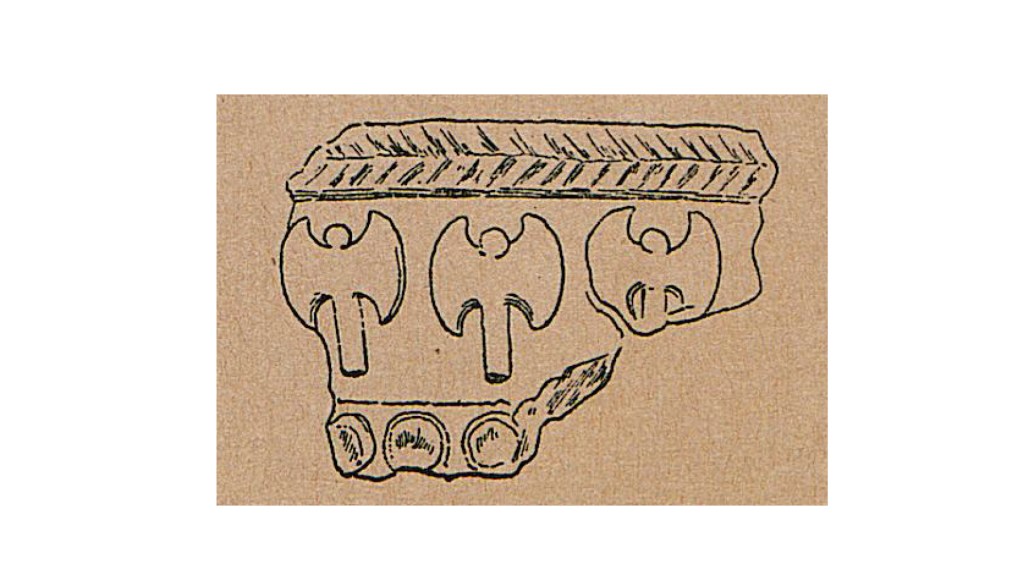
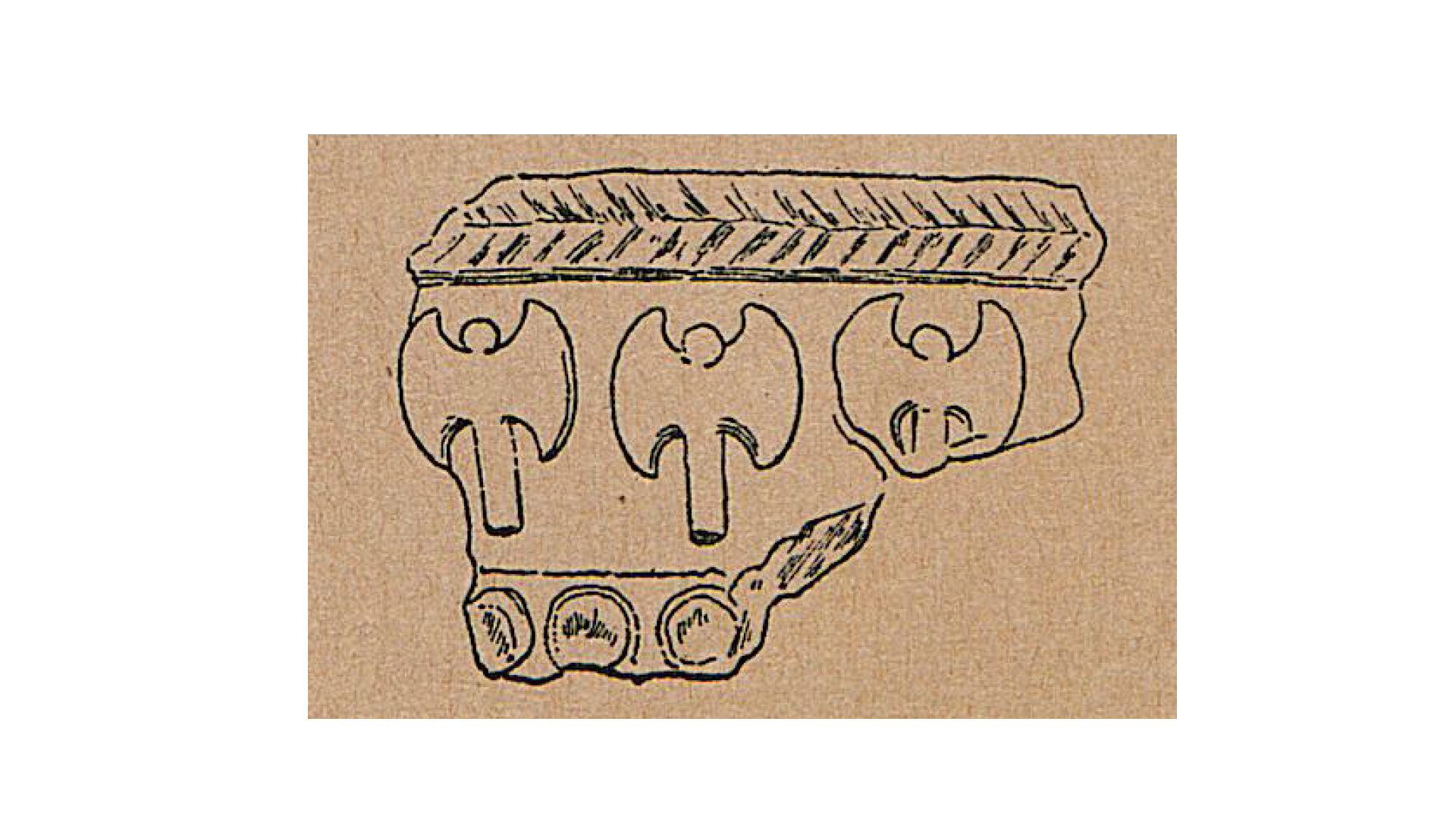
« A double axe painted on a pottery from Knossos »


On the edge of the Fayum, the pyramid of Hawara is considered the architectural masterpiece of the Middle Kingdom. Built of bricks covered with a limestone facing, it still forms a massive mound, housing an imposing funerary vault composed of enormous blocks of white quartzite. It was once flanked by an immense funerary temple, larger than the pyramid itself, but now almost entirely disappeared. Famous in antiquity, described with admiration by Herodotus and Strabo, this unique complex included twelve courtyards surrounded by numerous rooms, served by galleries and ambulatories. Long before the time of Herodotus (5th century B.C.), this place was already known as the « Labyrinth » of Egypt. Indeed, Greek visitors saw in its architectural complexity a supposed resemblance with another famous « Labyrinth », that of Knossos in Crete, which undoubtedly possessed the temporal precedence over that of Hawarai.
Considering the numerous exchanges between Egypt and Crete, since ancient times, it is possible to argue that the idea of a ‘labyrinthine’ architectural complex with a religious or cultic function could have been imported from Crete to Egypt, to make a magnificent counterpart to the no less magnificent pyramidal tomb of Hawara.

In any case, what is sure, it is that the ‘labyrinthine’ idea was staged with greatness, both at Knossos and at Hawara, in a context strongly marked by the respective practice of the Minoan-Mycenaean religions on the one hand and Egyptian on the other hand.

It is particularly exciting that the word ‘labyrinth’, λαϐύρινθος, is certainly not an Egyptian word, and is not a Greek word either. The word ‘labyrinth’ actually has a pre-Hellenic origin, since it has been proven that this word means in Carian, an Indo-European language of Asia Minor, ‘the place of the double axe’.

Since the ‘double axe’ designates by name the ‘labyrinth’, one may wonder what this ‘double axe’ really represents. Why did it give its (Karian) name to two of the most prestigious architectural constructions of the brilliant Minoan and Egyptian civilizations?

The ‘double axe’ was in fact a symbol of the divine, widespread in all Asia Minor, since ancient times. Plutarch tells us that the supreme God, Zeus, was represented emblematically, in Anatolia, in the form of the ‘double axe’, and that he was called there Zeus Labradeus (Ζεύς λαϐραδευς), a name formed from the Carian word λάϐρυς, ‘axe’.

This view has since been confirmed by modern science:
« Almost all scholars adopt the opinion that the double axe is the fetish or symbol of a deity (…) The double axe is considered to represent the heavenly God, (…) the Zeus Stratios of Labranda in Caria, the god Sandan in Tarsus, and other later gods. And during the peak of the Minoan civilization, the god Teshub of the Hittites carried the double axe in one hand and lightning in the other. He could well be the prototype of the gods we have just mentioned. One touches here the important question of the connection between the Minoan religion and that of Asia Minor.ii

What is certain, as has already been said, is that the word λάϐρυς is not Greek, and that the word labyrinth that derives from it is not Greek either, but Carian. The etymological trail thus takes us out of Egypt and Crete and into Asia Minor…

« The German philologist Kretschmer has shown that the group of ‘Asian’, non-Aryan languages, to which Lycian and Karian certainly belong, spread towards Greece and Italy before the Aryan Greeks penetrated Hellas. These languages have left traces in place names and in the Greek language itself. Before the ‘real’ Hellenes reached Crete, an Asian dialect must have been spoken there, and it is to this language that the word ‘labyrinth’ must originally belong. The original labyrinth was built in the territory of Knossos. The palace of Knossos was undoubtedly the seat of a religion celebrating a God whose emblem was the double axe. It was the ‘Place of the Double Axe’ of Knossos, the ‘Labyrinth’ of Crete. »iii

The word labyrinth thus denotes nothing objectively architectural, but refers only to the idea of the ‘double axe’, which is itself the cultic emblem of the Supreme Divinity. Why did this weapon receive the honor of symbolizing the supreme Deity, not only in Minoan Crete, but in other regions of Anatolia and Asia Minor, including Caria and Lycia?

Is it for its warrior symbolism, which could be appropriate to an Almighty God, Lord of the heavenly armies, or is it for a possible symbolism referring to the lightning of a god of the atmosphere?
According to the opinion of specialists, it is much more likely that the double axe owes its emblematic elevation to its sacrificial role. The double axe is the symbol of the power to kill the victim destined for the God. It is indeed a fact that the double axe was used for the immolation of bulls or oxen, during the sacrifices considered the most important, the most ‘noble’.

Walter Burkert gives a striking description of such sacrifices:

« The most detailed representation of a sacrifice comes from the sarcophagus of Ayia Triada. A double axe, on which a bird has landed, is erected near a tree shrine. In front of the axe stands an altar that a priestess, ritually dressed in an animal skin, touches with both hands, as if to bless it. A little higher up, we see a vase for libations and a basket filled with fruit or bread, i.e. preparatory offerings that are brought to the altar. Behind the priestess, on a wooden table, lies a freshly sacrificed ox, whose blood is flowing from its throat into a vase. A flute player accompanies the scene with his sharp instrument. Following him, a procession of five women in a ritualistic attitude approaches. Almost all the elements of Greek sacrifice seem to be present here: procession (pompê), altar, preparatory offerings, flute accompaniment, collection of blood. Only the fire on the altar is missing ».iv

The sacrifice was an act of worship of great importance. It so happens that two of its by-products (so to speak), namely the horns of the sacrificed beast and the axe used for the sacrifice, have acquired considerable importance over time, reflected in a multitude of architectural, graphic, symbolic forms.
« The sacrifice of the bull, the noblest of the sacrifices in normal time, is associated with the two sacred symbols of the most known and the most repetitive of the Minoan and Mycenaean cult: the pair of horns and the double axe. Both, nevertheless, are already fixed symbols, beyond their practical use, when, after a long prehistory, which begins in Anatolia, they end up reaching the Cretan shores. The excavations of the Neolithic city of Çatal Hüyük do not allow today to doubt that the symbol of the horns, which Evans named ‘horns of consecration’, drew its origin from real bull horns. (…) In the background, we find the custom of a partial restoration, observed by hunters, of a symbolic compensation for the killed animal. (…) The axe was used for the sacrifice of oxen, that does not suffer any discussion. In its form, the double axe joins practical efficiency to a powerful ornamental aspect which was surely charged with a symbolic function in very high times. (…) For the 4th millennium B.C., the first double axe is detected, still in lithic form, at Arpachiyah in Upper Mesopotamia. In the 3rd millennium, it is known in Elam and Sumer, as well as in Troy II. It reaches Crete at the beginning of the Minoan period, where it precedes the arrival of the symbol of the horns. »v

From the scene of the Minoan sacrifice reported by Burkert, I retain an idea: the ‘compensation’ due to the animal killed in sacrifice, through its horns, raised to the rank of divine symbol, – and a very beautiful image: ‘A double axe, on which a bird has landed’, on which I will return in a moment.

The two symbols, that of the pair of bovid horns (bulls, bucranes, or oxen), as well as that of the double axe used to immolate them, ended up transcending their respective origins, that (metonymic) of the animal victim, and that (equally metonymic) of the human sacrificer. They ended up designating the divine Himself, as figuratively and symbolically grasped in His highest essence…

This essence can be sensed in its ornamental, ubiquitous role, and it is revealed, in full light, by yet another metonymy, that of the bird which comes to rest at the top of the double axe.

To help us to understand the range, it is necessary to recall that « the most specific and distinctive feature of the Minoan experience of the divine resides in the epiphany of the Goddess who, during the trance, arrives ‘from above’. On a gold ring from Isopata, in the midst of an explosion of flowers, four women in festive garb lead a dance of varying figures, bending forward or raising their hands to the sky. Just above their outstretched arms appears a much smaller and differently dressed figure, which seems to float in the air. The interpretation is unanimous: in the midst of the swirling dances of the faithful, it is the Goddess who manifests herself.

Similar small floating figures appear in other scenes, each time forcing the interpretation of a divine epiphany (…) It is not known how the epiphany could be arranged during the cult itself, but it is possible that the women pushed their dance into a trance. According to a common interpretation, the birds should also be considered as an epiphany of the gods. « vi

Indeed, in his famous work on the Minoan-Mycenaean religion, Martin Nilsson devotes a whole chapter to the divine epiphanies which borrow forms of birds:
« The fact that a bird is perched on the head of a large bell-shaped ‘idol’ in the Temple of the Double Axes at Knossos, must be interpreted as proof that it is an object of worship, that is, an image of the Goddess. For the bird is a form of the epiphany of the gods.  (…) The obvious explanation is that birds are signs of the presence of the divinity. »vii

Nilsson gives another much older example, dating back to the Middle Minoan II period, that of the Sanctuary of the Dove-Goddess of Knossos, in which the birds symbolize the incarnation of the Divinity coming to visit the sacred place.
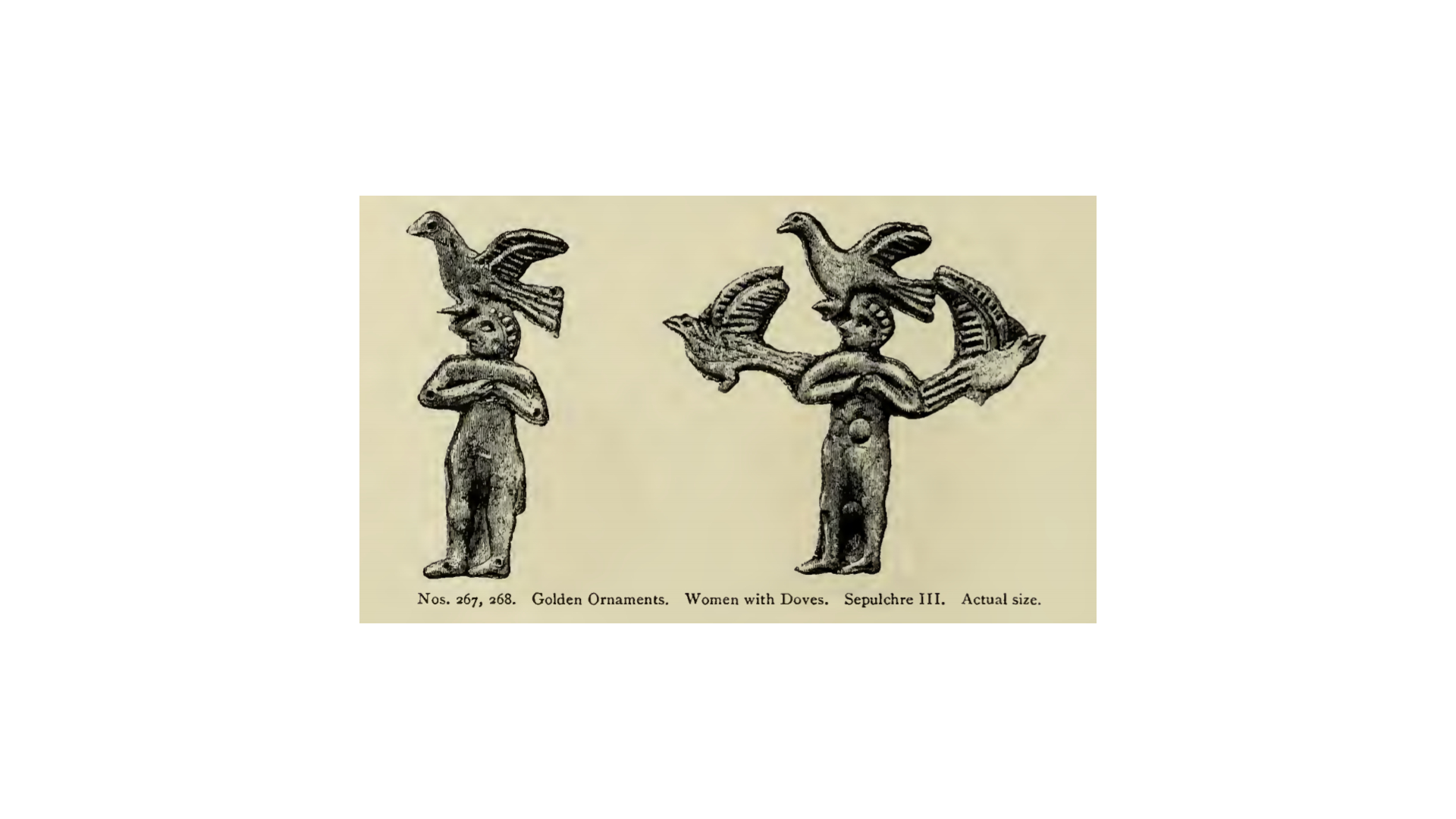
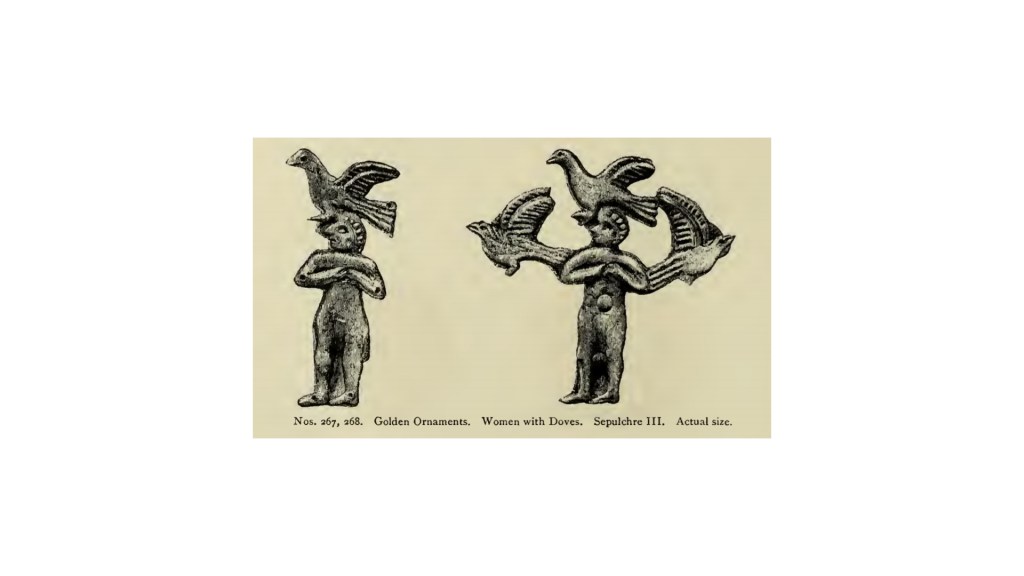
He also cites the example of two gold leaves found in the third tomb at Mycenae representing a naked woman, her arm resting on her breasts. In one of the leaves, a bird seems to be whirling above her head, and in the other a bird seems to be touching her elbows with the tip of its wingsviii.
I reproduce here these amazing figures:
How to interpret these « divine epiphanies » borrowing bird forms?

In the context of the cult of the dead implied by the Hagia Triada sarcophagus, Nilsson briefly mentions the hypothesis of ‘soul-birds’, representations of the souls of the deceased, but immediately rejects it. In agreement with the rest of the scientific community, he emphasizes that the double axe on which the birds are perched is assigned to the cult of the supreme divinity and cannot therefore be associated with human souls.
He then proposes to follow Miss Harrison’s interpretation insteadix: « The bird is perched on a column. This column, as Dr. Evans has clearly shown, and as is evident from the sarcophagus at Hagia Triada, represents a sacred tree. This column, this tree, takes on a human form as a goddess, and this goddess is the Great Mother, who, taking different forms as Mother or Maiden, later develops into Gaia, Rhea, Demeter, Dictynna, Hera, Artemis, Aphrodite, Athena. As Mother Earth, she is also Pontia Theron [the ‘Bridge’ of Animals], with her lions, her deer, her snakes. And the bird? If the tree is of the earth, the bird is surely of the sky. In the bird perched on the column, we have, I think, the primitive form of the marriage of Ouranos and Gaia, of the Heaven-Father with the Earth-Mother. And from this marriage arose, as Hesiod told us, not only mortal man, but all divine glory. « x

The bird is thus clearly associated with the representation of the « epiphany » of the Supreme Divinity of the Minoans-Mycenians.

This is a very interesting result. But there is still more to say on this subject…

By carefully examining the numerous representations of the Double Axe, and their curious variations presented in the work of Nilssonxi, one can advance with a strong probability that the Double Axe could also have progressively taken the ‘shape’ of winged beings, in a vast range going from the abstract figuration of ‘butterflies’ to strange representations of anthropomorphic birds, or even of female and winged characters, which one could easily assimilate to figures of ‘angels’, if one did not risk anachronism, the biblical ‘angels’ appearing (in the Jewish Bible) one or two thousand years later
Here is an example taken from Nilsson’s book:

I am well aware, in doing so, of proposing a certain transgression, by mixing with Minoan and Mycenaean representations concepts and representations belonging to Assyrian, Mesopotamian and even Jewish and Hebrew traditions.

But it is difficult to resist in this case the metaphorical and metonymic shifts that Minoan and Mycenaean images allow and encourage, especially those that go in the direction of an increasingly refined abstraction.

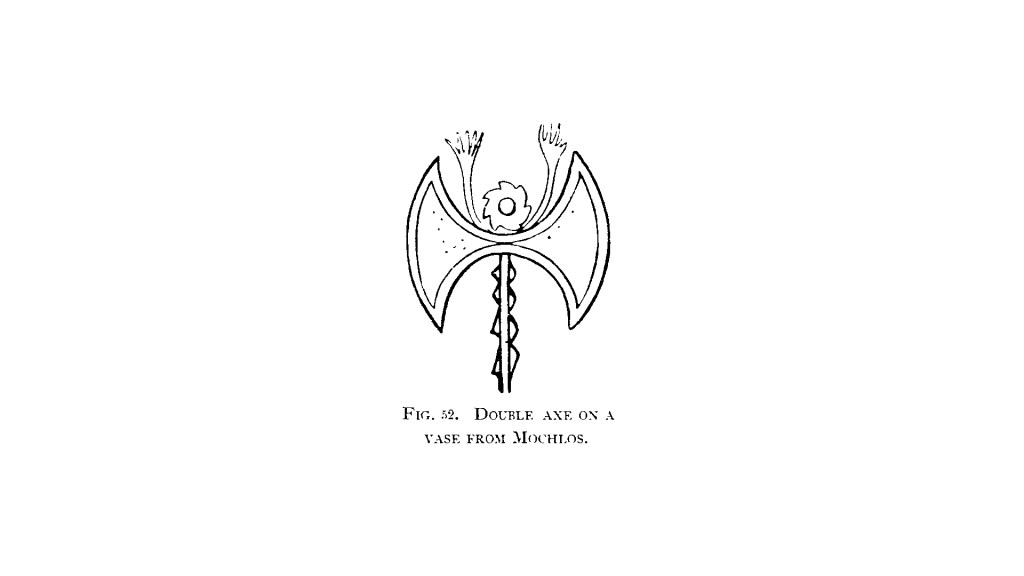
The representation of the double axe as an abstract form of ‘butterflies’, is quoted by Nilsson himself, as stemming from the work of Seagerxii and Evansxiii: « Some scholars recognize a double axis in the so-called ‘butterfly’ patterntwo cross-hatched triangles touching each other at only one angle, the bases being parallel (…) The earliest example is an Early Minoan II saucer from Mochlos »xiv of which we present the reproduction below:

As for the evocation of winged anthropomorphic forms, let us consider the image of a double axe painted on a pottery chosen to illustrate the work of Joseph Joûbert, The archaeological excavations of Knossosxv:

It looks like a stylized double axe, but the general appearance also evokes a kind of angel. This idea of a winged being is reinforced when one remembers that a bird supposedly embodying the Divinity comes to perch at the top of the Double Axe, thus establishing a sort of twinning between the spread wings of the bird and the double blades of the axe.

In the chapter entitled « Epiphanies of the Gods in human shape » of his book, The Minoan-Mycenaean Religion and its Survival in Greek religion, Martin Nilsson finally quotes a very interesting opinion of Professor Blinkenberg according to which the names used to designate the Great Minoan Goddess such as Fanassa, Athenaia, Lindia, Paphia, suggest that the Minoans-Mycenaeans called their supreme deity simply ‘the Lady’ (or ‘Our Lady’), without giving her any particular name.xvi

Nilsson unreservedly agrees with Professor Blinkenberg’s opinion. I shall therefore adopt it in my turn, and I shall make it the subject of the conclusion of this article.

On the one hand, the labyrinth and the double axe have allowed us to establish the existence of real currents of religious, architectural and artistic exchange between Egypt, Crete and Anatolia.

Moreover, many works have shown that the double axe was in reality the emblem of the supreme divinity (a unique divinity, implying the emergence of a ‘Minoan monotheism’ with a matriarchal character) worshipped in Crete by the Minoans and the Mycenaeans from the end of the 3rd millennium BC.
This cult was prolonged during the 2nd millennium B.C., thus well before the appearance of the ‘Abrahamic monotheism’ (with patriarchal character) as the many archaeological remains in Crete attest it.

Finally, we have accumulated evidence tending to prove that the imaginative force of the figurative representations of the ‘double axe’ had allowed free rein to the associations of ideas, and had encouraged the creation of completely abstract or singularly anthropomorphic forms, being able to go as far as to represent the incarnation of the Divinity in the form of double hatched triangles, or birds, or even figures of ‘angels’.

This is all the more astonishing since these figurations precede by at least a millennium the winged angels in the Jewish Torah, such as the angels of the Ark of the Covenant whose wings touch each other by their extremities, as described in the Book of Exodus:
« These cherubim will have their wings spread out in front and dominating the mercy seat, and their faces, turned toward each other, will be directed toward the mercy seat. »xvii

_________________________________

iThe Hawara Funerary Complex (the pyramid and Lbyrinth Temple) was built by Amenemhet III (1843-1797), the sixth king of Dynasty 12. According to some, the Hawara complex introduced the prototype of the ‘labyrinth’. However, the site of Knossos in Crete, populated since the 8th millennium B.C., already had a large palace in 2200 B.C., built several centuries before the Hawara complex, during the Ancient Minoan phase (MA III), and followed, during the Middle Minoan phase (MM IA) called ‘archaeopalatial’, dating from 2100 to 2000 B.C., by the construction of an Old Palace organized around a central courtyard. It is possible that reciprocal influences between Egyptian and Minoan civilizations took place as early as the 3rd millennium BC, or even earlier. In any case, the very name ‘labyrinth’ has nothing Egyptian or Greek about it, but is of Carian origin, and therefore of Asia Minor.

iiMartin P. Nilsson. The Minoan-Mycenaean Religion and its Survival in Greek religion. Copenhagen, London, 1927, p. 186-188

iiiL.W. King, H.R. Hall. History of Egypt, Chaldea, Syria, Babylonia and Assyria. The Grolier Society. London, 1907, p.125-126

ivWalter Burkert. The Greek religion in the archaic and classical period. Translation Pierre Bonnechere. Ed. Picard. 2011, p. 60

vWalter Burkert. The Greek religion in the archaic and classical period. Translation Pierre Bonnechere. Ed. Picard. 2011, p. 61-62.

viWalter Burkert. The Greek religion in the archaic and classical period. Translation Pierre Bonnechere. Ed. Picard. 2011, p. 65.

viiMartin P. Nilsson. The Minoan-Mycenaean Religion and its Survival in Greek religion. Copenhagen, London, 1927, p. 285

viiiHeinrich Schliemann. Mycenae : A Narrative of Researches and Discoveries at Mycenae and Tiryns, Ed. Scribner, Armstrong and Co., New York, 1878, p. 180, Fig. 267 et 268.

ixDans sa conférence Bird and Pillar. Worship in connexion with Ouranian Divinities. Transactions of the 3rd Congress for the History of Religions at Oxford, II, p.156.

xCité par Martin P. Nilsson. The Minoan-Mycenaean Religion and its Survival in Greek religion. Copenhagen, London, 1927, p. 292-293

xiMartin P. Nilsson. The Minoan-Mycenaean Religion and its Survival in Greek religion. Copenhagen, London, 1927, Ch. VI  » The Double-Axe « , p. 162-200

xiiSeager, Mochlos, p.96 and p.36, fig.13

xiiiEvans, Palace of Minos, I, p.166

xivMartin P. Nilsson. The Minoan-Mycenaean Religion and its Survival in Greek religion. Copenhagen, London, 1927, p.180

xvJospheh Joûbert, Les fouilles archéologiques de Knossos, Edition Germain et G. Grassin, Angers, 1905

xviBlinkenberg. The temple of Paphos. Det. Kgl. Danske Videnskabernes Selskab,Hist-filol. Medd, IX:2, 1924, p.29 cited by Martin Nilsson. In Op.cit. p.338.

xviiEx 25, 18-20 and Ex 37, 7-9

xviiiEx 25, 18-20 and Ex 37, 7-9
La Hache et l’Ange. Ou : De la circulation des métaphores du Divin en Asie mineure, en Crète, et en Égypte


En bordure du Fayoum, la pyramide de Hawara passe pour le chef d’œuvre architectural du Moyen Empire. Bâtie de briques recouvertes d’un parement de calcaire, elle forme aujourd’hui encore un monceau massif, célant en son sein un imposant caveau funéraire composé d’énormes blocs de quartzite blanc. Elle était côtoyée jadis par un immense temple funéraire, plus vaste que la pyramide elle-même, mais aujourd’hui presque entièrement disparu. Célèbre dans l’antiquité, décrit avec admiration par Hérodote et Strabon, ce complexe unique en son genre comprenait douze cours entourées de nombreuses salles, servies par des galeries et des déambulatoires. Bien avant l’époque d’Hérodote (5ème siècle av. J.-C.), ce lieu était déjà réputé être « le Labyrinthe » de l’Égypte. Les visiteurs grecs voyaient en effet dans sa complexité architecturale une ressemblance supposée avec un autre « Labyrinthe » célèbre, celui de Knossos en Crète, qui possédait indubitablement la précellence temporelle sur celui de Hawarai.

Compte tenu des nombreux échanges avérés entre l’Égypte et la Crète, depuis une haute époque, il est possible d’avancer que l’idée d’un complexe architectural ‘labyrinthique’ ayant une fonction religieuse ou cultuelle a pu être importée en l’occurrence de Crète en Égypte, pour faire un magnifique pendant au non moins magnifique tombeau pyramidal de Hawara.

Quoi qu’il en soit, ce qui est sûr, c’est que l’idée ‘labyrinthique’ a été mise en scène avec grandeur, à la fois à Knossos et à Hawara, dans un contexte fortement marqué par la pratique respective des religions minoenne-mycénienne d’une part et égyptienne d’autre part.

Il est également sûr, mais aussi particulièrement excitant par les perspectives ainsi ouvertes, que le mot ‘labyrinthe’, λαϐύρινθος, n’est certes pas un mot égyptien, mais n’est absolument pas non plus un mot grec. Le mot ‘labyrinthe’ a en réalité une origine pré-hellénique, puisqu’il est avéré que ce mot signifie en carien, langue indo-européenne d’Asie mineure, ‘le lieu de la double hache’.

Puisque c’est le nom de la ‘double hache’ qui désigne nommément le ‘labyrinthe’, il est permis de se demander ce que représente réellement cette ‘double hache’, laquelle a donné son nom (carien) à deux des plus prestigieuses constructions architecturales des brillantes civilisations minoennes et égyptiennes.

La double hache était en fait un symbole du divin, répandu dans toute l’Asie mineure, depuis une époque reculée. Plutarque nous apprend que le Dieu suprême, Zeus, était représenté emblématiquement, en Anatolie, sous la forme de la ‘double hache’, et qu’il y était appelé Zeus Labradeus (Ζεύς λαϐραδευς), nom formé à partir du mot carien λάϐρυς, ‘hache’.

Cette opinion a depuis été confirmée par la science moderne :

« Presque tous les savants adoptent l’opinion que la double hache est le fétiche ou le symbole d’une divinité (…) La double hache est considérée comme représentant le Dieu-Ciel (the Sky-God), (…) le Zeus Stratios de Labranda en Carie, le dieu Sandan à Tarse, et d’autres dieux plus tardifs. Et pendant la période de l’apogée de la civilisation minoenne, le dieu Teshub des Hittites portait la double hache dans une main et l’éclair dans l’autre. Il pourrait bien être le prototype des dieux que l’on vient de citer. On touche ici la question importante de la connexion entre la religion minoenne et celle d’Asie mineure.»ii

On l’a déjà dit, le mot λάϐρυς n’est pas grec, et le mot labyrinthe qui en découle n’est pas grec non plus, mais bien carien. Le fil d’Ariane étymologique nous emmène donc hors des labyrinthes d’Égypte et de Crète et nous fait prendre pied en Asie mineure…

« Le philologue allemand Kretschmer a montré que le groupe de langues ‘asiatiques’, non-aryennes, auquel appartiennent certainement le lycien et le carien, s’est étendu vers la Grèce et l’Italie avant que les Grecs aryens ne pénètrent l’Hellas. Ces langues ont laissé des traces dans les noms de lieux et dans la langue grecque elle-même. Avant que les ‘vrais’ Hellènes atteignent la Crète, un dialecte asiatique devait y être parlé, et c’est à cette langue que le mot ‘labyrinthe’ devait originellement appartenir. Le labyrinthe originel fut bâti dans le territoire de Knossos. Le palais de Knossos était indubitablement le siège d’une religion célébrant un Dieu dont l’emblème était la double hache. C’était le ‘Lieu de la Double Hache’ de Knossos, le ‘Labyrinthe’ de Crète. »iii

Le mot labyrinthe ne dénote donc rien d’objectivement architectural mais renvoie seulement à l’idée de la ‘double hache’, qui est elle-même l’emblème cultuel de la Divinité suprême. Pourquoi cette arme a-t-elle reçu l’honneur de symboliser la Déité suprême, non seulement dans la Crète minoenne, mais dans d’autres régions d’Anatolie et d’Asie mineure, dont la Carie et la Lycie ?

Est-ce pour son symbolisme guerrier, qui pourrait convenir à un Dieu Tout-Puissant, Seigneur des armées célestes, ou est-ce encore pour un éventuel symbolisme renvoyant à la foudre d’un dieu de l’atmosphère ?

Selon l’avis des spécialistes, il est beaucoup plus vraisemblable que la double hache doit son élévation emblématique à son rôle sacrificiel. La double hache est le symbole du pouvoir de tuer la victime destinée au Dieu. Il est en effet avéré que la double hache servait à l’immolation des taureaux ou des boeufs, lors des sacrifices considérés comme les plus importants, les plus ‘nobles’.

Walter Burkert donne une description saisissante de tels sacrifices :

« La représentation la plus détaillée d’un sacrifice provient du sarcophage d’Ayia Triada. Une double hache, sur laquelle s’est posé un oiseau, est dressée près d’un sanctuaire à l’arbre. Face à la hache s’élève un autel qu’une prêtresse, rituellement revêtue d’une peau d’animal, touche des deux mains, comme pour le bénir. Un peu plus haut, on voit un vase à libations et un panier rempli de fruits ou de pains, à savoir des offrandes préparatoires qu’on apporte à l’autel. Derrière la prêtresse, sur une table de bois, gît un bœuf à peine sacrifié, dont le sang s’écoule de la gorge dans un vase. Un joueur de flûte accompagne la scène de son instrument aigu. A sa suite approche une procession formée de cinq femmes affectant une attitude rituelle. Presque tous les éléments du sacrifice grec semblent ici déjà présents : procession (pompê), autel, offrandes préparatoires, accompagnement de flûte, collecte du sang. Seul le feu sur l’autel manque à l’appel. »iv

Le sacrifice était un acte cultuel d’une très grande importance. Il se trouve que deux de ses sous-produits (si l’on peut dire), à savoir les cornes de la bête sacrifiée et la hache qui sert au sacrifice, ont acquis avec le temps une importance considérable, se reflétant sous une multitude de formes (architecturales, graphiques, symboliques).

« Le sacrifice du taureau, le plus noble des sacrifices en temps normal, est associé aux deux symboles du sacré les plus connus et les plus répétitifs du culte minoen et mycénien : la paire de cornes et la double hache. Tous deux, néanmoins, sont déjà des symboles fixés, au-delà de leur usage pratique, quand, après une longue préhistoire, qui débute en Anatolie, ils finissent par atteindre les rivages crétois. Les fouilles de la ville néolithique de Çatal Hüyük ne permettent plus aujourd’hui de douter que le symbole des cornes, qu’Evans nomma ‘cornes de consécration’, tirait son origine de véritables cornes de taureau. (…) On retrouve là, en arrière-fond, la coutume d’une restauration partielle, observée par les chasseurs, d’une compensation symbolique pour l’animal tué. (…) La hache était utilisée pour le sacrifice des bœufs, cela ne souffre aucune discussion. Dans sa forme, la double hache joint à l’efficacité pratique un puissant aspect ornemental qui s’est sûrement chargé d’une fonction symbolique à très haute époque. (…) Pour le IVème millénaire on détecte la première double hache, encore sous forme lithique, à Arpachiyah en haute Mésopotamie. Au IIIème millénaire, elle est connue en Élam et à Sumer, de même qu’à Troie II. Elle parvient en Crète au début de l’époque minoenne, où elle devance l’arrivée du symbole des cornes. »v

De la scène du sacrifice minoen rapportée par Burkert, je retiens une idée : la ‘compensation’ due à l’animal tué en sacrifice, au travers de ses cornes, élevées au rang de symbole divin, – et une très belle image : ‘Une double hache, sur laquelle s’est posé un oiseau’, sur laquelle je vais revenir dans un instant.

Les deux symboles, celui de la paire de cornes de bovidés (taureaux, bucranes, ou bœufs), ainsi que celui de la double hache servant à les immoler, ont fini par transcender leurs origines respectives, celle (métonymique) de la victime animale, et celle (tout aussi métonymique) du sacrificateur humain. Ils ont fini par désigner enfin le Divin Lui-même, tel que saisi figurativement et symboliquement dans sa plus haute essence…

Cette essence se pressent peut-être dans son rôle ornemental, ubiquitaire, et elle se révèle parfois, dans une plus grande lumière, par une autre métonymie encore, celle de l’oiseau qui vient se poser au sommet de la double hache.

Pour nous aider à en comprendre la portée, il faut rappeler que « le trait le plus spécifique et distinctif de l’expérience minoenne du divin réside dans l’épiphanie de la Déesse qui, durant la transe, arrive ‘d’en haut’. Sur une bague en or d’Isopata, au beau milieu d’une explosion de fleurs, quatre femmes en tenue de fête mènent une danse aux figures variées, elles se penchent vers l’avant ou lèvent les mains au ciel. Juste au-dessus de leurs bras étendus apparaît une figure beaucoup plus petite et différemment vêtue, qu’on dirait flotter dans les airs. L’interprétation fait l’unanimité : au milieu des danses tourbillonnantes des fidèles, c’est la Déesse qui se manifeste. De petites figures flottantes , analogues, apparaissent en d’autres scènes qui, chaque fois, forcent l’interprétation d’une épiphanie divine (…) On ignore comment l’épiphanie pouvait être arrangée lors du culte lui-même, mais il est possible que les femmes aient poussé leur danse jusqu’à la transe. Selon une interprétation courante, les oiseaux seraient eux aussi à considérer comme une épiphanie des dieux. »vi

En effet, dans son fameux ouvrage sur la religion minoenne-mycénienne, Martin Nilsson consacre tout un chapitre aux épiphanies divines qui empruntent des formes d’oiseaux :

« Le fait qu’un oiseau soit perché sur la tête d’une grande ‘idole’ en forme de cloche dans le Temple des Doubles Haches à Knossos, doit être interprété comme une preuve qu’il est un objet du culte, c’est-à-dire une image de la Déesse. Car l’oiseau est une forme de l’épiphanie des dieux.  (…) L’explication évidente est que les oiseaux sont des signes de la présence de la divinité.»vii

Nilsson donne un autre exemple beaucoup plus ancien encore, remontant à la période du Minoen Moyen II, celui du Sanctuaire de la Déesse-Colombe (Dove-Goddess) de Knossos, dans lequel les oiseaux symbolisent l’incarnation de la Divinité venant visiter le lieu sacré.

Il cite aussi l’exemple de deux feuilles d’or trouvées dans la IIIème tombe à Mycène représentant une femme nue, son bras posé sur ses seins. Dans l’une des feuilles, un oiseau semble tournoyer au-dessus de sa tête, et dans l’autre un oiseau paraît toucher ses coudes par le bout de ses ailesviii.

Je reproduis ici ces figures étonnantes:

Se pose crucialement la question de l’interprétation de ces « épiphanies divines » empruntant des formes d’oiseaux…

Dans le contexte du culte des morts impliqué par le sarcophage de Hagia Triada, Nilsson évoque brièvement l’hypothèse d’y voir des ‘âmes-oiseaux’ (soul-birds), des représentations de l’âme des personnes décédées, mais pour aussitôt la rejeter. En accord avec le reste de la communauté scientifique, il souligne que la double hache sur laquelle les oiseaux sont perchés est assignée au culte de la Divinité suprême et ne peut donc être associée à des âmes humaines.

Il propose alors de suivre plutôt l’interprétation de Miss Harrisonix, qui exploite une veine résolument syncrétiste : « L’oiseau est perché sur une colonne. Cette colonne, comme le Dr Evans l’a clairement montré, et comme cela est rendu évident par le sarcophage de Hagia Triada, représente un arbre sacré. Cette colonne, cet arbre, prennent une forme humaine comme déesse, et cette déesse est la Grande Mère, qui, prenant différentes formes comme Mère ou Jeune Fille, se développe plus tard en Gaïa, Rhéa, Déméter, Dictynna, Héra, Artémis, Aphrodite, Athéna. En tant que Mère Terre, elle est aussi Pontia Thèron [le ‘Pont’ des Animaux], avec ses lions, ses cerfs, ses serpents. Et l’oiseau ? Si l’arbre est de la terre, l’oiseau sûrement est du ciel. Dans l’oiseau perché sur la colonne, nous avons, je pense, la forme primitive du mariage d’Ouranos et de Gaïa, du Ciel-Père avec la Terre-Mère. Et de ce mariage a surgi, comme Hésiode nous l’a dit, non seulement l’homme mortel, mais toute la gloire divine. »x

L’oiseau est donc clairement associé à la représentation de « l’épiphanie » de la Divinité Suprême des Minoens-Mycéniens.

C’est déjà là un résultat fort intéressant. Mais il y a encore plus à dire à ce sujet…

En examinant attentivement les nombreuses représentations de la Double Hache, et leurs curieuses variations présentées dans l’ouvrage de Nilssonxi, on peut avancer avec une forte probabilité que la Double Hache a pu aussi prendre progressivement la ‘forme’ d’êtres ailés, dans une vaste gamme allant de la figuration abstraite de ‘papillons’ à d’étranges représentations d’oiseaux anthropomorphes, ou même de personnage féminins et ailés, que l’on pourrait aisément assimiler à des figures d’« anges », si l’on ne risquait pas là l’anachronisme, les « anges » bibliques apparaissant (dans la Bible juive) quelque mille années plus tard…

En voici un exemple tiré du livre de Nilsson :

J’ai bien conscience, ce faisant, de proposer une certaine transgression, en mêlant aux représentations minoennes et mycéniennes des concepts et des représentations appartenant à des traditions assyriennes, mésopotamiennes et même juives et hébraïques.

Mais il est difficile de résister en l’occurrence aux glissements métaphoriques et métonymiques que les images minoennes et mycéniennes autorisent et encouragent, en particulier celles qui vont dans le sens d’une abstraction de plus en plus épurée.

La représentation de la double hache en tant que forme abstraite de ‘papillons’, est citée par Nilsson lui-même, comme découlant des travaux de Seagerxii et de Evansxiii : « Some scholars recognize a double axe in the so-called ‘butterfly’ pattern, two cross-hatched triangles touching each other at only one angle, the bases being parallel (…) The earliest example is an Early Minoan II saucer from Mochlos »xiv, — dont nous présentons la reproduction ci-après :

Pour ce qui concerne l’évocation de formes anthropomorphes ailées, qu’on en juge ! Voici une image de double hache peinte sur une poterie choisie pour illustrer l’ouvrage de Joseph Joûbert, Les fouilles archéologiques de Knossosxv :

Il s’agit a priori d’une double hache stylisée, mais l’allure générale fait penser à une sorte d’ange. Cette idée d’un être ailé se renforce quand on se rappelle qu’un oiseau censé incarner la Divinité vient se percher au sommet de la Double Hache, établissant ainsi une sorte de jumelage entre les ailes déployées de l’oiseau et les doubles lames de la hache.

Dans le chapitre intitulé « Epiphanies of the Gods in human shape » (Épiphanies des Dieux sous forme humaine) de son ouvrage, The Minoan-Mycenaean Religion and its Survival in Greek religion, Martin Nilsson cite enfin une fort intéressante opinion du professeur Blinkenberg selon laquelle les noms utilisée pour désigner la Grande Déesse minoenne, comme Fanassa, Athenaia, Lindia, Paphia, suggère que les Minoens-Mycéniens appelaient leur Divinité suprême simplement ‘la Dame’ (ou ‘Notre Dame’), sans lui donner donc de nom particulier.xvi

Nilsson approuve sans réserve l’opinion du professeur Blinkenberg. Je l’adopterai donc à mon tour, et j’en ferai la matière de la conclusion de cet article.

D’une part, le labyrinthe et la double hache nous ont permis d’établir l’existence de véritables courants d’échanges religieux, architecturaux et artistiques entre l’Égypte, la Crète, l’Anatolie.

Par ailleurs, de nombreux travaux ont montré que la double hache était en réalité l’emblème de la Divinité suprême (divinité unique, impliquant donc l’émergence d’un ‘monothéisme minoen’ à caractère matriarcal) adorée en Crète par les Minoens et les Mycéniens dès la fin du 3ème millénaire av. J.-C.

Ce culte s’est prolongé pendant le 2ème millénaire av. J.-C., donc bien avant l’apparition du ‘monothéisme abrahamique’ (à caractère patriarcal) ainsi que l’attestent les nombreux restes archéologiques en Crète.

Enfin, nous avons accumulé des indices tendant à prouver que la force imaginative des représentations figuratives de la ‘double hache’ avait permis de laisser libre cours aux associations d’idées, et avait encouragé la création de formes complètement abstraites ou bien singulièrement anthropomorphiques, pouvant aller jusqu’à représenter l’incarnation de la Divinité abstraitement, sous forme de doubles triangles hachurés, ou au contraire, sous forme figurative, par des oiseaux, ou même des figures d’ « anges ».

Ce dernier résultat est d’autant plus étonnant que ces figurations précèdent d’au moins un millénaire les représentations d’anges ailés dont parle la Torah juive (les anges de l’Arche d’alliance dont les ailes se touchent par leurs extrémités, ainsi que décrit dans le Livre de l’Exode) :

« Ces chérubins auront les ailes étendues en avant et dominant le propitiatoire et leurs visages, tournés l’un vers l’autre, seront dirigés vers le propitiatoire. »xvii

iLe complexe funéraire de Hawara (la pyramide et le temple-labyrinthe) a été construit par Amenemhat III ( (-1843 à -1797) , 6ème roi de la XIIème dynastie. Selon certains, le complexe de Hawara introduisit le prototype du ‘labyrinthe’. Cependant, le site de Knossos en Crète, peuplé depuis le 8ème millénaire av. J.- C., possédait déjà un grand palais en -2200, construit plusieurs siècles avant le complexe de Hawara, pendant la phase du Minoen Ancien (MA III), et suivi, pendant la phase du Minoen Moyen (MM IA) dite ‘archéopalatiale’, datant de -2100 à -2000, de la construction d’un Vieux Palais organisé autour d’une cour centrale. Il est possible que des influences réciproques entre les civilisations égyptiennes et minoennes aient eu lieu dès le 3ème millénaire av. J.- C., ou même auparavant. Quoi qu’il en soit, le nom même de ‘labyrinthe’ n’a certes rien d’égyptien, ni de grec d’ailleurs, mais est d’origine carienne, et donc provient d’Asie mineure.

iiMartin P. Nilsson. The Minoan-Mycenaean Religion and its Survival in Greek religion. Copenhagen, London, 1927, p.186-188

iiiL.W. King, H.R. Hall. History of Egypt, Chaldea, Syria, Babylonia and Assyria. The Grolier Society. London, 1907, p.125-126

ivWalter Burkert. La religion grecque à l’époque archaïque et classique. Traduction Pierre Bonnechere. Ed. Picard. 2011, p. 60

vWalter Burkert. La religion grecque à l’époque archaïque et classique. Traduction Pierre Bonnechere. Ed. Picard. 2011, p. 61-62

viWalter Burkert. La religion grecque à l’époque archaïque et classique. Traduction Pierre Bonnechere. Ed. Picard. 2011, p. 65

viiMartin P. Nilsson. The Minoan-Mycenaean Religion and its Survival in Greek religion. Copenhagen, London, 1927, p.285

viiiHeinrich Schliemann. Mycenae : A Narrative of Researches and Discoveries at Mycenae and Tiryns, Ed. Scribner, Armstrong and Co., New York, 1878, p. 180, Fig. 267 et 268.

ixDans sa conférence Bird and Pillar. Worship in connexion with Ouranian Divinities. Transactions of the 3rd Congress for the History of Religions at Oxford, II, p.156.

xCité par Martin P. Nilsson. The Minoan-Mycenaean Religion and its Survival in Greek religion. Copenhagen, London, 1927, p.292-293

xiMartin P. Nilsson. The Minoan-Mycenaean Religion and its Survival in Greek religion. Copenhagen, London, 1927, Ch. VI « The Double-Axe », p.162-200

xiiSeager, Mochlos, p.96 et p. 36, fig.13

xiiiEvans, Palace of Minos, I, p.166

xivMartin P. Nilsson. The Minoan-Mycenaean Religion and its Survival in Greek religion. Copenhagen, London, 1927, p.180

xvJospheh Joûbert, Les fouilles archéologiques de Knossos, Edition Germain et G. Grassin, Angers, 1905

xviBlinkenberg. Le temple de Paphos. Det. Kgl. Danske Videnskabernes Selskab,Hist-filol. Medd, IX:2, 1924, p.29 cité par Martin Nilsson. In Op.cit., p.338

xviiEx 25, 18-20 et Ex 37, 7-9