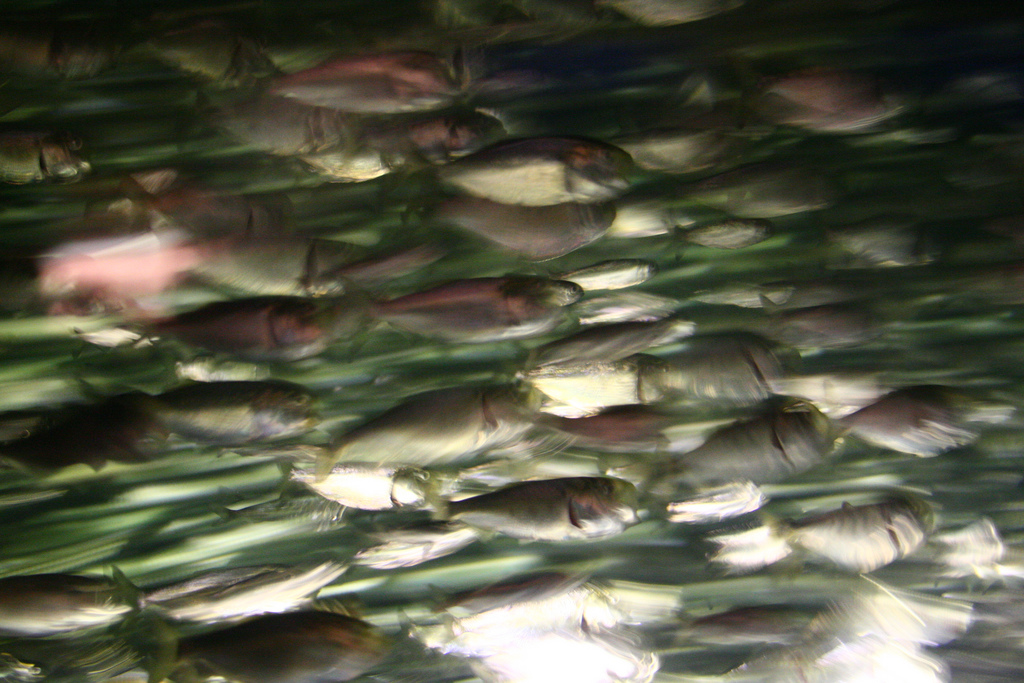
Wriggling Fry


In a short, strange, visionary book, « Bible of Mankind », Jules Michelet wrote in 1864 about the future of religions, considered as a whole. His angle? The comparison, in this respect, between East and West.

« My book is born in the sunlight among the sons of light, the Aryas, Indians, Persians and Greeks”, says Michelet.

Goodbye fogs, goodbye dark clouds. The light! The light!

It’s all about returning to the dawn of the world, which is perhaps best celebrated in the Vedas. It is about evoking a « Bible of light », not a Bible of words.

For Michelet, who was stuck in a colonialist and imperialist century, it was above all a question of escaping as far as possible from the conceptual prison of stifling ideas, of escaping from too many conventional clichés.

« Everything is narrow in the West. Greece is small: I’m suffocating. Judea is dry: I am panting. Let me look a little at the side of high Asia, towards the deep East.”

Michelet, panting!

He was, though, a man who had a lot of breath. But no more. His ode to light came from an asthma of the soul.

One hundred and fifty years after Michelet, his naive cry is still moving. His panting signals a deep shortness of breath, for our entire era.

One hundred and fifty years after Michelet, we too are panting. We too are suffocating.

We would like to breathe. To fill our retinas with light.

But where are the sea winds? Where are the promised dawns?

The West is today, much more than yesterday, in crisis. But the East is probably not much better off. We are more or less persuaded of the absence of an enlightened horizon west of Eden. But one does not believe either in the supposed depths of Asia.

One may only be sure of the thinness of the earth’s crust, under which a sun of lava roars.

Everything is narrow in this world. The planet is too small. And we are all suffocating. The West? The East? Eurasia? Old-fashioned clichés. Simple and false slogans.

Where are the thinkers ? Where are the prophets?

We are suffocating. The breathing of the people is wheezy, hoarse, corseted… Everything is dry, cracked, dusty.

Water is lacking, air is scarce.

No depths in the crowded pools, where the crocodiles kindly bite themselves, while the fry wriggle.

The Land of Death and Resurrection


In ancient Egypt, Death was the key moment, – the moment when took place the transformation of the soul of the dead into the “Ba”, the divine principle of Re.

Neferubenef’s Papyrus identifies the « Ba » with the « divine ram of Mendes, the city where the mystical union of the two souls of Re and Osiris is made, »i according to Si Ratié, who translated it.

The religion of ancient Egypt used to bring hope to everyone. The hope for eternal salvation. Every human soul was given the possibility of carrying out an ultimate, divine and royal ‘mutation’ at the moment of death, – under certain conditions. The soul had the power to transform herself into a « Horus of gold », whose flesh is of gold, and the bones of silver, to speak metaphorically.

The origin of this belief goes back to the dawn of time. Archaeological evidence of a funeral cult in Upper Egypt dating back to before the first dynasty, around 3500 BC, has been found.

Today, Neferoubenef’s Papyrus makes us hear the voice of the faithful as they prepared for this decisive test.

« Hail to you who is in the holy necropolis of Rosetau; I know you, I know your name. Deliver me from these snakes that are in Rosetau, that live from the flesh of humans, that swallow their blood, for I know them, I know their names. May the first order of Osiris, Lord of the Universe, mysterious in what he does, be to give me the breath in this fear that is in the midst of the West; may he never cease to order the directives according to what has existed, he who is mysterious within the darkness. May glory be given to him in Rosetau! Master of the darkness, who descends and orders food in the West! We hear his voice, we don’t see him, the great God who is in Busiris! (…)

I come as a messenger from the Lord of the Universe. Horus, his throne has been given to him. His father gives him all the praise, as well as those in the boat. Lord of fear in Nut and in the Douat! I am Horus. I have come to be in charge of the sentence. Let me come in, let me say what I saw. »ii

These ancient words strike us by their mysterious echoes, later reverberating in other, subsequent, religions, such as Judaism or Christianity.

Several millennia before Abraham left Ur and gave tribute to Melchisedech, some high priests in Egypt used to sing psalms such as :

« We hear His voice, we don’t see him, the great God. »

« I come as a messenger from the Lord of the Universe. Horus, His throne has been given to Him. His father gives Him all the praise, as well as those in the boat. »

And there is this even stranger, prophetic, formula:

« The fear that is in the middle of the West ».

The West has always been for the Semites, as evidenced today by the Arabic language, which calls it « Maghreb », literally the “place of exile”, a “place of danger”.

For the ancient Egyptians, the West was indeed the place associated with “death”. But it was also the place of “resurrection”.

The deep, collective, memory, embodied in minds and in the unconscious for thousands of years, has undoubtedly cultivated this fear. Maybe it still exists in a latent form. That could explain a hidden connection between the ancient myth of the Golden Horus, the revelation of the great God who is in Busiris, and the fear many people of the ‘Esat’ resent about the ‘West’ today?

« The fear that is in the middle of the West » is several thousand years old.

It is a strange paradox, completely devoid of any “modern” rationality, but still worth considering, with all its overtones: for the oldest religion ever appeared in the “East”, the “West” is the « Land of Death », but also as the unique place for “Resurrection”.

If there are still ears to hear, there is an interesting lesson to be learned here.

i Si Ratié, Le Papyrus de Naferoubenef, 1968

iiIbid.