
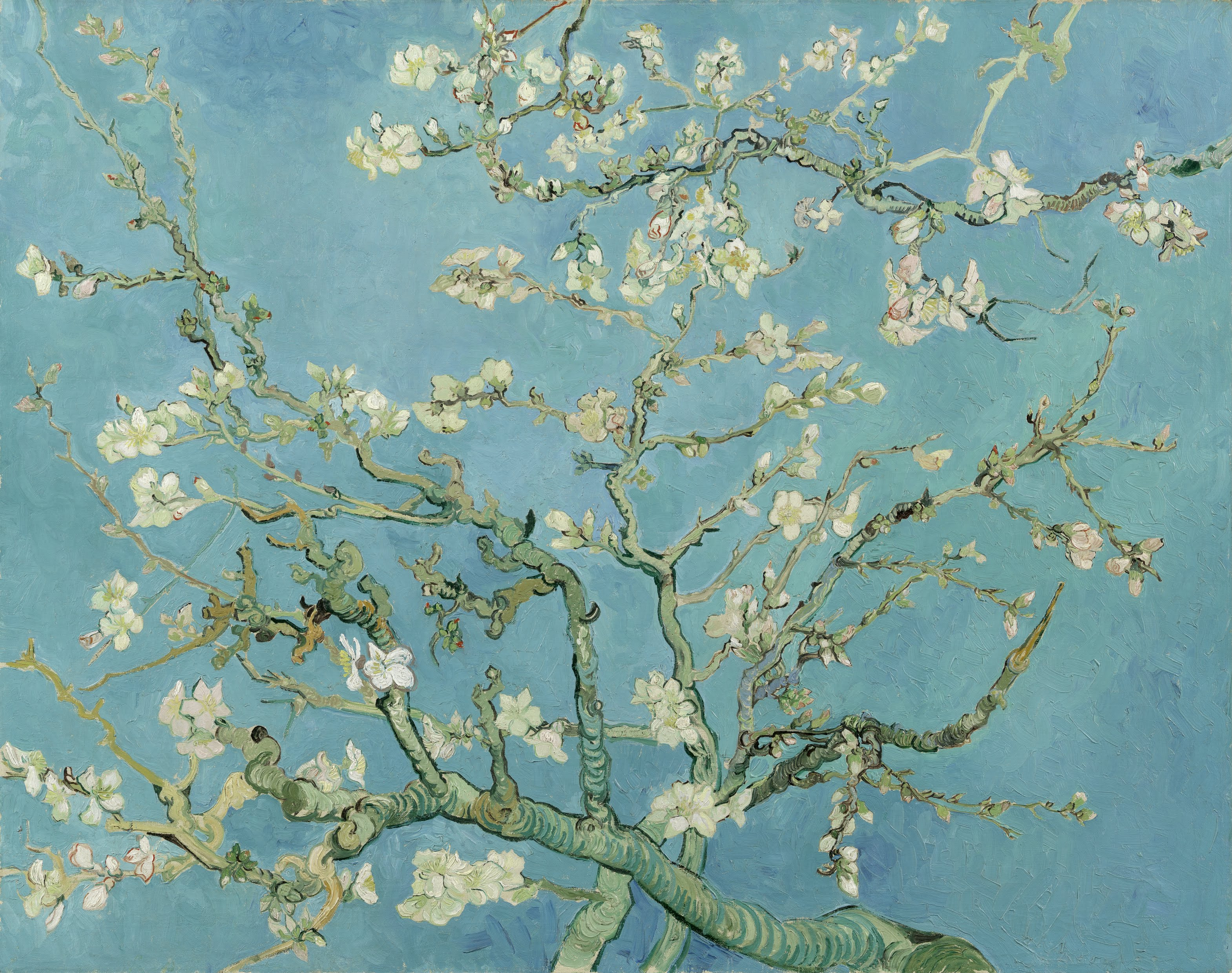
Jeremiah once played on the word shaqed (‘almond tree’) as a springtime metaphor for wakefulness and awakening. « Then YHVH said to me: ‘What do you see, Jeremiah? Then YHVH said to me: ‘You have seen well, for I am watching over my word to fulfil it’. »i There is an untranslatable allusion here. In Hebrew, the word שָׁקֵד, shaqed, « almond tree », comes from the verbal root שָׁקַד, « to watch over« . Watching over the arrival of spring, the almond tree blooms first, before the other trees. This word also evokes the Watcher (שׁוֹקֵד, shôqed), which is one of the names of God, always awake, always vigilant.
In the dark winter, does the almond tree feel its sap rising? Does it know its juice? Does it already light the milk of the almond to come? We need to use the metaphor of sap to savour its flavour. In plants, there are two kinds of sap: « raw » sap, which « rises », and « elaborated » sap, which « descends ».ii Light is captured by « antennae » and converted into energy, which is then used to synthesise the carbohydrates that make up the « elaborated » sap that the plant needs to survive.iii As it « descends », this sap takes some of the water and mineral salts contained in the « ascending » sap. The two types of sap cross paths and work together to nourish the plant and help it grow.
The almond tree, like all plants, is a kind of « antenna », receiving signals from the sky and the earth, the energy of light and water. In winter, it watches out for spring. As soon as it sees the signs of spring, it proclaims its arrival. Mobilising the power of its sap, it buds and covers itself with flowers.
The almond tree is a metaphor for consciousness. Both « watch ». Like an almond tree in winter, consciousness watches for the coming of a spring that will cover it with flowers. It may also be dreaming of the summer that will bring them to fruition. Plunged into its night, surrounded by an obscure winter, consciousness keeps watch. It awaits the coming of that which is absent in it. It does not run away from the experience of life in which it seems to be buried. It wants to savour it in all its amplitude, to sense its power, to smell its future fragrances. It watches over the revelation to come. It waits for the moment to rise above its essence, its natural being, to soar beyond all nature. It awaits the manifestation of the super-nature in its nature.
Does the almond tree, in its waking hours, have some sort of proto-consciousness of the almond to come? Does human consciousness have, in its first, amniotic night, some subconsciousness of its future?
After the birth, she lives as a « child of the world »iv . Does she then dream of another coming to light, another coming to life?
Like the almond tree in winter, the philosopherv ‘suspends’ for a time the rise of consciousness, the surge of sap. Does this get him a better taste?
______________
iJer 1:11-12
iiRaw sap is a solution made up of water and mineral salts. This solution is absorbed at root level by the rootlets. It circulates mainly in the xylem, i.e. the vessels of the wood. Through the xylem, the plant sends the sap up into its aerial parts. It does this by means of a suction effect and root pressure. The suction effect is caused by the loss of water (through transpiration and evaporation) from the leaves, leading to a drop in pressure. The drop in pressure then draws water from the xylem towards the top of the plant. Root pressure occurs mainly at night. The accumulation of mineral salts in the root stele causes water to flow upwards, water pressure to increase and the liquid to rise in the xylem. Elaborated sap is produced by photosynthesis in the leaves and consists of sucrose. It travels downwards to be distributed to the various organs of the plant, using another conductive tissue, the phloem, in the opposite direction to the raw sap, which rises in the xylem. This dual circulation allows water molecules to move from the xylem to the phloem. See http://www.colvir.net/prof/chantal.proulx/BCB/circ-vegetaux.html#c-transport-de-la-sve-brute-
iiiOrganisms that use photosynthesis absorb light photons in structures called « antennae ». Their energy excites electrons and causes them to migrate in the form of excitons, whose energy is then converted into energy that can be used chemically. These « antennae » vary from organism to organism. Bacteria use ring-shaped antennae, while plants use chlorophyll pigments. Studies on photon absorption and electron transfer show an efficiency of over 99%, which cannot be explained by conventional mechanical models. It has therefore been theorised that quantum coherence could contribute to the exceptional efficiency of photosynthesis. Recent research into transport dynamics suggests that the interactions between the electronic and vibrational modes of excitation require both a classical and a quantum explanation for the transfer of excitation energy. In other words, while quantum coherence initially (and briefly) dominates the exciton transfer process, a classical description is more appropriate to describe their long-term behaviour. Another photosynthesis process that has an efficiency of almost 100% is charge transfer, which may also justify the hypothesis that quantum mechanical phenomena are at play. C f.Adriana Marais, Betony Adams, Andrew K. Ringsmuth and Marco Ferretti, « The Future of Quantum Biology », Journal of the Royal Society, Interface, vol. 15, no. 148, 11 14, 2018.
ivIn the words of E. Husserl. Philosophie première, t.II, Translation from the German by Arion Kelkel, PUF, 1972, p.173
vCf. E. Husserl. The Crisis of the European Sciences and Transcendental Phenomenology. Gallimard, 1976, p.172

Vous devez être connecté pour poster un commentaire.